
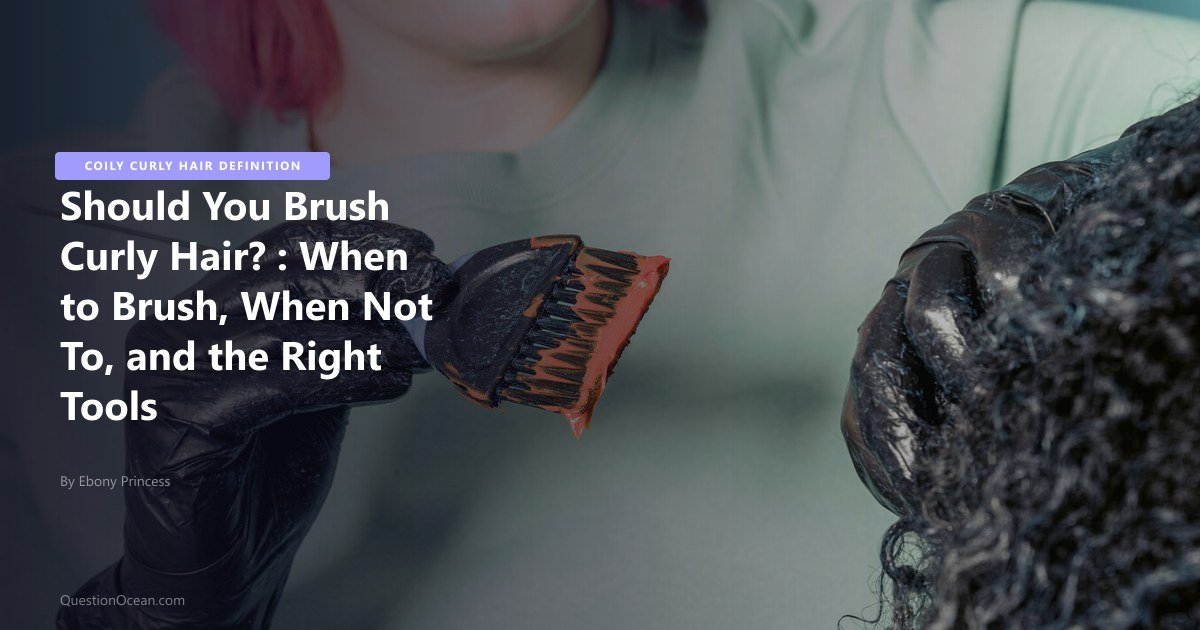
Quick answer: You should never brush curly hair when it’s dry. Dry-brushing separates curl clumps, lifts the cuticle, creates frizz, and causes breakage. But brushing curly hair isn’t always wrong. Brushing or combing wet, conditioner-coated hair is fine and often necessary for detangling. The rule is simple: detangle wet with conditioner, never dry.
Why Dry Brushing Destroys Curl Pattern
Last updated: June 1, 2026
Curly hair forms defined clumps where multiple strands curl together in the same pattern. These clumps are what give curly hair its shape and definition. When you run a brush through dry curly hair, you force apart these natural groupings.
Here’s what happens mechanically:
Step 1: The brush bristles enter a curl clump and physically separate strands that were curling together.
Step 2: Once separated, individual strands can’t reform the same clump pattern. They puff outward independently.
Step 3: The friction of bristles against dry cuticles lifts the cuticle scales, creating a rough surface that catches on neighboring strands.
Step 4: The result is a cloud of frizz instead of defined curls. Volume increases, but definition disappears.
Step 5: If you brush hard enough, the mechanical stress on already-curved strands causes breakage at the bend points of the curl, where the hair shaft is structurally weakest.
When It’s OK to Brush (or Comb) Curly Hair
The “never brush curly hair” advice is overly simplified. There are situations where brushing or combing is fine and even helpful:
| Situation | Tool | OK to Brush? |
|---|---|---|
| Wet hair, coated in conditioner | Wide-tooth comb or fingers | Yes, this is how you detangle |
| Wet hair, coated in conditioner | Wet brush or Denman brush | Yes, can also create curl clumps |
| Dry hair, wanting to restyle | Nothing (don’t brush) | No, refresh with water instead |
| Dry hair before washing | Wide-tooth comb (very gently) | Sometimes, to pre-detangle before shower |
| Before a blowout or straightening | Brush while blow-drying | Yes, you’re stretching hair straight anyway |
| Scalp brushing for circulation | Scalp massager (not a hair brush) | Yes, on the scalp only (not through hair length) |
The key variable is moisture + slip. Conditioner provides slip (lubrication) that lets the brush or comb glide through without catching on the cuticle. Dry hair has no slip, so every bristle catches, pulls, and breaks.
The Right Way to Detangle Curly Hair
Step-by-Step Method
- Start in the shower with conditioner. Apply a generous amount of conditioner to soaking-wet hair. Let it sit for 1-2 minutes so the slip develops.
- Use your fingers first. Gently separate any major knots or tangles by hand. Fingers are gentler than any tool and you can feel knots before you tear through them.
- Then use a wide-tooth comb or wet brush. Starting from the ENDS, work upward in small sections. Never start from the roots and pull down, that forces every tangle tighter and increases breakage.
- Work in sections. Clip the top half of your hair up and detangle the bottom first. Then release another section. This prevents already-detangled sections from re-tangling while you work.
- Rinse while keeping clumps intact. After detangling, rinse the conditioner but don’t break apart the curl clumps that formed during combing. These are your definition clumps for styling.
Wide Tooth Comb for Curly Hair
The Right Tools for Curly Hair
Wide-Tooth Comb
Best for: All curl types, gentle detangling Why it works: The widely spaced teeth don’t separate curl clumps as aggressively as a brush. Less disruption means better definition after drying.
Denman Brush (D3 or D4)
Best for: Type 3A-3C curls for curl clumping during styling Why it works: When used on wet, conditioned hair, the Denman brush actually creates and defines curl clumps. You brush through a section, then the strands snap back together in smooth, defined coils. It’s a styling tool, not a detangling tool. Important: Only use on wet hair with product. Never use dry.
Wet Brush
Best for: Type 2A-3B curls, gentle detangling Why it works: Flexible bristles that bend before pulling, reducing breakage. Good for looser curl types but can be too aggressive for very tight coils.
Fingers
Best for: Type 4A-4C coils Why it works: Fingers are the gentlest “tool.” For very tight coils where even a wide-tooth comb catches, finger detangling causes the least breakage. Slower but worth it.
Detangling Brush for Curly Hair
What About the Denman Brush Technique?
The Denman brush has a specific technique for defining curls, not just detangling:
- Take a small section of wet, product-coated hair
- Brush through from root to end to smooth the section
- At the end, twist the brush slightly to encourage the curl to coil around the bristles
- Release, and the section springs back into a tight, defined curl clump
- Repeat section by section
This technique gives salon-level curl definition. It’s popular in the curly hair community for Type 3A-3C curls. For Type 4 coils, it can cause too much tension and breakage on some textures, so test on one small section first.
Common Brushing Mistakes on Curly Hair
Mistake 1: Brushing dry hair “just to shape it.” There is no “gentle way” to brush dry curly hair without disrupting curl clumps. If your curls need refreshing, use a spray bottle with water and a small amount of conditioner. Scrunch upward. Don’t brush.
Mistake 2: Starting from the roots. Always start detangling from the ends and work up. Starting from roots pushes every tangle down toward the ends, creating a massive knot at the bottom.
Mistake 3: Using a fine-tooth comb. Fine-tooth combs separate curl clumps too aggressively and create more friction than wide-tooth combs. They’re designed for straight hair.
Mistake 4: Brushing to “distribute product.” Use your hands or the praying-hands method to distribute product through curly hair. A brush distributes product but also destroys curl definition in the process.
Mistake 5: Brushing after plopping or air-drying. If your curls are mid-set (partially dry with product forming a cast), brushing at this stage ruins the cast and the curl definition underneath. Wait until fully dry, then scrunch out the crunch (SOTC).
Mistake 6: Using a boar bristle brush. These are excellent for straight hair (distributing natural oils). On curly hair, the dense bristles aggressively separate every curl clump, creating maximum frizz.
Curly Hair Detangling Frequency
| Curl Type | How Often to Detangle | Best Time |
|---|---|---|
| 2A-2C (wavy) | Every wash day, possibly between washes | In shower with conditioner |
| 3A-3C (curly) | Every wash day only | In shower with conditioner |
| 4A-4C (coily) | Every wash day, never between washes | In shower or during pre-poo with oil |
Type 4 special note: Many people with Type 4 coils only detangle on wash day, once per week. Detangling between washes disrupts protective styles and can cause excessive breakage on tight coil patterns that knot naturally.
Frequently Asked Questions
Q: Why should you not brush curly hair? A: Dry brushing separates natural curl clumps, lifts the cuticle (causing frizz), and breaks hair at the weakest points of each curl’s bend. The only time to brush is on wet, conditioner-coated hair for detangling.
Q: Can brushing curly hair make it straight? A: No. Brushing disrupts curl clumps and creates frizz, which looks poofy but not straight. If anything, dry-brushed curly hair looks worse than both curly and straight. To actually straighten curly hair, you need heat or chemicals.
Q: How do you detangle curly hair without brushing? A: Use your fingers on wet, conditioned hair. Work through knots gently, starting from the ends. Finger detangling is the gentlest option and works well for all curl types.
Q: Is a Denman brush good for curly hair? A: Yes, when used correctly on wet hair with product. The Denman brush is a styling tool that creates defined curl clumps. It’s not a dry-brushing tool and should never be used on dry curly hair.
Q: How often should curly hair be detangled? A: On wash day only for most curl types. Type 2-3 curls may need a quick finger-detangle between washes. Type 4 coils should only be detangled during the wash routine to minimize breakage.
The bottom line: wet + conditioner + gentle tool = safe detangling. Dry + brush + force = frizz and breakage. Follow that rule and your curl pattern stays intact.
For the complete detangling tool guide, see our detangling brushes for coily hair review.