
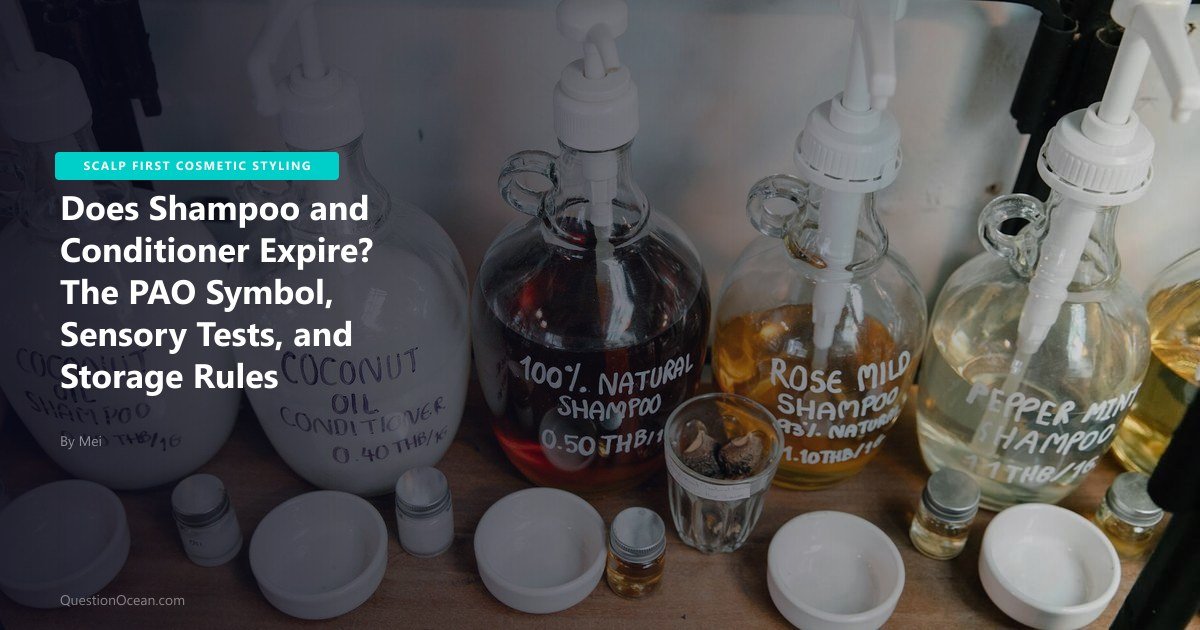
Shampoo and conditioner do expire, even though most bottles don’t show a printed expiration date, instead, they show the PAO symbol (Period After Opening), an open-jar icon with a number followed by “M” indicating the safe months after first opening, which most consumers don’t recognize. Unopened shampoo and conditioner typically last 2-3 years from the manufacturing date thanks to preservatives, while opened bottles last 12-18 months for shampoo and 6-12 months for conditioner, and using expired product won’t poison you, but the broken-down preservatives can cause scalp irritation, the separated emulsion delivers uneven cleansing, and oxidized ingredients can actually damage the hair cuticle they’re meant to protect. This guide covers the PAO symbol, sensory tests to detect spoilage, the storage rules that double shelf life, and what to do with expired product.
For the broader scalp-first care framework, see our pillar guide to scalp-first styling routines.
The PAO Symbol Explained
Last updated: April 23, 2026
Look at the back of any shampoo or conditioner bottle. Find the small icon of an open jar with a number followed by “M.” This is the Period After Opening (PAO) symbol, which is the EU-required (and globally adopted) indicator of how long the product remains safe and effective once opened.
| PAO Marking | Meaning |
|---|---|
| 6M | 6 months after opening |
| 12M | 12 months after opening |
| 18M | 18 months after opening |
| 24M | 24 months after opening |
| 36M | 36 months after opening |
Most shampoos display 12M or 18M. Most conditioners display 12M. Specialty natural products with fewer preservatives often display 6M.
The PAO is calculated from the day you first open the bottle, NOT from the manufacturing date or the purchase date.
Unopened vs Opened Shelf Life
| Product Type | Unopened | Opened |
|---|---|---|
| Standard sulfate shampoo | 3 years | 18 months |
| Sulfate-free shampoo | 2-3 years | 12-18 months |
| Standard conditioner | 2-3 years | 12 months |
| Deep conditioner | 2-3 years | 6-12 months |
| Natural / preservative-free | 1-2 years | 3-6 months |
| Dry shampoo (aerosol) | 3 years | 24 months |
| Leave-in conditioner | 2-3 years | 6-12 months |
The bigger gap between unopened and opened is because once the bottle is opened, air, light, water from wet hands, and bacterial introduction begin breaking down the preservatives.
How to Tell If Shampoo or Conditioner Has Expired
The 5-sense test for spoiled hair products:
Sense 1. Smell
The first sign of expiration. Fresh product smells like its intended fragrance. Expired product smells:
- Sour, vinegary, or “off”
- Plastic-like or chemical
- Rancid (especially products with natural oils)
- Funky or fermenting
If the smell has changed from when you first opened the bottle, the product is likely expired.
Sense 2, Sight
Visual changes indicate breakdown:
- Color shift (yellowing, browning, separation)
- Liquid separation (oils floating on top, watery layer at bottom)
- Cloudiness in a previously clear product
- Lumpy or grainy texture in a previously smooth product
- Mold spots (rare but happens with natural preservative-free products)
Sense 3, Touch
Texture changes:
- Slimy or stringy consistency
- Watery, runny consistency where it was once thick
- Lumpy or grainy texture
- Sticky residue on the bottle opening
Sense 4. Test Use
Apply a small amount to a hidden hair section:
- Doesn’t lather as much as before
- Doesn’t condition / detangle as well as before
- Causes scalp itching, redness, or irritation
- Leaves residue that wasn’t there before
Sense 5 — Bottle Inspection
Check the bottle itself:
- Bulging or warping (gas buildup from bacterial activity)
- Cracked or damaged seal
- Sticky residue around the cap
- Significant date past the PAO
If two or more of these signs are present, throw the product out.
Why Expired Products Are Bad for Hair
Expired hair products don’t just lose effectiveness, they can actively cause damage:
Damage 1. Scalp Irritation
Broken-down preservatives release compounds that cause contact dermatitis, scalp itching, redness, and flaking even in people who tolerated the product when it was fresh.
Damage 2, Bacterial / Fungal Contamination
Once preservatives stop working, the warm, water-rich environment of a shampoo bottle becomes a microbial growth medium. Applying contaminated product to the scalp can introduce fungal infections.
Damage 3, Oxidized Oils
Conditioners and oils contain unsaturated fatty acids that oxidize over time. Oxidized oils generate free radicals that damage the cuticle.
Damage 4. Reduced pH Stability
Expired products can drift outside the safe 4.5-5.5 pH range, leaving the cuticle either too open (alkaline drift) or too closed (extreme acid).
Damage 5, Surfactant Breakdown
Cleaning agents lose effectiveness, leaving more residue on hair and scalp instead of properly removing dirt and oil.
Storage Rules That Double Shelf Life
The PAO assumes “average” storage conditions. Better storage extends life; worse storage shortens it.
Rule 1. Cool, Dry, Dark
Store in the linen closet or bathroom cabinet, NOT in direct light or near a window. Bathroom shower humidity is acceptable but suboptimal.
Rule 2, Keep the Cap Closed Tight
After every use. Open caps allow water, air, and contaminants in.
Rule 3, Don’t Get Water in the Bottle
When showering, dispense product into your hand outside the water stream. Water entering the bottle dilutes preservatives and accelerates spoilage.
Rule 4. Use a Pump Dispenser for Frequently-Used Products
Pump dispensers reduce contamination risk by preventing hand contact with the product inside the bottle.
Rule 5: Refrigerate Natural / Homemade Products
Products with natural preservatives or DIY recipes benefit from refrigeration. Mark the date opened on the container.
Rule 6, Don’t Decant Into Smaller Bottles Repeatedly
Each transfer introduces contamination. If you must decant for travel, use within 1-2 weeks.
Rule 7. Buy Only What You’ll Use Within the PAO
A 1-liter bottle of shampoo with 12M PAO is wasted if you only use it once a week. Match bottle size to usage rate.
Sulfate Free Shampoo Conditioner Set
What to Do With Expired Hair Products
Don’t pour them down the drain (the chemicals are still active enough to affect plumbing or septic systems). Don’t compost (preservatives are not compost-safe).
Best practice:
- Pour into a sealed container
- Dispose with regular household waste
- Recycle the rinsed bottle if it’s a recyclable plastic
For larger quantities, check your local hazardous waste disposal program.
Common Expiration Myths
Myth 1: “Shampoo never expires.” False, every shampoo has a PAO. Look for the open-jar icon.
Myth 2: “If it doesn’t smell bad, it’s fine.” Mostly true but not always, some expired products show no smell change but still cause irritation.
Myth 3: “Refrigerating doubles the shelf life.” Partially true for natural products with weaker preservatives. Standard mass-market products don’t benefit much from refrigeration.
Myth 4: “Adding more preservative extends shelf life.” Don’t do this, adding preservatives at home is unsafe without precise concentration measurement and pH testing.
Myth 5: “Expired shampoo is dangerous if used.” Usually not “dangerous” in the toxic sense, but can cause scalp irritation, ineffective cleansing, and hair damage.
Frequently Asked Questions
Q: Does shampoo really expire? A: Yes. Shampoo expires due to preservative breakdown, oxidation of natural oils, and microbial growth. Unopened shampoo lasts 2-3 years; opened shampoo lasts 12-18 months for standard formulas, 6 months for natural/preservative-free formulas. Look for the PAO symbol (open-jar icon with month number) on the back of the bottle.
Q: What is the PAO symbol on shampoo bottles? A: PAO stands for “Period After Opening.” It’s a small icon of an open jar with a number followed by “M” (e.g., 12M = 12 months). This indicates how many months after first opening the product remains safe and effective. The PAO countdown starts the day you first open the bottle.
Q: How do I know if my shampoo has expired? A: Use the 5-sense test: smell (sour, off, rancid), sight (color change, separation, cloudiness), touch (slimy, watery, lumpy), test use (doesn’t lather, causes irritation), and bottle inspection (bulging, sticky residue). Two or more changes indicate the product has expired.
Q: Can I use expired shampoo or conditioner? A: Not recommended. Expired products can cause scalp irritation, contain bacterial contamination, damage hair through oxidized oils, and don’t clean or condition effectively. The risk-to-benefit ratio favors throwing it out.
Q: How long does conditioner last after opening? A: 12 months for standard rinse-out conditioners, 6-12 months for deep conditioners and leave-in conditioners. Natural and preservative-free conditioners last only 3-6 months. Always check the PAO symbol on the back of the bottle.
Q: What happens if I use expired conditioner? A: Possible scalp irritation, less effective conditioning, slimy or stringy texture, possible bacterial or fungal contamination, and oxidized oils that damage the hair cuticle instead of protecting it. The hair feels worse after application instead of better.
Q: Does dry shampoo expire? A: Yes, typically 24 months after opening for aerosol dry shampoos, 12-18 months for powder dry shampoos. The propellant in aerosol cans degrades over time, and the active ingredients can oxidize. Check the PAO on the can.
Q: How can I make my shampoo last longer? A: Store in cool, dry, dark conditions (not in direct sunlight or shower spray), keep the cap tightly closed, dispense outside the water stream to keep water out of the bottle, use a pump dispenser to reduce contamination, and refrigerate natural or DIY products.
Q: Is it safe to use shampoo without a PAO symbol? A: Products without PAO symbols are usually older bottles or products from regions where PAO labeling isn’t required. Check for an alternative expiration date printed on the bottom of the bottle. If neither is present, assume 18-24 months from the date you opened the bottle.
Q: Can expired shampoo cause hair loss? A: Direct hair loss is rare, but expired products can cause scalp irritation that triggers temporary inflammatory shedding, and the broken-down ingredients fail to protect the hair from breakage. Both effects can mimic or contribute to hair loss.
Shampoo and conditioner expire, the PAO symbol shows when, and the storage rules above can extend shelf life by 50-100%. The simplest practice: write the date you opened the bottle on the cap with a Sharpie, set a phone reminder for the PAO end date, and replace the product on time.
For the related question of expired natural products like shea butter, see our uses for expired shea butter guide.