
The hair tool market in 2026 has split into two distinct categories: legacy tools that heat a surface and blow air, and engineered systems that use sensor arrays, aerodynamic modeling, and material science to deliver styling results with measurably less damage per use. The best high tech hair tools 2026 are defined by four measurable metrics: airflow velocity (cubic feet per minute), maximum heat at the hair surface (not the element), tool weight under 1.5 pounds for fatigue-free extended use, and attachment versatility that eliminates the need to purchase separate single-purpose devices.
This pillar guide evaluates every major category of high-tech hair tools, dryers, straighteners, curling devices, and hybrid stylers. Through the lens of engineering performance rather than brand marketing, covering what US, UK, and Canadian consumers actually need to know before investing $50-600 in styling technology.
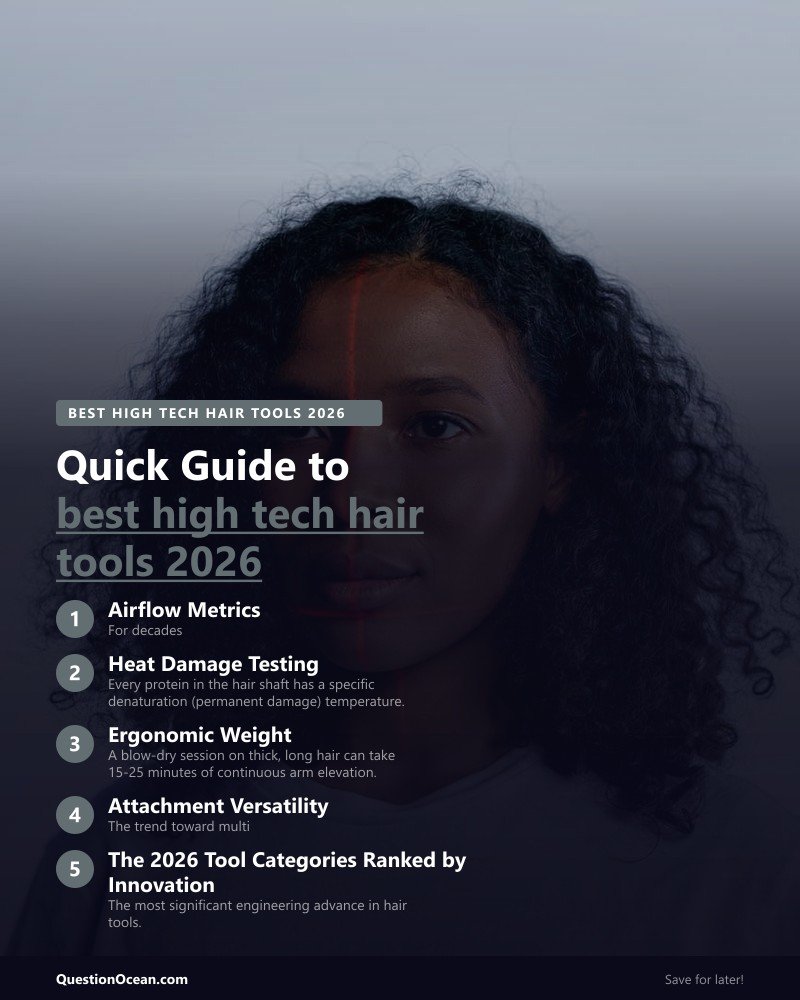
Airflow Metrics: Why CFM Matters More Than Wattage
For decades, hair dryer quality was measured in watts: the higher the wattage, the “more powerful” the dryer. This metric is misleading. Wattage measures total electrical power consumption, not the air velocity that actually dries hair. A 1875-watt dryer with a poorly designed fan produces less useful airflow than a 1400-watt dryer with an optimized impeller blade.
Cubic feet per minute (CFM) measures the actual volume of air moving through the dryer nozzle per minute. This is the metric that determines drying speed, and drying speed determines heat exposure time, which is the primary damage variable.
| Tool Category | CFM Range | Drying Time (Medium Density) | Heat Exposure |
|---|---|---|---|
| Budget dryers (1875W, standard motor) | 25-35 CFM | 15-25 min | High |
| Mid-range dryers (1875W, improved fan) | 35-50 CFM | 10-18 min | Moderate |
| High-speed motor dryers (1400W, 110K RPM) | 50-75 CFM | 5-12 min | Low |
| Reverse-air dryers (no direct heat) | 40-60 CFM | 8-15 min | Very Low |
The engineering insight: High-speed motor dryers (Dyson Supersonic, Shark HyperAIR, Zuvi Halo) use compact brushless motors spinning at 80,000-110,000 RPM. These motors move dramatically more air per watt of electricity consumed. Producing faster drying at lower temperatures with less total heat exposure.
For a deep dive into reverse-air drying technology, see our reverse air dryer review. For the Dyson vs budget alternatives comparison, see Dyson Airwrap alternatives under $150.
High-Speed Hair Dryer with Digital Motor
Heat Damage Testing: The 365°F Threshold
Every protein in the hair shaft has a specific denaturation (permanent damage) temperature. Keratin: the dominant structural protein in human hair, begins irreversible denaturation at approximately 365°F (185°C). Below this threshold, heat styling causes temporary structural changes that reverse when the hair is washed. Above this threshold, the damage is permanent and cumulative.
The best high tech hair tools 2026 are engineered around this biological limit:
- Smart flat irons with predictive heat algorithms that maintain surface temperature below 365°F regardless of styling speed
- Infrared dryers that heat the hair from inside-out, reaching styling temperatures with lower surface heat
- Temperature-controlled curling wands that measure barrel temperature in real-time rather than relying on static thermostat settings
For comprehensive heat damage prevention science, see our guide to hot tools that don’t damage hair. For smart temperature control in flat irons specifically, see smart flat iron review.
Ergonomic Weight: The 1.5-Pound Standard
A blow-dry session on thick, long hair can take 15-25 minutes of continuous arm elevation. Tool weight directly impacts fatigue, shoulder strain, and styling precision — a heavy tool in a tired hand produces less controlled results in the final minutes of styling.
The 2026 ergonomic standard is 1.5 pounds or less for dryers and 0.75 pounds or less for flat irons and curling wands.
| Tool | Weight | Arm Fatigue Rating |
|---|---|---|
| Traditional salon dryer | 1.8-2.5 lbs | High (pain after 10+ min) |
| Dyson Supersonic | 1.6 lbs | Moderate |
| Shark SpeedStyle | 1.2 lbs | Low |
| Laifen Swift SE | 1.1 lbs | Very Low |
| Traditional flat iron | 0.8-1.2 lbs | Moderate |
| Smart flat irons (GHD, Dyson) | 0.7-0.9 lbs | Low |
For thick hair specifically: Weight tolerance matters more because drying time is longer. See our blow dry brushes for thick hair guide for tools optimized for extended-use comfort on dense hair.
Attachment Versatility: Multi-Tool Systems
The trend toward multi-attachment styling systems (pioneered by the Dyson Airwrap) eliminates the need to own separate dryers, curling irons, and straightening brushes. A single motorized base unit accepts interchangeable attachments for different styling functions.
What makes an attachment system worth the investment:
- Magnetic or click-lock attachment mechanism. Fast switching between attachments mid-session
- Minimum 3 distinct styling functions from the base unit (dry, curl, smooth)
- Consistent airflow/heat delivery across all attachments (some systems lose performance with larger attachments)
- Replacement attachment availability. Can individual attachments be purchased separately if damaged?
For the complete Dyson vs alternative comparison with attachment durability analysis, see our Dyson Airwrap drugstore alternatives guide.
The 2026 Tool Categories Ranked by Innovation
1. High-Speed Motor Dryers
The most significant engineering advance in hair tools. High-speed brushless motors (80,000-110,000 RPM) produce 2-3x the airflow of conventional motors at equal or lower temperatures, cutting drying time by 40-60%.
Best for: Everyone. The reduced heat exposure benefits all hair types. For heatless alternatives, see our guide on types of heatless curls.
2. Infrared Hair Dryers
Infrared dryers emit electromagnetic radiation in the infrared spectrum that heats the water molecules inside the hair shaft directly, rather than heating the air around the hair. This “inside-out” drying approach reaches the cortex faster with lower surface temperatures.
For the complete infrared vs ionic technology comparison, see our infrared vs ionic hair dryers guide.
3. Smart Flat Irons
Flat irons with microprocessor-controlled heating elements that measure plate temperature multiple times per second and adjust power delivery to maintain the target temperature precisely, even when cold, wet hair contacts the hot plate and causes a temperature drop.
See our detailed smart flat iron review for the predictive algorithms that prevent heat spikes.
4. Reverse-Air Dryers
A fundamentally different approach: instead of blowing hot air at the hair surface, reverse-air dryers use negative pressure (suction) or ambient-temperature airflow to evaporate moisture without direct heat contact. See our reverse air dryer review.
5. Cordless Styling Tools
Lithium-ion battery technology has reached the point where cordless curling wands deliver 25-35 minutes of continuous styling at full temperature: enough for a complete styling session without a power outlet. For travel-specific considerations, see our cordless curling wand travel guide.
Smart Flat Iron with Temperature Control
Tool Maintenance: Protecting Your Investment
High-tech hair tools are precision instruments. They require regular maintenance to deliver their engineered performance. A clogged filter reduces airflow by 20-40%, defeating the purpose of a high-speed motor. Buildup on flat iron plates creates hot spots that exceed the damage threshold.
For the complete maintenance protocol for every tool type, see our cleaning and maintaining luxury hair tools guide.
Travel Considerations
High-end hair tools designed for the US market (110V) will not function, or may be damaged, when plugged into European or UK outlets (220-240V) without proper voltage conversion. Many 2026 tools include native dual-voltage capability, but not all.
For the complete guide to safely traveling with hair tools, see our voltage converters and travel hair tools guide. For heat-free travel alternatives, see this resource on hot rollers for travel styling.
How to Choose the Right High-Tech Hair Tool
For Fine Hair
Priority: temperature control precision. Fine hair is more vulnerable to heat damage and requires tools that maintain accurate, consistent temperatures below 350°F. Smart flat irons and ionic dryers excel here. For more on fine hair tools, see this guide on root lifters for fine hair.
For Thick or Dense Hair
Priority: airflow volume and motor power. Thick hair needs high CFM dryers (50+ CFM) and wide-plate flat irons that cover more surface area per pass. See our blow dry brushes for thick hair and this guide on brushes for thick hair.
For Curly or Coily Hair
Priority: diffuser quality and infrared technology. Curly hair benefits from gentle, even heat distribution. Infrared dryers with large diffuser attachments preserve curl pattern while reducing frizz. For heat-free curl styling alternatives, see our guide on retro velcro roller techniques.
For Travel
Priority: dual voltage, compact size, and cordless options. See our cordless curling wand guide and travel voltage converter guide.
Blow Dry Brush for Salon Blowout at Home
Frequently Asked Questions
Q: What are the best high-tech hair tools in 2026? A: High-speed motor dryers (Dyson Supersonic, Shark HyperAIR), smart flat irons (GHD Chronos, Dyson Corrale), multi-attachment stylers (Dyson Airwrap, Shark FlexStyle), and infrared dryers lead the 2026 market. The key metrics are CFM airflow, temperature precision, weight under 1.5 lbs, and attachment versatility.
Q: Are expensive hair tools worth it? A: For daily users, yes. A $300-500 high-speed dryer that cuts drying time by 50% reduces cumulative heat exposure by thousands of minutes per year. The damage prevention compounds over time, potentially saving hundreds in repair products and salon treatments.
Q: What temperature should I use on my hair tools? A: Stay at or below 365°F (185°C) for all heat styling. Fine or damaged hair should stay below 330°F (165°C). Smart tools with predictive algorithms maintain these thresholds automatically. Removing the guesswork.
Q: Do ionic hair dryers really work? A: Yes. Ionic dryers emit negative ions that break water molecules into smaller droplets, accelerating evaporation by 20-30% and reducing surface static (frizz). The effect is measurable and consistent across quality ionic tools.
Q: What’s the difference between ceramic and titanium flat irons? A: Ceramic plates heat evenly but slowly, maintaining consistent temperature across the plate surface. Titanium plates heat rapidly and maintain higher temperatures under load, making them better for thick or coarse hair. Ceramic is gentler; titanium is more efficient.
Q: How often should I clean my hair tools? A: Dryer filters: weekly. Flat iron plates: after every use (wipe with a damp cloth when cool). Curling iron barrels: weekly. Brush attachments: weekly. Clogged or dirty tools lose performance and can create uneven heat distribution.
The best high tech hair tools 2026 earn their premium pricing through engineering that reduces damage per styling session. Not through marketing claims or brand prestige. Evaluate every tool by its airflow metrics, temperature control precision, ergonomic weight, and attachment ecosystem. The technology that keeps hair below 365°F while completing the style faster is the technology worth investing in.