
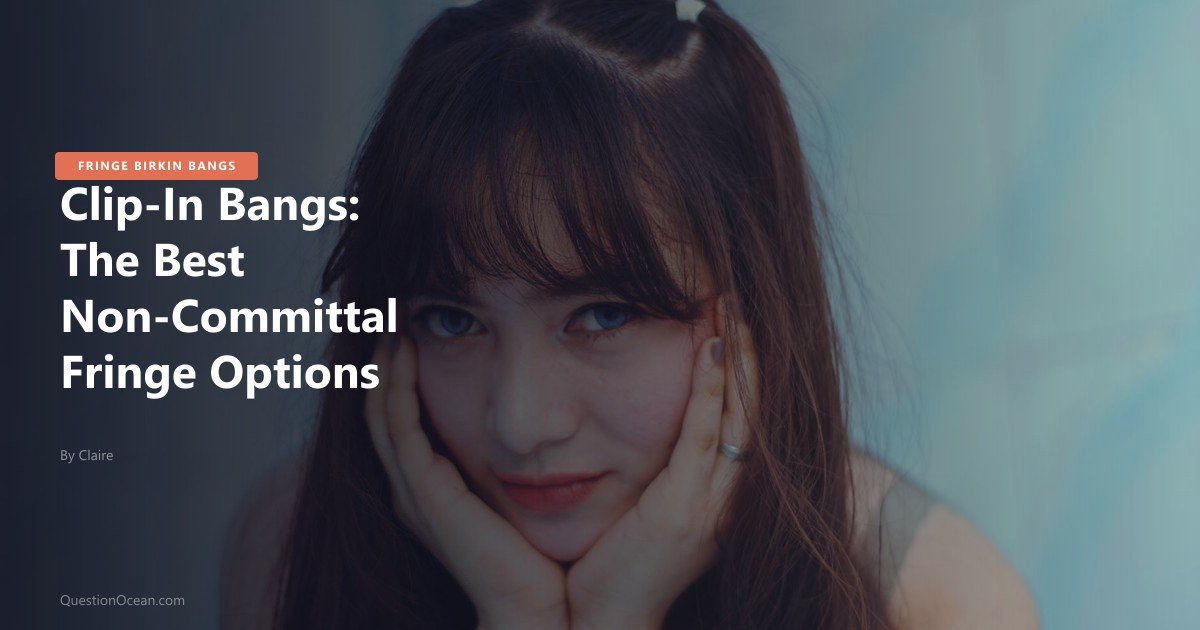
A real fringe takes six months or more to grow out if you decide you hate it — six months of awkward pinning, headband phases, and bobby-pin emergencies. Clip in bangs real hair pieces eliminate that risk entirely, letting you test-drive a fringe for an evening, a week, or a full season without touching your own hair.
The problem is that most people buy clip-in bangs, snap them on, and immediately hate the result. The hairline looks fake, the color is slightly off, and the clips slide backward within an hour. This guide moves past the purchase and into the work that actually matters: customization, blending, and secure attachment that fools everyone, including your stylist.
For context on how clip-in fringe fits within the broader landscape of bang styles, our 2026 fringe styling guide covers every major trend and technique.
Human Hair vs. Synthetic Fiber: Which Clip-In Bangs Are Worth It?
Human hair clip-in bangs accept heat styling, blend more naturally, and last significantly longer, making them the better investment for regular wear. Real hair moves, reflects light, and responds to humidity exactly like your own strands. Synthetic fibers, even premium heat-friendly ones, have a uniform sheen that looks artificial under direct light.
Human hair pieces can be flat-ironed, curled, and blow-dried just like natural hair. This means you can adjust the shape, texture, and movement to match your styling on any given day. Synthetic clip-ins hold a pre-set shape, which works if you want the exact same look every time but limits versatility.
The tradeoff is cost and maintenance. Human hair clip-in bangs typically cost three to five times more than synthetic and require gentle washing, conditioning, and air-drying to maintain quality. Synthetic pieces are essentially disposable: wear them for a few months, then replace.
For anyone planning to wear clip-in bangs more than twice a week, human hair pays for itself in longevity and styling flexibility. A high-quality human hair clip-in bang piece is the foundation of a convincing look [AMAZON LINK]. Occasional wearers can start with a mid-range synthetic set to confirm they like the style before upgrading.
Dimensional Color Matching: Getting the Shade Right
Matching your clip-in bangs requires comparing strands in natural daylight against the mid-lengths of your hair, not the roots or ends. Roots are often darker from regrowth, and ends may be lighter from sun exposure or old color. The mid-shaft represents your truest visible tone, and that is what your bangs need to match.
Single-tone clip-ins rarely look convincing on color-treated or naturally multi-dimensional hair. Look for pieces that blend two or three tones, sometimes labeled as balayage, rooted, or highlighted options. These multi-tonal pieces mimic the natural variation in real hair and disappear far more effectively.
If you cannot find an exact match off the shelf, a professional colorist can tint human hair clip-in bangs to your precise shade. This service typically costs far less than a full color appointment and makes a dramatic difference. Bring the clip-in piece to your next salon visit and ask your stylist to tone or glaze it alongside your own hair.
When ordering online, request swatch samples or buy from retailers with strong return policies. Screen colors are unreliable, and a shade that looks perfect on a monitor often arrives noticeably warmer or cooler in person. Hold swatches against your hair in sunlight near a window before committing.
Why You Must Get Clip-In Bangs Customized by a Stylist
Clip-in bangs arrive in a generic one-size shape that flatters almost nobody; a stylist’s ten-minute trim transforms them into a piece that looks grown from your scalp. Out of the package, most clip-in bangs are cut blunt, slightly too long, and too thick for the average forehead. Wearing them unaltered is the single biggest reason people think clip-in fringe looks fake.
Book a quick appointment with your stylist specifically for this trim. Bring the clip-in piece and wear it clipped in while the stylist cuts. They will thin the density, add texture with point cutting, and shape the length to your face, just like they would with natural bangs.
This customization step is non-negotiable for synthetic pieces, which cannot be styled with heat to compensate for a bad cut. Even human hair clip-ins benefit from professional shaping, a quick $15-25 trim at most salons in the US, UK, or Canada gets the density, length, and angle matched to your face.
If you want to understand how professional trimming techniques apply to bangs generally, the principles in trimming bangs between salon visits translate directly to clip-in pieces. Learn the point-cutting method and you can maintain your clip-in shape at home between salon trims.
How Do You Blend Clip-In Bangs Seamlessly?
The crown seam where the clip-in base meets your natural hair is the giveaway; concealing it requires strategic parting, teasing, and sometimes an accessory. Most clip-in bang pieces attach along a curved weft that sits roughly two inches behind the natural hairline. If your hair is thin or your part is visible, that weft line shows through.
Start by teasing the roots of your natural hair directly behind the clip placement zone. Use a fine-tooth comb to backcomb a thin section of hair at the crown, creating a cushion of volume. Clip the bang piece into this teased base rather than flat against the scalp; the lifted hair hides the weft and gives the clips more grip.
Pull a thin layer of your natural hair forward over the top edge of the clip-in piece. This overlay disguises the junction point and creates a seamless gradient from your real hair into the bang. Use a single pass of a flat iron across both your natural hair and the clip-in together to fuse the textures visually.
For extra insurance, a thin headband, scarf, or strategically placed hair clip positioned just behind the bang line covers the transition area completely. This is not cheating; it is a standard technique that editorial stylists use on set. A slim velvet headband works particularly well because it sits naturally at the crown without looking like it is hiding anything.
Root Teasing for Grip: Securing Clip-In Bangs on Fine Hair
Fine or silky hair causes clip-in combs to slide backward within minutes; teasing the roots and adding texture spray creates the friction needed for all-day hold. The small pressure-sensitive combs on most clip-in pieces are designed for average-density hair. On fine strands, they have nothing substantial to grip and gradually loosen under their own weight.
Before clipping in, spray a light mist of dry texture spray or dry shampoo onto the roots in the attachment zone. This coats the strands with grit that the comb teeth can latch onto. Follow with gentle backcombing using a teasing brush, building a small nest of volume at the base.
Snap the clip-in combs into this teased, textured section and press firmly until you feel them lock. Test by shaking your head gently; if the piece shifts, add another pass of texture spray and re-tease. A quality texturizing spray is essential for fine-hair clip-in security [AMAZON LINK].
Some wearers add a bobby pin on each side as a secondary anchor, sliding the pin through the weft and into the teased hair beneath. This two-point system, combs plus pins, withstands wind, movement, and even moderate exercise. For a broader look at how extensions interact with fine hair, our guide to tape-in vs clip-in extensions covers attachment methods across all extension types.
Customizing Synthetic Clip-In Bangs at Home
Synthetic clip-in bangs can be carefully trimmed, thinned, and shaped with sharp shears, but they cannot tolerate standard heat tools unless explicitly labeled heat-friendly. Regular synthetic fiber melts or frizzes permanently above roughly 150 degrees Celsius. Heat-friendly synthetic can handle low-temperature tools, but still does not behave like human hair under heat.
Use sharp hair shears, never household scissors, to trim synthetic clip-ins. Dull blades crush the fiber rather than cutting it cleanly, creating frayed, visible ends. Cut in small increments, holding the piece clipped in on your head so you can see the result in real time.
Thinning shears remove bulk from overly dense synthetic pieces without shortening the length. Take vertical snips through the lower third of the bang to remove weight and create movement. Avoid thinning near the top of the piece where the weft is visible, as this can expose the base construction.
If you want to add a slight bend to heat-friendly synthetic, use a flat iron on the lowest setting and work quickly. Test an inconspicuous strand first. The margin for error with synthetic fiber is far smaller than with human hair, so caution outweighs speed.
Washing and Maintaining Clip-In Bangs for Longevity
Cleaning clip-in bangs every five to eight wears prevents product buildup and extends the life of both human hair and synthetic pieces. Fill a small bowl with cool water and a few drops of sulfate-free shampoo. Submerge the piece, gently swish for thirty seconds, and rinse under cool running water.
For human hair clip-ins, follow with a lightweight conditioner applied to the mid-lengths and ends, avoiding the weft clips. Leave the conditioner on for two minutes, rinse, and lay the piece flat on a towel to air-dry. Never wring or twist the hair; blot gently and let gravity do the work.
Synthetic pieces skip conditioner entirely; it can coat the fibers and create a waxy feel. Simply wash with shampoo, rinse, and lay flat. Both types should be stored on a small wig stand or clipped to a hanger to maintain shape between wears.
A dedicated extension brush with looped bristles detangles without pulling on the weft [AMAZON LINK]. Brush from the ends upward in small sections, never from root to tip in one aggressive stroke. Gentle handling during brushing is the single easiest way to extend the life of any clip-in piece.
Styling Clip-In Bangs to Match Your Look Each Day
Versatility is the main advantage of human hair clip-in bangs; you can flat-iron them sleek one day and curl them into a curtain bang the next. Match the texture of the clip-in to whatever you are doing with the rest of your hair. Straight bangs with wavy lengths can look intentional, but the textures should at least feel cohesive.
For a curtain-bang look, part the clip-in piece slightly off center and use a round brush to blow the ends away from the face on each side. For a full blunt fringe, blow-dry straight down with a paddle brush and finish with a flat iron on low heat. If you are curious about the micro-fringe aesthetic, our piece on the micro-fringe daring trend explains how to cut and style that shorter length.
Second-day clip-in bangs benefit from the same refreshing techniques used on natural fringe. A quick pass with a flat iron or a few minutes in a velcro roller restores shape. Our guide to styling second-day bangs covers dry shampoo and overnight storage methods that work just as well on clip-in pieces.
Frequently Asked Questions
Can I sleep in clip-in bangs?
Sleeping in clip-in bangs stresses the weft clips and tangles the hair against your pillow. Remove them each night, brush gently, and store them on a stand or hanger to maintain their shape.
How long do human hair clip-in bangs last?
With proper care, washing every five to eight wears and gentle brushing, human hair clip-in bangs last six to twelve months of regular use. Synthetic pieces typically last two to four months before the fiber degrades noticeably.
Can I dye clip-in bangs to match my hair color?
Human hair clip-in bangs can be professionally colored, toned, or glazed just like natural hair. Synthetic pieces cannot be dyed with traditional hair color; the fiber does not absorb pigment and the chemicals may melt or warp it.
Do clip-in bangs work on very short hair?
Clip-in bangs work on hair as short as a chin-length bob, provided there is enough length at the crown to cover the weft seam. On pixie cuts, the blending challenge increases significantly, and a headband or scarf may be needed to conceal the attachment.
Will clip-in bangs damage my natural hair?
The small pressure combs can cause minor stress on the hair at the attachment point if worn daily for extended hours. Rotating the exact clip placement slightly each time and removing the piece at the end of the day minimizes any risk.
How do I keep clip-in bangs from looking shiny and fake?
Apply a small amount of matte finishing powder or dry shampoo to synthetic pieces to knock down the artificial sheen. Human hair pieces naturally lack this problem but can develop excess shine from conditioner buildup; a dry texture spray corrects it instantly.
Conclusion
Clip in bangs real hair pieces offer the freedom to experiment with fringe on your own terms, but the out-of-package piece is only the starting point. Professional trimming, dimensional color matching, root teasing for grip, and deliberate seam blending turn a generic clip-on into something genuinely undetectable. Invest the time in customization and maintenance, and non-committal bangs become a permanent part of your styling toolkit without a single permanent cut.