
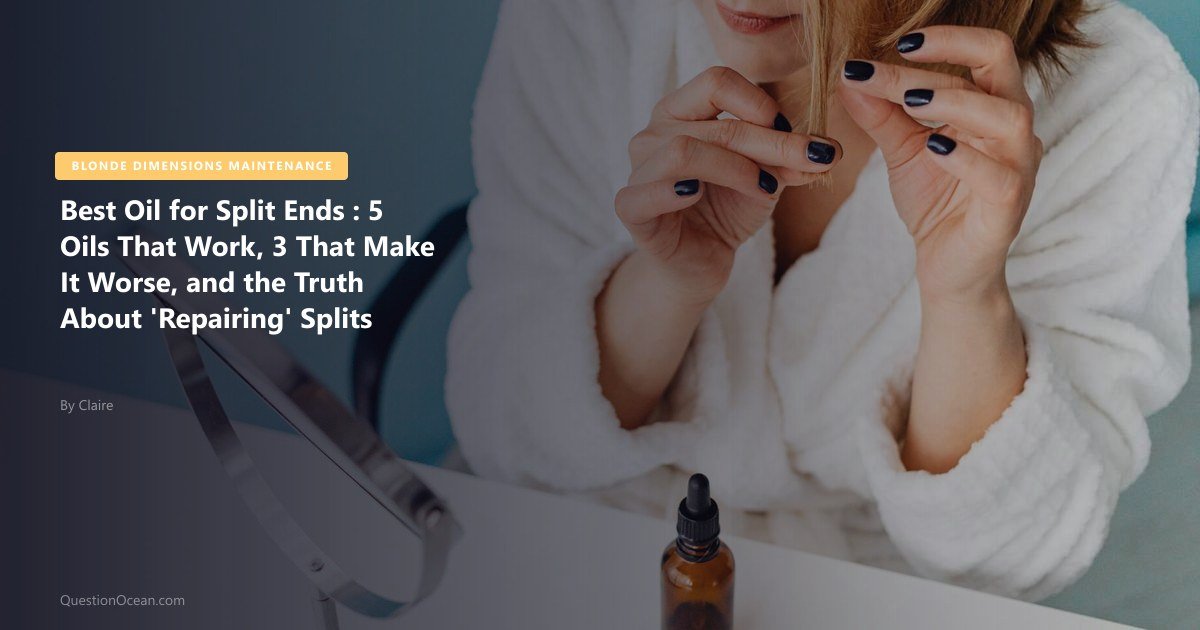
Quick answer: No oil repairs split ends. Once a hair strand splits, the only permanent fix is cutting above the split. What oils CAN do is temporarily seal split ends shut, prevent new splits from forming, and make existing splits less visible. The best oils for this job are argan oil, jojoba oil, and coconut oil, lightweight oils that coat the strand without weighing it down. Heavy oils like castor oil or olive oil can actually make fine or damaged hair worse by adding weight that causes more breakage.
The Truth: Why No Oil “Repairs” Split Ends
Last updated: July 22, 2026
A split end is a physical tear in the hair cuticle and cortex. The strand has literally frayed apart, like a rope unraveling. No topical product can fuse the two sides of a split back together permanently. Products that claim to “repair” splits are using marketing language, what they actually do is temporarily glue the split closed with a coating that washes out with the next shampoo.
That temporary sealing is still useful. It prevents the split from traveling further up the shaft, keeps the ends looking smoother, and buys time between trims. But it’s a cosmetic fix, not a structural one.
The 5 Best Oils for Split Ends
1. Argan Oil: Best Overall
Why it works: Argan oil is rich in oleic acid and vitamin E, both of which coat the hair shaft effectively without heaviness. The molecular weight is small enough to partially penetrate the strand (not just sit on top), providing both surface sealing and some internal conditioning.
How to use: 2-3 drops rubbed between palms, applied to damp ends after washing. Also works as a finishing oil on dry hair.
Best for: All hair types, especially fine-to-medium hair that can’t handle heavy oils.
2. Jojoba Oil, Best for Oily Hair
Why it works: Jojoba oil is technically a liquid wax, not an oil. Its structure is almost identical to human sebum, so it absorbs into the hair without leaving a greasy residue. Seals splits effectively while feeling almost invisible on the hair.
How to use: 3-5 drops on dry ends as a finishing treatment. Can also be used as a pre-wash soak (apply to ends, wait 30 minutes, then shampoo).
Best for: Oily hair types that need split end care without added greasiness.
3. Coconut Oil — Best for Porous, Damaged Hair
Why it works: Coconut oil has been shown in studies to penetrate the hair shaft more deeply than most oils, thanks to its small molecular structure and lauric acid content (research published in the Journal of Cosmetic Science). This deep penetration helps strengthen the strand from inside, reducing future splitting.
How to use: Small amount on damp ends. For a deeper treatment, apply generously to ends, leave 1-2 hours or overnight, then shampoo out.
Best for: Thick, coarse, or high-porosity hair. Bleached or chemically treated hair that’s lost protein.
Caution: On fine or low-porosity hair, coconut oil sits on the surface and makes hair feel heavy and greasy. If your fine hair hates coconut oil, switch to argan or jojoba.
4. Sweet Almond Oil, Best Budget Option
Why it works: Light-to-medium weight with good vitamin E content. Smooths the cuticle and adds a soft shine without heaviness. Available at most grocery stores for $4-8.
How to use: 3-5 drops on damp or dry ends.
Best for: Budget-conscious buyers, medium-thickness hair.
5. Grapeseed Oil. Best for Fine Hair
Why it works: One of the lightest hair oils available. Absorbs fast, doesn’t leave residue, and provides a mild seal on split ends without any weight. The lightest option on this list.
How to use: 2-4 drops on damp ends after conditioning.
Best for: Very fine hair that reacts badly to heavier oils.
3 Oils That Make Split Ends Worse
1. Castor Oil
Extremely thick and heavy. On fine or damaged hair, the weight of castor oil pulls on fragile strands, causing more breakage at weak points. The viscosity also makes it nearly impossible to distribute evenly, so some spots get too much while others get none.
2. Olive Oil (in excess)
A decent conditioner in small amounts, but most people use too much. Olive oil is heavy and doesn’t absorb well into the hair shaft. On already-split ends, it adds weight that can cause the split to travel further up the strand.
3. Mineral Oil
Sits entirely on the surface without any penetration. Creates a seal, but the seal is so heavy it attracts dust and buildup. Requires sulfate shampoo to remove, which strips moisture and creates a drying cycle.
How to Apply Oil to Split Ends (Without Making Hair Greasy)
The difference between “oil makes my ends look great” and “oil makes my hair look greasy” is almost always about quantity.
The right amount: For shoulder-length hair, start with 2 drops of oil. Not a pump. Not a dime-sized amount. Two drops, rubbed between palms until invisible, then smoothed over the last 2-3 inches of hair.
Where to apply: Ends only. Never mid-shaft or roots unless you want flat, oily-looking hair.
When to apply: Best on damp hair after towel-drying. The water helps distribute the oil evenly. On dry hair, use even less.
When to Just Trim
Oil maintenance can extend the time between trims, but it can’t replace trims entirely. Once splits become visible to the naked eye, oil can’t contain them.
Trim schedule for split-prone hair:
- Fine hair: every 6-8 weeks
- Medium hair: every 8-10 weeks
- Thick hair: every 10-12 weeks
- Bleached/color-treated: every 6-8 weeks regardless of thickness
Taking 0.25-0.5 inches off per trim is enough to stay ahead of most splits. Waiting longer means cutting more, which means losing more length over time. Frequent small trims preserve more length than infrequent large cuts.
Frequently Asked Questions
Q: What is the best oil for split ends? A: Argan oil for most hair types. Jojoba oil for oily hair. Coconut oil for thick, damaged, or porous hair. Grapeseed oil for very fine hair.
Q: Does coconut oil fix split ends? A: No oil fixes split ends permanently. Coconut oil temporarily seals splits and penetrates the shaft to reduce future splitting, but existing splits can only be permanently removed by trimming.
Q: How often should I oil my ends? A: Every wash day (2-3 times per week for most people), applied to damp ends after conditioning. Daily application on dry hair is fine if you use a very small amount (1-2 drops).
Q: Can you glue split ends back together? A: Some serums with silicone or polymers temporarily bond split ends closed. The effect lasts until the next wash. This is cosmetically useful but not a permanent repair.
For more on how splits travel up the hair shaft (and why trimming early matters), see our split ends guide.