
The original Y2K butterfly clip era (1998-2003) scattered tiny, colorful, plastic clips randomly across the head. A playful, unmistakably juvenile aesthetic. The 2026 revival reinterprets butterfly clips for adults: larger acetate or tortoiseshell clips positioned strategically in pairs or symmetric patterns that function as architectural elements rather than decoration. Adult y2k hair styles butterfly clips placement follows three rules: symmetry over scatter, acetate over plastic, and function over ornament.
This guide translates the nostalgic butterfly clip into a modern accessory with specific placement templates, anchoring physics for fine hair, and the twisting techniques that transform clips from afterthoughts into statement styling tools.
The 2026 Butterfly Clip: What’s Changed
| Feature | Original Y2K (1998-2003) | 2026 Revival |
|---|---|---|
| Size | Small (1-1.5 inches) | Large (2-3 inches) |
| Material | Colored plastic | Acetate, tortoiseshell, matte resin |
| Quantity per look | 8-20 scattered randomly | 2-4 placed symmetrically |
| Color palette | Neon pastels, rainbow | Tortoiseshell, amber, matte black, pearl |
| Styling role | Decorative scatter | Structural accent |
The shift from “more is more” to “less is precise” is the defining characteristic of the 2026 butterfly clip. Two acetate clips positioned at matching angles along a center part create a more sophisticated visual effect than a dozen small clips scattered randomly.
Acetate Butterfly Clips, tortoiseshell, large format
Placement Template 1: The Symmetric Half-Up
The most popular adult y2k hair styles butterfly clips arrangement in 2026: two clips positioned symmetrically above each ear, securing a loose half-up section.
Instructions
- Part hair at the center (or slightly off-center at your natural part)
- Take a 1-inch section from each temple, the section should run from the hairline to approximately 2 inches behind the ear
- Twist each section away from the face 2-3 times (the twist creates texture and visual interest)
- Bring both twisted sections to the back of the head
- Cross the twists over each other at the crown for structural integrity
- Clip each twist with one butterfly clip, positioned at a 45-degree angle pointing toward the back of the head
- Allow the remaining hair to fall naturally below the clips
The crossing step (Step 5) is what elevates this from a basic clip-back to an architectural hairstyle. The crossed twists create a woven visual effect at the crown that photographs beautifully from behind.
Placement Template 2: The Front-Loaded Statement
Two to three clips positioned along the part line, visible from the front. This template treats the clips as the focal point of the look.
Instructions
- Center-part the hair
- Take a small section (0.5 inches) from one side of the part, twist it once away from the face
- Clip the twist at the hairline using a butterfly clip positioned horizontally (perpendicular to the part line, parallel to the forehead)
- Repeat on the other side at the same height for symmetry
- Optional: add a third clip 2 inches behind one of the front clips for asymmetric editorial effect
- Leave all remaining hair down and styled naturally
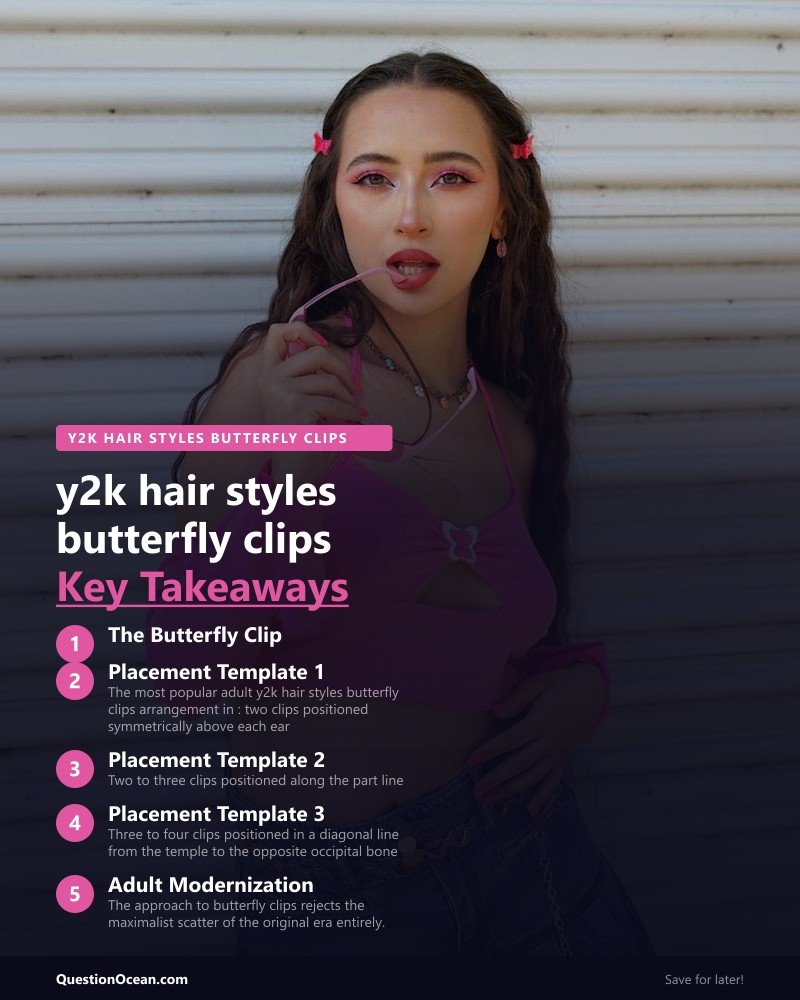
Placement Template 3: The Diagonal Line
Three to four clips positioned in a diagonal line from the temple to the opposite occipital bone, creating a visual line across the back of the head.
This template works exceptionally well for events and is the most photographed y2k hair styles butterfly clips arrangement on 2026 Instagram. The diagonal creates visual movement and frames the face from a three-quarter angle.
Adult Modernization: Y2K Hair Styles Butterfly Clips for 2026
The 2026 approach to butterfly clips rejects the maximalist scatter of the original era entirely. Instead of loading 10-15 small clips randomly across the head: the signature 2001 look — the modern technique uses 2-4 medium clips in a deliberate, symmetrical pattern that reads as intentional styling rather than nostalgic costume.
Position clips along the temporal ridge, angled 45 degrees toward the ear. This angle follows the natural bone structure of the skull, creating a geometric line that flatters every face shape. The temporal ridge provides a natural shelf for the clip to rest on, improving hold time compared to flat-scalp placement.
For fine hair that lacks the density to anchor clips securely, twist a small section 2-3 times before clipping. The twist compresses individual strands into a denser bundle that gives the clip’s hinge mechanism more material to grip. This creates an anchor point that prevents the slow slide-out that fine-haired users experience with untwisted sections.
Anchoring Techniques for Fine Hair
Fine hair presents the primary challenge with butterfly clips: the hinged clip mechanism relies on friction between the clip’s upper arm and a sufficient mass of hair underneath. Fine, slippery hair provides insufficient friction, causing clips to slide out within 30-60 minutes.
The Bobby Pin Anchor Method
- Position one or two bobby pins in an X pattern at the exact spot where you want the butterfly clip placed
- Slide the bobby pins in with the wavy side facing down (toward the scalp) for maximum grip
- Open the butterfly clip and position it over the bobby pin X, clamping down on both the hair and the bobby pins
- The bobby pins create a textured base that the butterfly clip grips, the clip now holds through the mechanical lock of pin + clip + hair
The Texturizing Spray Grip Method
Before placing clips, apply 2-3 short bursts of dry texturizing spray to the specific section where the clip will sit. The spray’s micro-particles (silica or starch) create surface roughness that increases friction between the clip arm and the hair shaft. After clip placement, the textured section grips significantly better than smooth, clean hair.
The Twist-and-Loop Method
Rather than clipping straight sections of hair, twist the section 3-4 times before clipping. The twist compresses multiple strands into a denser, thicker bundle that provides more material for the clip to grip. This method is particularly effective for fine hair under 50 microns per strand.
Choosing Quality Butterfly Clips vs. Fast-Fashion Knockoffs
The hinge mechanism is the critical quality differentiator. Cheap clips use soft metal hinges that lose tension within 2-3 months of use. The clip stops snapping shut firmly, and slippage becomes constant regardless of technique.
What to look for:
- Spring-loaded hinge: The clip should snap shut with firm, consistent pressure. Test by opening and closing 10 times. If tension decreases noticeably, the hinge is substandard.
- Smooth interior teeth: The gripping teeth on the clip’s interior should be smooth and evenly spaced. Rough or uneven teeth catch and break individual strands.
- Acetate or cellulose acetate material: These plant-derived plastics are lighter, stronger, and more visually sophisticated than petroleum-based plastics. They also create less static than standard plastic.
Product recommendations:
- Machete Clips ($48/pair), handmade Italian acetate, superior hinge mechanism
- Kitsch Butterfly Clips ($14/set of 4), mid-range acetate with adequate hinge tension
- Amazon Basics Acetate Clips ($8/set of 6), budget option with acceptable 6-month hinge lifespan
For complementary Y2K accessories, see our fluffy claw clips guide and oversized scrunchies. For formal clip and accessory styling, see pearl accessories for formal updos.
For the broader retro trend context, see our pillar guide to 90s hair trends.
Frequently Asked Questions
Q: How do you do Y2K butterfly clip hairstyles? A: Adult y2k hair styles butterfly clips use 2-4 large acetate clips placed symmetrically. The most popular arrangement: twist temple sections away from the face, cross them at the crown, and clip each twist with one butterfly clip at a 45-degree angle.
Q: Are butterfly clips in style in 2026? A: Yes. Butterfly clips are one of the top Y2K hair accessories in 2026, with 190% search volume increase since 2023. The 2026 version uses large acetate or tortoiseshell clips in neutral tones, positioned symmetrically for an adult aesthetic.
Q: How do I keep butterfly clips from falling out? A: Three anchoring methods work: bobby pin X-pattern underneath the clip, dry texturizing spray on the hair before clipping, or twisting the hair 3-4 times before clipping to create a denser grip surface. Fine hair benefits most from the bobby pin anchor method.
Q: What size butterfly clips should I buy? A: 2-3 inch clips are the standard for the 2026 adult aesthetic. Clips smaller than 2 inches read as juvenile. Clips larger than 3 inches can overwhelm shorter hairstyles, size up for long hair, size down for bobs and lobs.
Q: Can I wear butterfly clips with short hair? A: Yes, use the front-loaded statement placement (along the part line) with 2-inch clips. Short hair doesn’t have enough length for the crossed half-up template but supports front-positioned clip arrangements effectively.
Y2K hair styles butterfly clips have evolved from juvenile scatter to architectural precision. Two large acetate clips in matching placement. Anchored properly on fine hair, positioned along symmetry lines rather than randomly, create a statement accessory look that references the original Y2K era while functioning as a legitimate styling element for adult professionals and editorial settings.