
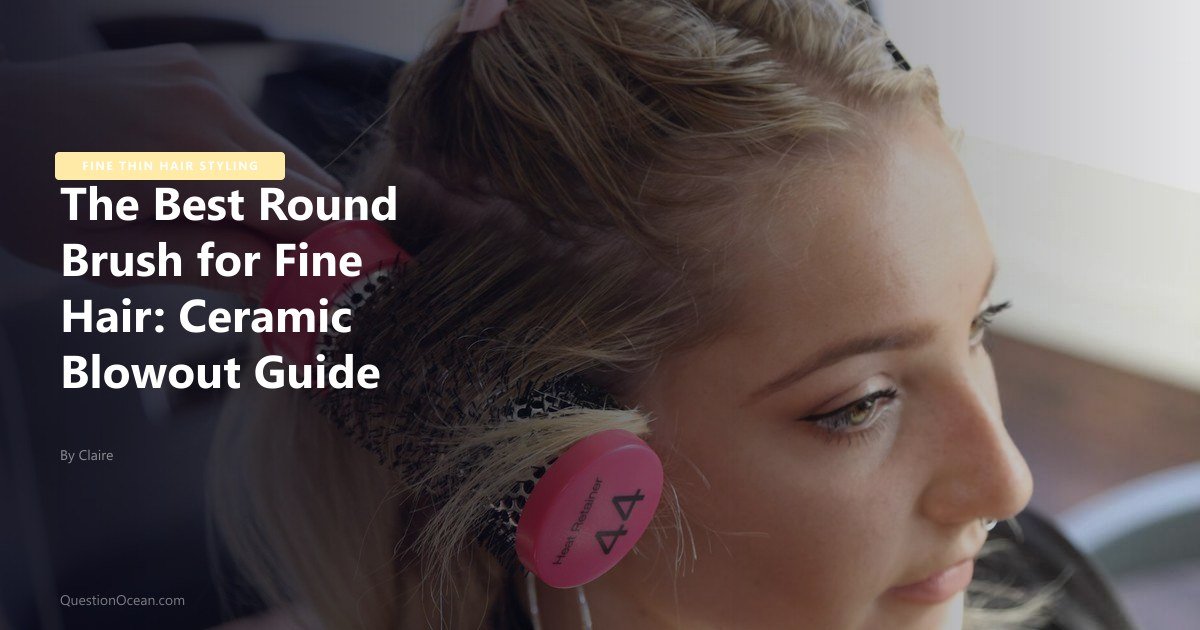
The wrong round brush on fine hair produces one of two equally frustrating outcomes: strands tangled around the barrel in a knotted disaster, or a limp, lifeless blowout that collapses into flatness before you leave the bathroom. The right round brush for fine hair solves both problems simultaneously: ceramic barrels provide consistent heat distribution that activates styling products without hot spots, while properly spaced bristles grip fine strands with enough tension to create lift without enough friction to snap fragile hair.
This guide covers bristle types, barrel materials, diameter selection, and the tension mechanics that turn a round brush for fine hair from a tangle-producing obstacle into the most effective volume tool in your styling routine.
Ceramic Heat Retention: Why It Matters for Fine Hair Blowouts
Ceramic-coated or solid ceramic round brushes heat evenly across the entire barrel surface when exposed to blow-dryer airflow. This uniform heat distribution is particularly important for fine hair because of how thermal styling physically works on delicate strands.
Fine hair reaches its thermal activation point (the temperature where hydrogen bonds break and reform into a new shape) approximately 30% faster than thick hair. Each strand has less mass to absorb heat energy, so it heats and cools quickly. A ceramic barrel that maintains consistent temperature across its surface ensures every strand in a section receives the same heat exposure: creating uniform curl and lift throughout the blowout.
Non-ceramic barrels (bare metal or aluminum) develop hot spots where the blow dryer’s airstream concentrates. On thick hair, the additional mass buffers against these temperature spikes. On fine hair, a hot spot can overheat individual strands in under 3 seconds, causing the cuticle to buckle and producing a rough, frizzy texture in isolated patches throughout the finished blowout.
Our complete guide to fine hair styling covers the full product and tool ecosystem for fine textures, with the ceramic round brush positioned as the primary blowout tool.
Is Boar Bristle or Ceramic Better for Fine Hair?
For blowout volume and root lift, ceramic brushes outperform boar bristle on fine hair. The distinction comes down to what each bristle type does mechanically to the strand during the blow-drying process.
Boar Bristle Brushes
Natural boar bristle brushes distribute sebum from the scalp along the hair shaft, creating a smooth, glossy finish. The dense bristle pattern grips fine hair firmly, often too firmly. Boar bristle brushes on fine hair create excessive tension that can snap fragile strands during the rolling and pulling motion of a blowout.
Boar bristle brushes excel at smoothing and finishing passes on fine hair, a final once-over after the blowout is complete to polish flyaways and distribute natural oils. They are not ideal for the volume-building phase where the brush needs to lift sections at the root while rotating through mid-shaft and ends.
Ceramic or Nylon-on-Ceramic Brushes
Ceramic barrels fitted with nylon bristles spaced 2-3mm apart provide the ideal grip-to-release ratio for fine hair. The nylon bristles are smooth-tipped and flexible, gripping the strand firmly enough to create tension for curl formation but releasing cleanly when the brush is unwound: without the catching and pulling that boar bristles produce.
The combination of ceramic barrel heat retention and nylon bristle flexibility makes this brush type the single best round brush for fine hair blowouts. The ceramic heats the section evenly, the nylon bristles hold it in place for curl formation, and the smooth bristle tips release without tangling.
Mixed Bristle (Boar + Nylon)
Mixed-bristle brushes combine boar and nylon in alternating rows. These work for fine hair when the boar-to-nylon ratio favors nylon (70% nylon, 30% boar). If the ratio reverses, the excessive boar bristle density creates the same tangling and snapping issues as a pure boar brush.
Check the bristle layout before purchasing. If the boar bristles are evenly distributed among the nylon (rather than clustered in dense rows), the brush will grip and release fine hair smoothly.
Ceramic Round Brush with Nylon Bristles, multiple diameter options
Preventing Snapping and Tangling on Fragile Hair
Tangling is the primary reason fine-haired users abandon round brushes entirely. The strand wraps around the barrel, catches in the bristle gaps, and refuses to release, leading to forced pulling that snaps hair at the point of entanglement.
Why Fine Hair Tangles on Round Brushes
Fine hair tangles on round brushes for a specific mechanical reason: the strand diameter is thin enough to slide between bristle gaps and wrap around the barrel’s base. Thick hair sits on top of the bristles. Fine hair falls between them.
To prevent tangling, choose a round brush for fine hair with bristle gaps no wider than 2mm. Tightly spaced bristles keep fine strands on the surface of the bristle bed rather than allowing them to sink into the gaps and wrap around the barrel shaft.
The Controlled Unwind Technique
Most tangling occurs during the release phase, when you try to pull the brush straight out of a wound section. Instead of pulling straight, use a controlled unwind:
- After holding the wrapped section at the ends for 5 seconds with heat, hit the cool shot
- Rotate the brush slowly in the opposite direction from which you wound it — unwinding rather than pulling
- Keep light outward tension as you rotate so the hair peels off the barrel gradually
- If you feel resistance at any point, stop rotating, add a single drop of detangling spray to the resistant area, and continue the unwind
Never yank the brush backward through a section. This drives bristles against the cuticle direction and creates the same abrasion damage as aggressive backcombing.
Brush Maintenance for Smooth Performance
Product buildup on bristles and the barrel increases friction and tangling frequency. Clean your ceramic round brush weekly:
- Remove trapped hair from the bristles with a tail comb
- Soak the bristle portion (not the handle) in warm water with a drop of clarifying shampoo for 10 minutes
- Use an old toothbrush to scrub between bristle rows
- Rinse thoroughly and allow to air-dry bristle-side-down
A clean brush glides through fine hair with 40-50% less friction than a buildup-coated brush. This maintenance step alone eliminates most tangling incidents.
Diameter Selection for Root Lift on Fine Hair
The diameter of your round brush for fine hair directly controls the tightness of the curl or bend it produces, and more importantly, the degree of root lift it can create.
Small Diameter (1-inch / 25mm)
A 1-inch barrel creates the tightest curl and the most dramatic root lift. Fine hair wraps fully around this diameter in 1.5-2 rotations, creating a concentrated lift zone at the base. Best for:
- Chin-length and bob-length fine hair
- Maximum root lift at the crown and part line
- Creating visible curled ends on layered cuts
- Face framing sections that need tight swooping shape
Medium Diameter (1.5-inch / 38mm)
The 1.5-inch barrel is the most versatile round brush for fine hair. It produces a medium bend with substantial root lift, enough volume for everyday blowouts without creating tight curls that feel overdone. Best for:
- Shoulder-length to collarbone-length fine hair
- All-purpose blowout volume with a natural bend
- Styling face framing layers with an open, swooping shape
- Creating the appearance of thicker ends through a rolled-under finish
If you own only one round brush for fine hair, choose the 1.5-inch diameter. It handles the widest range of hair lengths and styling goals. For detailed swooping technique on face framing layers, see our guide to strategic face framing layers for fine hair.
Large Diameter (2-inch / 50mm)
A 2-inch barrel produces a loose, blowout-style bend with gentle root lift. Fine hair may not wrap fully around this diameter, which reduces the tension-based curl formation. Best for:
- Long fine hair (past the collarbone)
- Loose, polished blowout styles with subtle body
- Smoothing rather than curling
- Second-pass finishing after initial volume is set with a smaller brush
Extra-Large Diameter (2.5-inch+ / 65mm+)
Extra-large barrels are rarely effective on fine hair. The diameter is too wide for fine strands to grip against, and the limited wrapping distance produces almost no curl memory. Reserve these for thick, dense hair that needs smoothing rather than volume.
Tension Mechanics: Creating Lift Without Damage
The amount of pulling force you apply through the round brush during a blowout is called tension. Correct tension creates the curl shape. Excessive tension snaps fine hair at the root.
Fine hair requires approximately 40-60% of the tension used on thick hair. You should feel the brush gripping the section with light resistance, enough that the hair wraps neatly around the barrel, but not so much that you see the scalp pulling or feel strain at the root.
The Root Lift Rolling Technique
- Clip all sections except the one you are styling
- Insert the round brush at the root of the section, bristles touching the scalp
- Roll the brush outward (away from your face for face framing, upward for crown) by one half-turn
- Direct the blow dryer nozzle along the barrel from root toward tips for 5-7 seconds at medium heat
- Hit the cool shot for 3 seconds while the brush holds the position
- Unwind the brush slowly using the controlled unwind technique
- Do not touch the section for 15 seconds while it cools and sets
The half-turn roll at the root is critical. A full rotation wraps the fine hair too tightly around the barrel, increasing tangling risk and creating an overly curled result. The half-turn provides lift and bend without over-wrapping.
For brushes in the sustainable category, our guide to eco-friendly brushes and tools covers FSC-certified and bamboo-handle ceramic brush options that perform identically to standard plastic-handle versions on fine hair.
Ceramic Round Brush Set. Multiple diameters (1″, 1.5″, 2″)&tag=bala08-20)
Combining the Round Brush for Fine Hair with Styling Products
The round brush for fine hair performs best when paired with lightweight volumizing products applied before the blowout. Heavy serums and oils coat the strand, reducing the bristle grip and causing the hair to slide off the barrel without holding a curl.
Product pairing sequence for maximum blowout volume:
- Apply a volumizing mousse or root lifting spray to 80% dry hair, roots only
- Clip sections and begin the blowout with the ceramic round brush
- After completing the blowout, apply a misting of lightweight flexible-hold hairspray from 10-12 inches away
- Avoid touching or brushing the finished blowout for 5 minutes while the polymer sets
For mousse recommendations that pair with round brush blowouts, weightless volumizing mousses for fine hair covers formulas that add grip without adding weight that would collapse the lift you created with the brush.
Frequently Asked Questions
Q: Is boar bristle or ceramic better for fine hair? A: Ceramic with nylon bristles is better for blowout volume on fine hair. Boar bristle grips too aggressively on fine strands, causing tangling and breakage during the rolling motion. Reserve boar bristle for smoothing passes after the blowout is complete.
Q: What size round brush is best for fine hair? A: A 1.5-inch (38mm) diameter ceramic round brush is the most versatile size for fine hair. It produces substantial root lift and a natural bend on shoulder-to-collarbone-length hair. Use a 1-inch brush for bob-length cuts or maximum root lift at the crown.
Q: Why does my fine hair always tangle on a round brush? A: Fine strands fall between widely spaced bristles and wrap around the barrel base. Choose a brush with bristle gaps no wider than 2mm, and use the controlled unwind technique (rotating the brush in reverse rather than pulling straight out) to release each section.
Q: How do I get root lift with a round brush on fine hair? A: Insert the brush at the root with bristles touching the scalp, roll outward by one half-turn, and direct the blow dryer along the barrel for 5-7 seconds. Follow immediately with 3 seconds of cool shot air. The half-turn creates lift without over-wrapping the strand.
Q: Should I use a round brush on wet or dry fine hair? A: Start the round brush blowout on hair that is approximately 80% dry. Fully wet fine hair is too heavy and fragile for round brush tension. Rough-dry with a concentrator nozzle first, then switch to the round brush for the shaping and volume phase.
Q: How often should I clean my round brush? A: Weekly cleaning removes product buildup that increases friction and tangling on fine hair. Soak the bristle portion in warm water with clarifying shampoo for 10 minutes, scrub between rows with a toothbrush, and air-dry bristle-side-down.
The right round brush for fine hair transforms the blowout from a damage-risk struggle into a 15-minute volume routine. Ceramic barrel heat retention, properly spaced nylon bristles, and the correct diameter for your hair length create the controlled tension and uniform heat that fine hair needs to hold a lifted, full-bodied shape from morning through evening.