
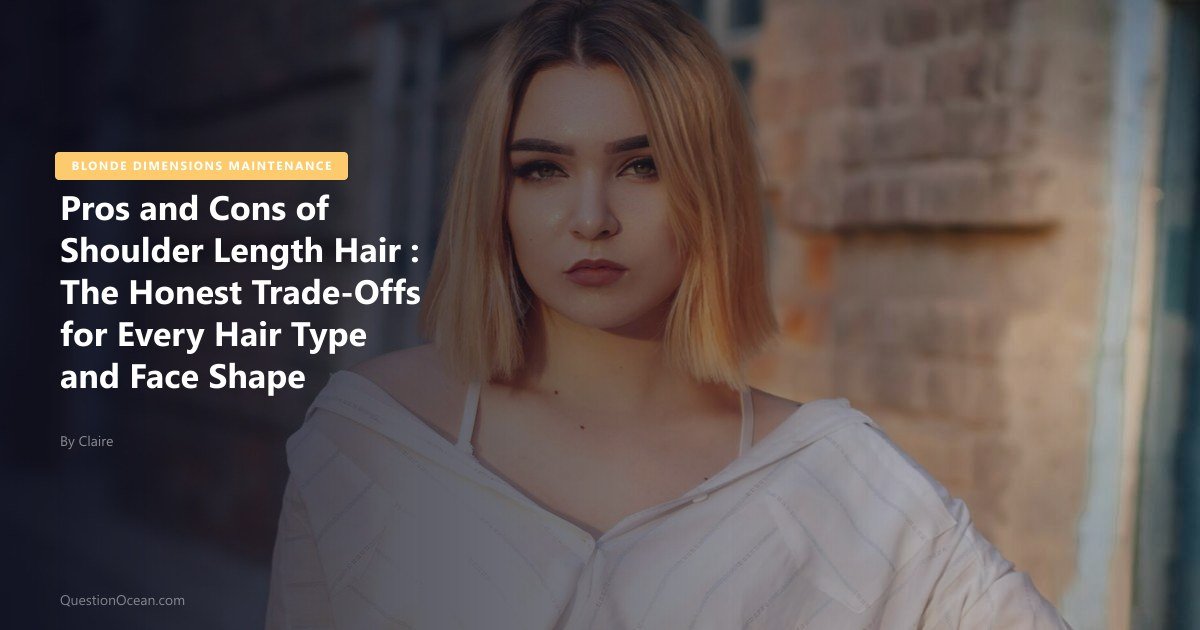
Quick answer: Shoulder length hair (collarbone to 2 inches below) is the most versatile length for most people. It’s long enough to put up in a ponytail, braid, or bun, but short enough to style quickly and maintain easily. The main downsides: it hits an awkward flip-out stage at exactly shoulder length, requires more frequent trims than long hair to keep the shape, and doesn’t suit every face shape equally. Below is a complete breakdown to help you decide.
The Pros
Last updated: July 30, 2026
1. Maximum Styling Versatility
Shoulder length sits in the sweet spot where both “short hair” and “long hair” styles work. You can wear it down (straight, wavy, curled), half-up, in a low ponytail, a messy bun, braids, and most updo variations. Truly short hair (above the chin) can’t do updos. Very long hair is heavy and time-consuming to style. Shoulder length gives you the widest range of daily options.
2. Faster Styling Time
Shoulder length hair takes roughly half the time to blow-dry and style compared to waist-length hair. For daily routines, that’s 10-15 minutes saved per styling session. Over a month, that adds up to 5-7 hours. For people who style their hair most mornings, this is significant.
3. Less Product Usage
Shorter length = less surface area = less shampoo, conditioner, heat protectant, and styling product per application. On average, shoulder length hair uses 40-50% less product than waist-length hair. At $15-25 per product, this translates to noticeable savings over a year — roughly $100-200 less on products annually compared to long hair.
4. Healthier Ends
Longer hair means older ends. The tips of waist-length hair can be 4-6 years old, accumulating years of sun, heat, and chemical damage. Shoulder length hair has ends that are 1.5-2.5 years old. Younger ends are healthier, shinier, and less prone to splitting and dryness. If you’ve struggled with dry, damaged ends on long hair, the cut alone often resolves the problem.
5. Works With Most Face Shapes
Shoulder length is flattering on oval, heart, and oblong face shapes. With the right layering, it works for round and square faces too. The length creates a frame around the face without elongating or widening the proportions in an unflattering way.
The Cons
1. The Shoulder Flip
This is the biggest frustration with shoulder length hair. When the ends hit exactly at the shoulder, they bounce off and flip outward. The shoulder creates a ledge that the hair curls around, producing an outward flip that looks unintentional and dated.
The fix: Cut 1-2 inches above or below the shoulder. Right AT the shoulder is the problem zone. Just above (a lob) or just below (collarbone length) avoids the flip entirely. Layers also help redirect the movement inward.
2. Not All Updos Work
While shoulder length can do most updos, some styles require more length than it provides. Very elaborate braided updos, long flowing ponytails, and styles that need length to wrap or drape (like a French twist on thick hair) may not work or may require extensions to achieve.
3. More Frequent Trims to Maintain Shape
Long hair can go 10-12 weeks between trims without looking overgrown. Shoulder length hair with layers starts looking shapeless after 6-8 weeks because the proportions change more noticeably as layers grow out. Budget for a trim every 6-8 weeks ($20-60 per trim depending on location).
4. The Grow-Out Awkward Phase
If you cut to shoulder length and later want to grow it out, the collarbone-to-mid-back range takes 12-18 months and includes several awkward stages where the hair is “too long to be short and too short to be long.” Clip-in extensions can bridge this phase for special occasions, but daily wear during the grow-out requires patience.
5. Doesn’t Suit Every Face Shape Equally
Round and very wide faces can look wider with shoulder length hair that lacks layers or movement. One-length shoulder hair that hugs the sides of the face emphasizes width. The fix is layers that create diagonal lines, drawing the eye vertically rather than horizontally. But if you have a round face and prefer zero-layer, blunt-cut hair, shoulder length may not be your most flattering option.
Shoulder Length by Hair Type
| Hair Type | How Shoulder Length Works | Tip |
|---|---|---|
| Fine, straight | Can look flat and limp without layers | Add long layers and texturizing spray for movement |
| Medium, straight | The easiest to maintain at this length | Versatile; works with or without layers |
| Thick, straight | May triangle outward without layering | Internal layers remove bulk without sacrificing length |
| Wavy (Type 2) | Looks effortless and full | Shoulder length is often the most flattering length for waves |
| Curly (Type 3) | Shrinkage means it looks shorter than it is | Cut 2-3 inches longer than your target to account for curl shrinkage |
| Coily (Type 4) | Significant shrinkage (50-75%) | Stretched length should be at or below shoulder; natural length will be much shorter |
The Cost of Maintaining Shoulder Length Hair
| Expense | Shoulder Length | Waist Length | Short (Pixie/Bob) |
|---|---|---|---|
| Trim frequency | Every 6-8 weeks | Every 10-12 weeks | Every 4-6 weeks |
| Trim cost (US avg) | $30-50 | $30-50 | $25-45 |
| Annual trim cost | $240-430 | $155-260 | $280-580 |
| Product usage | Moderate | High | Low |
| Styling time/day | 10-20 min | 20-40 min | 5-15 min |
Shoulder length hits the middle on almost every cost and time metric. It’s not the cheapest to maintain (that’s long hair with infrequent trims) and not the quickest to style daily (that’s short hair). It’s the compromise that gives the most flexibility.
Who Should Go Shoulder Length
Go for it if: You want daily styling options without daily styling effort. You’re frustrated with long hair maintenance but don’t want to commit to short. You have wavy or medium-textured hair that naturally looks good at this length.
Think twice if: You strongly prefer long flowing hairstyles. You have a very round face and prefer blunt, one-length cuts. You hate frequent trims.
Frequently Asked Questions
Q: Is shoulder length hair hard to maintain? A: Moderate. Less maintenance than long hair (less product, faster styling) but more frequent trims than long or very short hair to maintain the shape. Budget for a trim every 6-8 weeks.
Q: Does shoulder length hair make you look older or younger? A: Neither inherently. The cut, layers, and styling matter more than the raw length. Shoulder length with movement and layers reads as youthful and modern. Blunt shoulder length without layers can read as dated, depending on face shape.
Q: What face shape looks best with shoulder length hair? A: Oval and heart-shaped faces look great at shoulder length with almost any cut style. Round and square faces benefit from layers and side parts that create vertical movement. Oblong faces suit shoulder length with volume at the sides.
Q: How long does it take to grow hair to shoulder length? A: From a pixie cut: 18-24 months. From a bob (chin length): 8-12 months. From a buzz cut: 24-30 months. Hair grows roughly 0.5 inches per month on average.
Shoulder length is the “default” recommendation for a reason. It works for most people, in most situations, with the least daily effort relative to the styling options it provides.