
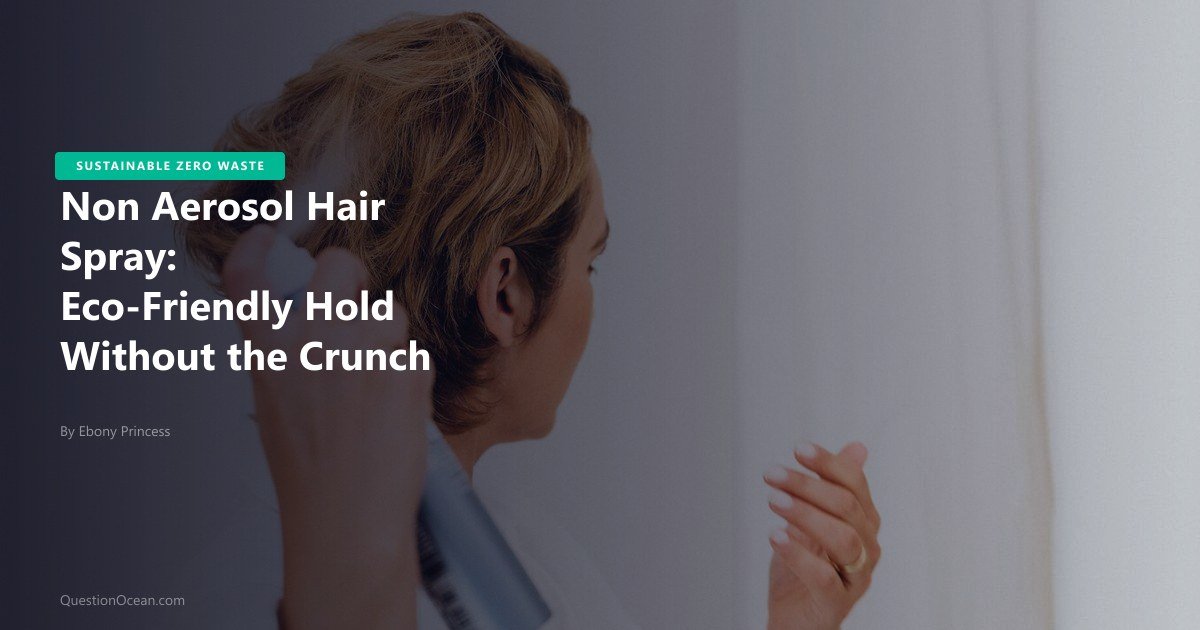
The average aerosol hairspray can contains pressurized hydrocarbons, butane, isobutane, and propane: that atomize the styling formula into a superfine mist of 10-30 micron droplets. That mist feels weightless going on, but the delivery system produces a steel can that takes 50-100 years to decompose in landfill and releases volatile organic compounds (VOCs) with every spray. A non aerosol hair spray delivers comparable hold through a mechanical pump mechanism that eliminates both the propellant chemicals and the pressurized metal waste.
Our complete guide to sustainable zero-waste haircare covers the full spectrum of eco-friendly styling products. This article focuses on the specific physics, ingredient science, and application technique differences that make pump-based hair sprays a genuine performance alternative to aerosols: not just a compromise for the environmentally conscious.
The Physics of Pump Droplets vs. Aerosol Mist
Understanding why non aerosol hair spray feels different on the hair starts with droplet size. Aerosol cans use compressed gas to shatter liquid into extremely fine particles (10-30 microns), creating that familiar dry, even mist. A pump trigger mechanism produces larger droplets, typically 50-150 microns. Because it relies on mechanical force rather than gas pressure to break the liquid stream apart.
Larger droplets mean the product lands on the hair in concentrated spots rather than as a uniform cloud. This is why a pump spray can feel wetter on application and why beginners often over-apply on the first attempt. The fix is technique, not product reformulation.
The droplet size difference also explains drying time variations. Aerosol mist evaporates in 3-8 seconds because each particle has an enormous surface-area-to-volume ratio. Pump spray droplets take 15-40 seconds to dry fully, depending on the formula’s alcohol content and the ambient humidity. In practical terms, this means you need to adjust your application distance and your patience. Both solvable problems once you understand the mechanics.
Optimizing Spray Distance
Hold a pump hair spray 10-12 inches from the hair, roughly three inches farther than the typical aerosol distance of 7-8 inches. The additional distance allows larger droplets to disperse in the air before landing, producing a more even coat. Spraying from too close creates wet patches that dry into stiff, crunchy spots rather than flexible hold.
For volume-building applications at the roots, flip your head upside down and spray from 12-14 inches. The droplets fall through gravity and coat the root area more evenly than a horizontal spray aimed at the crown.
Avoiding the “Crunch”: Flexible Polymer Ingredients
The crunchy texture people associate with non aerosol hair spray usually comes from one ingredient: VA/Crotonates/Vinyl Neodecanoate Copolymer applied too heavily. This polymer creates a rigid film when layered, fine in small doses, stiff as shellac when over-applied through a pump that deposits more product per squeeze than an aerosol burst.
The key to crunch-free hold from a pump spray is choosing formulas built around flexible polymers instead of rigid film-formers. Look for these ingredients on the label:
- PVP/VA Copolymer: Creates a flexible, brushable hold that moves with the hair. This is the gold-standard polymer for non-aerosol formulas because it maintains elasticity even in low humidity
- VP/Methacrylamide/Vinyl Imidazole Copolymer: A newer flexible polymer that provides strong hold without the tacky residue common in traditional formulas
- Polyurethane-14: Found in premium non-aerosol sprays, this polymer creates a microfilm with built-in flexibility that resists humidity without stiffening
- Panthenol (Pro-Vitamin B5): Not a hold polymer itself, but it softens the film created by other polymers, reducing crunchiness by 30-40% even in high-hold formulas
Avoid formulas where Octylacrylamide/Acrylates/Butylaminoethyl Methacrylate Copolymer is the primary hold ingredient. This polymer produces the hardest, least flexible film and is the number-one cause of crunchy texture in pump sprays.
Flexible-Hold Non-Aerosol Hair Spray: PVP/VA copolymer formula
Drying Time Adaptations for Pump Sprays
The 15-40 second drying window of a non aerosol hair spray requires a slight adjustment to your finishing routine. Rather than spraying and immediately leaving the house (as many aerosol users do), build in a 45-60 second setting window after your final application.
During this setting window, avoid touching, brushing, or reshaping the hair. The polymer film is still semi-liquid and will redistribute unevenly if disturbed, creating both crunchy spots (where product pools) and weak spots (where it was wiped away).
Speeding Up Dry Time
Three techniques reduce drying time without compromising hold:
- Cool-shot from a dryer: A 5-second blast of cool air from 12 inches away evaporates the solvent carrier (water or alcohol) and sets the polymer film in approximately 8-10 seconds. This is the single most effective technique for impatient users
- Choose alcohol-based formulas for speed: Ethanol or denatured alcohol evaporates 3-4 times faster than water. Alcohol-based non-aerosol sprays dry in 10-15 seconds versus 25-40 for water-based versions. The trade-off is slightly more drying to the hair over time
- Apply in thinner layers: Two light passes from 12 inches dry faster than one heavy pass from 6 inches, even though the total product amount is similar, because thinner films have more surface area for evaporation
For readers who use solid shampoo and conditioner bars, water-based non-aerosol sprays pair better with bar-washed hair because they add minimal alcohol-related dryness on top of the surfactant cleansing.
Environmental Impact: Aerosol vs. Pump by the Numbers
The environmental case for non aerosol hair spray extends beyond the obvious propellant issue. A full lifecycle comparison reveals multiple impact points.
- Propellant emissions: A standard 300ml aerosol can releases approximately 150ml of hydrocarbon propellant (butane/isobutane) into the indoor and outdoor atmosphere. Pump sprays release zero propellant gases
- Packaging weight: An aerosol can weighs 90-120g empty (steel body, valve assembly, actuator cap). A pump bottle weighs 25-40g (PET or HDPE plastic, trigger mechanism). Lower packaging weight reduces shipping emissions across the supply chain
- Recyclability: Aerosol cans require specialized processing because residual propellant makes them hazardous waste in many municipal systems. Pump bottles with PP or PET bodies are accepted in standard curbside recycling across all US, UK, and Canadian municipalities
- Refill potential: Aerosol cans cannot be refilled at home. Many pump-spray brands now offer refillable haircare systems using concentrated pouches that reduce packaging by 70-80% per refill cycle
The cumulative environmental difference is substantial: switching from aerosol to pump spray eliminates approximately 1.5kg of steel waste and 450ml of hydrocarbon emissions per person annually (based on average usage of three cans per year).
Non Aerosol Hair Spray for Different Hold Levels
Pump sprays are available across the full hold spectrum. The misconception that they only deliver light hold stems from early formulations that used weaker polymers to compensate for the larger droplet size.
Light Hold (1-2 Day Styles)
Best for natural movement, air-dried waves, and second-day refreshes. Look for formulas with PVP/VA Copolymer listed as the primary polymer and water as the solvent base. These provide touchable, invisible hold that allows the hair to move naturally while controlling flyaways.
Kenra Volume Spray 25 Non-Aerosol ($20/300ml, available across US, UK, and CA) is the benchmark in this category, offering flexible hold without visible residue on dark hair.
Medium Hold (Event-Ready Styles)
The sweet spot for everyday updos, blowout preservation, and humidity resistance. Medium-hold pump sprays typically combine two polymers, one rigid and one flexible. In a ratio that provides structure without stiffness.
These work well as finishing sprays over styles built with other tools. Spray from 10-12 inches, wait 30 seconds for the film to set, then assess whether a second pass is needed.
Strong Hold (All-Day Lock)
High-hold pump sprays exist but require more precise application technique than their aerosol equivalents. The larger droplet size means product concentration per square centimeter is higher, so the crunchy-spot risk increases proportionally.
Apply in three light passes rather than one heavy coat. Allow 15-20 seconds of drying time between each pass. This layering approach builds comparable hold to an aerosol strong-hold spray while maintaining flexibility because each individual layer is thin enough to cure without becoming rigid.
Strong-Hold Non-Aerosol Finishing Spray — humidity-resistant
Is Non-Aerosol Hairspray Better for You?
Non-aerosol hairspray eliminates your inhalation exposure to hydrocarbon propellant gases, which is the primary personal benefit beyond the environmental advantage. When you press an aerosol trigger, approximately 50% of the propellant gas disperses into the ambient air rather than landing on the hair. In a small bathroom with poor ventilation, propellant concentrations spike for 3-5 minutes after spraying.
Pump sprays produce zero propellant vapors. The only inhalable particles are the styling formula itself, and the larger droplet size means fewer particles become airborne. If you spray in a well-ventilated area from 10-12 inches away, virtually all the product lands on the hair rather than floating through the room.
For users with sensitivity to strong fragrances, pump sprays also offer more options in unscented or naturally scented formulations. Aerosol cans require fragrances that remain stable under high pressure and propellant exposure, which limits the formulator’s options. Pump bottles impose no such constraint.
If you enjoy streamlining your styling routine, multi-tasking hybrid styling products combine hold, heat protection, and conditioning in a single non-aerosol application.
Troubleshooting Common Pump Spray Problems
White Residue on Dark Hair
Switch to a formula with lower polymer concentration or increase your spray distance to 14 inches. White residue occurs when concentrated droplets dry on the hair surface before the solvent fully evaporates, leaving visible polymer particles.
Uneven Hold
You are spraying too close. Increase distance to 12 inches and rotate the bottle in a slow arc rather than holding it stationary. Pump mechanisms produce a fixed spray pattern (typically a cone of 20-30 degrees), so movement is essential for even distribution.
Nozzle Clogging
Pump nozzles clog when dried polymer seals the aperture between uses. After each use, wipe the nozzle opening with a damp cloth. If clogged, remove the trigger head and soak it in warm water for 5 minutes to dissolve the polymer film. Store the bottle upright to prevent formula from pooling in the nozzle channel.
Frequently Asked Questions
Q: Is non-aerosol hairspray better for you? A: Non-aerosol hairspray eliminates inhalation exposure to butane and isobutane propellant gases, which is the main personal health advantage. Pump sprays also produce larger droplets that are less likely to become airborne, reducing the amount of product you breathe in during application.
Q: Does non-aerosol hair spray hold as well as aerosol? A: Modern non-aerosol formulas using PVP/VA or Polyurethane-14 polymers deliver comparable hold at every level from light to strong. The key difference is application technique, spray from 10-12 inches and build hold through multiple light passes rather than one heavy coat.
Q: Why does my pump hair spray feel crunchy? A: Crunchiness results from over-application or formulas built on rigid polymers like Octylacrylamide copolymer. Switch to a flexible-polymer formula (check for PVP/VA Copolymer on the label) and apply from a greater distance in lighter coats. Allow each layer to dry before adding the next.
Q: How long does non-aerosol hairspray take to dry? A: Pump spray dries in 15-40 seconds depending on the formula’s solvent base. Alcohol-based formulas dry in 10-15 seconds, water-based in 25-40 seconds. A 5-second cool-shot from a dryer reduces drying time to under 10 seconds regardless of formula type.
Q: Can I travel with non-aerosol hair spray? A: Pump sprays are not classified as pressurized containers by TSA (US), CAA (UK), or CATSA (Canada), which simplifies air travel. They still count toward your liquid allowance (100ml/3.4oz in carry-on), but you can check larger bottles without the hazardous materials restrictions that apply to aerosol cans.
Q: Are non-aerosol hair sprays better for the environment? A: Significantly. They eliminate hydrocarbon propellant emissions, use lighter packaging (25-40g vs 90-120g per container), and are fully recyclable in standard curbside programs. Many brands now offer refill pouches that reduce packaging waste by 70-80% per cycle.
Non aerosol hair spray in 2026 delivers flexible, layerable hold that matches aerosol performance when applied correctly, farther from the hair, in thinner coats, with a brief setting window. The polymer science has caught up to the delivery system, and the environmental savings of eliminating propellant cans from your routine compound with every bottle you finish.