
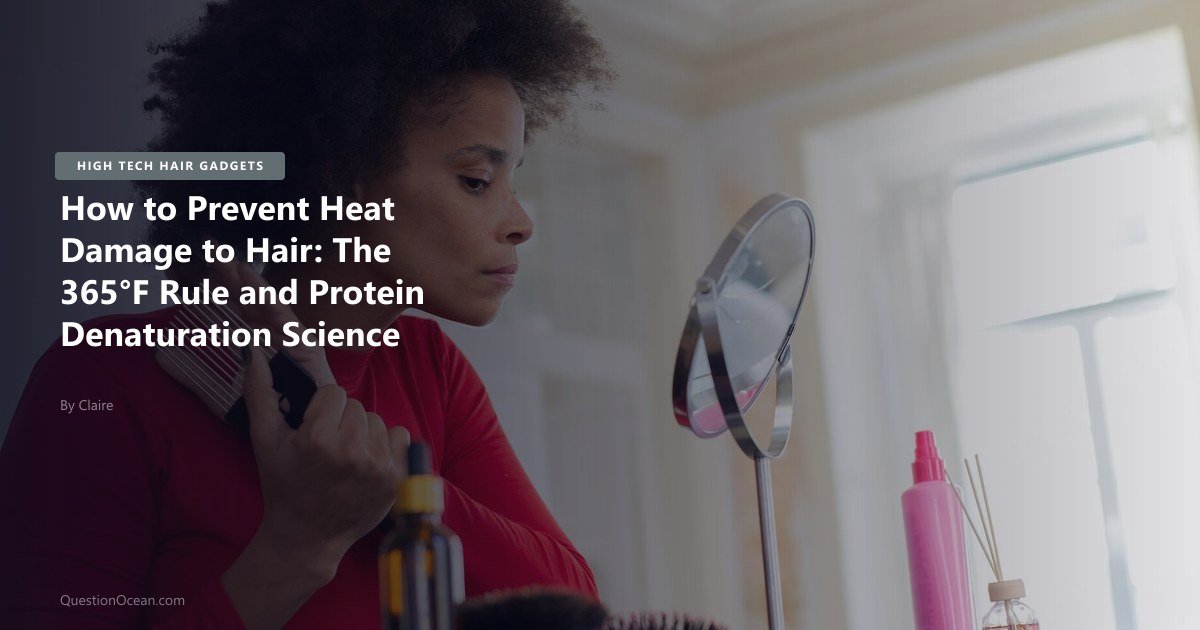
The hair industry’s relationship with heat is fundamentally contradictory: every styling tool sold promises better results, while every styling session inflicts measurable structural damage on the hair protein. The good news is that this damage is not inevitable. It happens at specific, predictable temperatures, through specific, predictable chemical mechanisms — and once you understand the biology, you can style with heat without crossing the threshold where reversible thermal effects become permanent protein destruction. How to prevent heat damage to hair comes down to one principle: keep the hair surface temperature below 365°F (185°C), which is the keratin denaturation threshold above which the protein structure cannot recover, regardless of conditioner, treatment, or repair products applied afterward.
This guide explains the protein denaturation science, the chemistry of heat protectant products, the temperature settings appropriate for each hair type, and the visible signs of accumulated heat damage that signal you need to lower your styling temperature.
For the broader high-tech tool landscape, see our pillar guide to the best high tech hair tools 2026.
The 365°F Keratin Denaturation Threshold
Keratin is the structural protein that makes up over 90% of the hair shaft. It is a fibrous protein with a specific three-dimensional structure held together by hydrogen bonds, salt bonds, and disulfide bonds. This structure determines the hair’s strength, elasticity, and ability to hold shape.
Protein denaturation is the process where heat (or chemicals) disrupts the bonds that hold a protein in its functional shape. Once the bonds break beyond a certain point, the protein cannot reform, it is permanently denatured.
The temperature thresholds for keratin:
| Temperature | Effect on Keratin |
|---|---|
| Below 250°F (121°C) | No structural change. Heat is fully reversible. |
| 250-300°F (121-149°C) | Hydrogen bonds temporarily reform. Style sets without damage. |
| 300-365°F (149-185°C) | Disulfide bonds begin temporary disruption. Style sets strongly. Some protein stress at upper end. |
| 365°F (185°C) | Keratin denaturation begins. Damage starts becoming permanent. |
| 365-400°F (185-204°C) | Disulfide bonds permanently break. Cuticle begins lifting. |
| Above 400°F (204°C) | Major protein structural damage. Cuticle damage becomes visible. |
| Above 450°F (232°C) | Acute thermal damage. Hair may smoke or burn. |
The critical insight: The 365°F threshold is not arbitrary. It’s the specific temperature at which the molecular bonds holding keratin together begin to fail catastrophically. This is the same threshold used in industrial protein chemistry, not a marketing number from styling tool brands.
The damage is cumulative. Each heat exposure above 365°F adds to the total accumulated damage. Three styling sessions at 380°F do more permanent damage than ten styling sessions at 350°F, even though the high-temperature sessions take less total time.
For deeper analysis of heat damage repair limits, see our guide on natural hair recovery.
How Heat Protectant Sprays Actually Work
Heat protectant products are not magic shields. They work through specific chemical mechanisms that buy a small but meaningful safety margin. Typically 30-50°F of temperature buffering before the underlying hair experiences the styling heat.
The three protective mechanisms:
1. Silicone film barrier: Silicone-based heat protectants (containing dimethicone, cyclomethicone, or similar) form a thin film on the hair surface. This film has a higher heat capacity than the hair itself, meaning it absorbs heat energy from the styling tool before that energy reaches the keratin. The silicone film essentially “takes the hit” instead of the hair.
2. Polymer cross-linking: Polymer-based protectants (PVP, PVP/VA copolymers, polyquaternium compounds) form a flexible web across the hair surface that distributes heat evenly across a wider area. Instead of a small section reaching peak temperature, the heat spreads across the polymer matrix and never quite reaches damaging levels at any single point.
3. Hydrolyzed protein supplementation: Protein-based protectants (hydrolyzed wheat protein, hydrolyzed silk, keratin amino acids) provide sacrificial protein fragments that the heat can damage instead of the hair’s own keratin. This is similar to how a sacrificial anode protects metal in marine environments.
Quality protectants combine all three mechanisms in a single formula. Look for ingredients lists that include silicones, polymers, AND hydrolyzed proteins.
Heat Protectant Spray for Hair Styling
How Much Protection Does a Heat Protectant Provide?
The honest answer: not as much as marketing implies. Quality heat protectants buffer the hair surface by approximately 30-50°F at most. This means:
- A flat iron set to 400°F still delivers approximately 350-370°F to the hair surface. Just below the denaturation threshold but with no margin for error
- A flat iron set to 365°F with protectant delivers approximately 315-335°F to the hair, safely below the threshold with a comfortable margin
- A flat iron set to 450°F with protectant delivers approximately 400-420°F to the hair: well above the damage threshold
The key insight: Heat protectants work, but they cannot rescue hair from inappropriate temperature settings. They provide a safety margin at appropriate temperatures, not a license to use higher temperatures.
Temperature Settings by Hair Type
The right styling temperature depends on hair density, porosity, and prior damage level. The 365°F maximum is universal, but the appropriate setting is often well below it.
| Hair Type | Recommended Max Temperature | Notes |
|---|---|---|
| Fine, damaged, or color-treated | 300-330°F | Lower threshold required due to vulnerability |
| Fine, healthy | 330-350°F | Sufficient for most styling needs |
| Medium density, healthy | 350-365°F | Balanced setting for most users |
| Medium density, coarse texture | 350-365°F | Coarse texture handles heat slightly better |
| Thick, healthy | 360-365°F | Maximum recommended for daily styling |
| Thick, coarse, virgin (uncolored) | 360-380°F | Special case: see warning below |
| Type 4 coily, virgin | 360-380°F | Tight coils may need slightly higher to set |
The warning about settings above 365°F: Even for thick, coarse, virgin hair, settings above 365°F should be reserved for occasional use, not daily styling. The cumulative damage from regular high-temperature exposure compounds over months and years even on the most resilient hair.
Smart flat irons that maintain precise temperature allow safe use of lower settings than conventional flat irons because they don’t experience the temperature drop that forces users to compensate with higher set temperatures. For a complete review of smart flat iron technology, see our smart flat iron review 2026.
The Visible Signs of Heat Damage
Heat damage doesn’t appear immediately. It accumulates over weeks and months of exposure. By the time the damage is visible, significant structural change has already occurred.
Early Warning Signs (Reversible with Tool Adjustment)
- Increased frizz at the ends, particularly within hours of styling
- Loss of natural shine, hair looks duller despite using conditioning products
- Slight rough texture when running fingers down the hair shaft from root to tip
- Color fade accelerating beyond normal post-color timeline
Action: Lower your styling temperature by 25-50°F immediately. Apply heat protectant to every section before heat application. Reduce styling frequency by at least one session per week.
Moderate Damage Signs (Requires Active Recovery)
- Visible split ends appearing within 4-6 weeks of trim
- Hair feels rough or “crispy” when dry
- Strands break easily when gently pulled from a brush
- Color treatments don’t last as long as they used to
- Heat styling no longer holds, curls fall out within hours
Action: Reduce styling temperature by 50-75°F. Schedule weekly protein-strengthening treatments. Trim damaged ends every 6-8 weeks to prevent damage from traveling up the shaft. Consider heat-free styling alternatives.
Severe Damage Signs (Requires Significant Recovery Period)
- Mid-shaft breakage, hair breaking off in the middle, not at the ends
- Translucent, hollow-looking strands at the ends
- Inability to hold any style, hair behaves like cotton candy
- Excessive shedding during washing and brushing
Action: Stop heat styling completely for 4-8 weeks. Use only heat-free styling methods. Focus on protein and moisture restoration treatments. Consider a significant trim to remove the most damaged sections. Consult a professional stylist about recovery protocols.
For heat-free styling alternatives during recovery, see this resource on heatless curl methods.
Tool Choices That Reduce Heat Damage Risk
Beyond temperature settings, the tool itself affects damage potential. Some tools are engineered to reduce damage at any given temperature setting.
Reverse-Air and Infrared Dryers
Reverse-air dryers (like the Zuvi Halo) and near-infrared dryers heat the water inside the hair shaft directly, evaporating moisture without the surface temperature spike that conventional dryers create. This is the single most effective way to reduce damage during the drying phase.
For the complete reverse-air dryer analysis, see our reverse air dryer review 2026.
Ceramic-Coated Plates and Barrels
Ceramic plates distribute heat more evenly than uncoated metal plates, eliminating the hot spots that cause localized damage even when the average temperature is in a safe range. All quality flat irons and curling tools should have ceramic coating (or better, tourmaline-infused ceramic).
Smart Temperature Control
Flat irons with multiple temperature sensors and predictive algorithms maintain target temperature within 5°F regardless of hair contact. Conventional flat irons drop 30-50°F on hair contact and then overshoot during recovery. The precision of smart irons allows safe use at lower settings.
Ceramic Flat Iron with Temperature Control
The Frequency Factor
How often you heat-style matters as much as the temperature. Damage is cumulative, daily styling at 350°F can do more total damage than weekly styling at 380°F.
Recommended maximum heat styling frequency:
| Hair Health Status | Maximum Frequency |
|---|---|
| Healthy, undamaged | 4-5 times per week |
| Slightly damaged or color-treated | 2-3 times per week |
| Moderately damaged | 1-2 times per week |
| Severely damaged | Avoid heat for 4-8 weeks during recovery |
Use heat-free styling methods on rest days. Foam rollers, braiding techniques, plopping, and overnight setting techniques can produce comparable styling results without any heat exposure.
Frequently Asked Questions
Q: At what temperature does hair get damaged? A: Permanent keratin denaturation begins at approximately 365°F (185°C). Below this temperature, heat styling causes temporary structural changes that reverse when the hair is washed. Above this temperature, damage becomes permanent and cumulative.
Q: Do heat protectants actually work? A: Yes, but with limits. Quality heat protectants buffer the hair surface by approximately 30-50°F. This is enough to provide a meaningful safety margin at appropriate temperature settings (under 365°F) but not enough to make high-temperature styling safe.
Q: How can I prevent heat damage when styling daily? A: Use the lowest effective temperature for your hair type (typically 330-350°F), apply heat protectant to every section before each pass, choose tools with precise temperature control (smart flat irons), and incorporate heat-free styling days to reduce total weekly heat exposure.
Q: Can heat damaged hair be repaired? A: Mild and moderate heat damage can be improved (not fully reversed) through protein treatments, moisture restoration, and consistent heat-free recovery time. Severe heat damage with broken disulfide bonds cannot be repaired. Only trimmed away as new healthy hair grows in.
Q: Is air drying better for hair than blow drying? A: Not necessarily. Air drying for extended periods (2+ hours) can actually cause cuticle damage from prolonged water exposure, particularly for high-porosity hair. The healthiest approach is rough air-drying to 70-80% then finishing with a low-heat dryer or reverse-air dryer.
Q: What hair tools cause the most damage? A: Conventional flat irons used at high settings (above 400°F) cause the most damage per use because they apply both extreme heat and mechanical pressure simultaneously. Curling irons used without heat protectant rank second. Standard hair dryers used on high heat for extended periods rank third.
How to prevent heat damage to hair is ultimately about respecting one biological constant: keratin protein begins permanent denaturation at 365°F. Stay below this threshold, use quality heat protectant for the additional 30-50°F safety buffer, choose tools engineered for precise temperature control, and incorporate heat-free styling days to reduce cumulative exposure. The payoff is hair that stays healthy through years of styling, instead of progressively deteriorating until it requires drastic intervention to recover.