
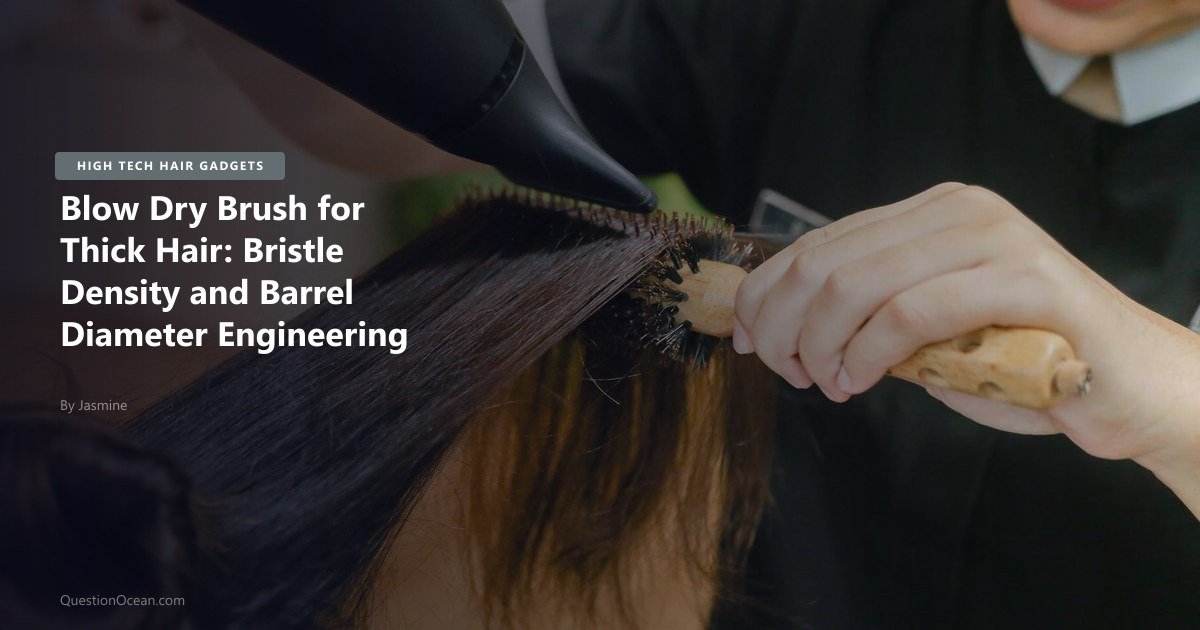
The blow-dry brush: a hybrid tool combining a round brush with an internal heat source and airflow: promises a salon-quality blowout in 15-25 minutes from a single device. The category exploded in 2018 with the launch of the Revlon One-Step Volumizer, and the 2026 market now includes dozens of variations across every price point. The challenge for thick-haired users is that most blow-dry brushes are engineered for fine-to-medium density hair, with bristle configurations and barrel diameters that physically cannot manage the volume and weight of dense, thick hair without snagging, overheating, or simply taking too long to deliver results. The best blow dry brush for thick hair must combine a 2.4-inch+ barrel diameter, mixed nylon and boar bristles in a high-density configuration, and at least 1100 watts of motor power to move enough air through dense hair sections.
This guide breaks down the bristle engineering, barrel physics, and motor specifications that determine whether a blow-dry brush will actually work on thick hair, plus the salon technique adaptations that compensate for thicker density.
For the broader high-tech tool landscape, see our pillar guide to the best high tech hair tools 2026.
Why Most Blow-Dry Brushes Fail on Thick Hair
The standard Revlon One-Step Volumizer (the most popular blow-dry brush on the market) was designed around fine-to-medium density hair specifications. When applied to thick hair, three failure modes emerge:
Failure mode 1, Insufficient airflow penetration: A 1100-watt motor moving air through a sparse-bristle barrel cannot push enough warm air through a thick hair section to dry the inner layers before the outer layers overheat. The result is the surface drying first while the underneath remains damp, requiring multiple passes that compound damage.
Failure mode 2. Section width too small: Standard 2.0-inch barrels cannot accommodate the cross-sectional area of a thick hair section. The brush either grabs only the top layer (leaving underneath wet) or fights against the density and creates frustrating tangles.
Failure mode 3 — Bristle gap too wide: Standard bristle configurations are spaced for medium-density hair. Thick hair filters through the gaps unevenly, creating bunching at the brush surface and uneven heat distribution.
The thick hair user’s actual experience: “It looks like it should work, the reviews are amazing, but on my hair it just blows hot air at the surface for 30 minutes and I end up with a frizzy mess that’s still damp underneath.”
This isn’t user error. It’s a tool engineering mismatch. Thick hair needs a tool engineered for its specific density requirements.
Bristle Density and Material Engineering
The bristle configuration on a blow-dry brush serves two functions: it grips and tensions the hair (the brush function) and it directs airflow against the hair surface (the dryer function). Both functions require different bristle properties.
Mixed bristle design (the gold standard for thick hair):
- Boar bristles (60-70% of total): Soft natural fibers that grip individual strands, distribute scalp oils through the length, and create the smoothing tension needed for a polished finish
- Nylon bristles (30-40% of total): Stiffer synthetic bristles that penetrate deeper into the hair section, lifting strands away from the barrel surface and allowing airflow to reach the hair from underneath
Why thick hair specifically needs both: Pure boar bristle brushes don’t create enough airflow channels through dense hair. Pure nylon brushes don’t grip thick hair well enough to maintain the tension needed for smoothing. The mixed configuration balances grip and airflow.
Bristle density (bristles per square inch):
| Brush Density | Best For | Performance on Thick Hair |
|---|---|---|
| Sparse (under 100/sq in) | Fine, thin hair | Poor, strands bunch and tangle |
| Medium (100-200/sq in) | Medium density hair | Marginal. Works slowly |
| High (200-300/sq in) | Thick, dense hair | Excellent, manages volume effectively |
| Ultra-high (300+/sq in) | Coarse, very thick hair | Best for extreme density |
The buyer’s check: Look at product photos closely. Premium thick-hair blow-dry brushes show visibly dense bristle coverage with no visible barrel surface between bristle clusters. Sparse-bristle brushes show large gaps where the metal or ceramic barrel is visible.
Blow Dry Brush for Thick Dense Hair
Barrel Diameter Physics
The barrel diameter of a blow-dry brush determines two critical things: how much hair it can handle per pass, and how much curl/wave it imparts versus how much smoothing.
Barrel diameter guide for thick hair:
| Barrel Diameter | Hair Length Range | Result |
|---|---|---|
| 1.5 inches | Shoulder-length thick hair | Tighter waves, more curl |
| 2.0 inches | Most thick hair lengths | Slight wave, mostly smoothing |
| 2.4 inches | Mid-back to long thick hair | Smooth blowout, slight bend |
| 2.8 inches | Long, thick, heavy hair | Maximum smoothing, minimal curl |
The physics: Larger barrels accommodate more hair per pass because the curved surface area is greater. They also produce less curl because the hair wraps less aggressively around the wider radius. For thick hair where the goal is usually a smooth blowout (not curls), the largest barrel that fits the hair length is typically the right choice.
The exception: If you want a curly or wavy blowout finish on thick hair, drop one barrel size. The increased section management of the smaller barrel matters more than the curl difference for thick hair.
Motor Power: The 1100W Minimum
Unlike standard hair dryers where wattage is misleading (CFM matters more than watts), blow-dry brushes use simpler centrifugal fans where wattage correlates closely with airflow volume.
Motor wattage guide for thick hair:
- Under 1000W: Insufficient for thick hair drying. Avoid.
- 1000-1100W: Acceptable for medium-thick hair. Marginal for very thick hair.
- 1100-1300W: Good for most thick hair types. The recommended range.
- 1300W+: Excellent for very thick or coarse hair. Worth the premium for difficult cases.
The trade-off: Higher wattage means heavier tool, more arm fatigue, and higher heat output (which requires more careful temperature monitoring). For thick hair, the higher wattage is worth the trade-off because the alternative is an underperforming tool that takes 30+ minutes per session.
For the relationship between heat exposure and damage prevention, see our guide to hot tools that don’t damage hair.
Top Blow-Dry Brushes for Thick Hair 2026
Revlon One-Step Volumizer Plus 2.0, $59 (US) / £49 (UK) / $79 (CA)
Specs: 2.4-inch oval barrel, mixed boar and nylon bristles, 1100W motor, 3 heat/speed settings.
Best for: Mid-thick hair shoulder-length to mid-back. The most popular blow-dry brush on the market, the larger 2.0 version specifically handles thicker hair than the original Revlon One-Step.
Limitations: Still struggles with extremely thick or coarse hair. Single brush head, no attachment versatility.
Drybar The Double Shot Oval, $155 (US) / £125 (UK) / $199 (CA)
Specs: 2.4-inch oval barrel, dense mixed bristles, 1100W motor, 3 settings, ceramic-coated barrel.
Best for: Thick hair users who want salon-grade build quality and the brand reputation of Drybar’s salon experience.
Limitations: Premium price for marginal performance improvement over the Revlon Plus 2.0.
Shark FlexStyle (with paddle brush attachment). $149 (US) / £129 (UK) / $189 (CA)
Specs: Multi-attachment system, dedicated thick-hair paddle brush attachment, high-speed motor (105,000 RPM), 4 temperature settings.
Best for: Thick hair users who want the multi-functionality of an attachment system rather than a dedicated single-purpose brush.
Advantage: The high-speed motor moves more air per pass than fixed-motor brushes, dramatically reducing styling time on thick hair.
For the complete Shark FlexStyle multi-styler comparison, see our Dyson Airwrap alternatives under $150 guide.
Salon Technique for Thick Hair Blowouts
Even with the right tool, technique matters. Salon blow-out specialists use specific techniques for thick hair that home users typically skip.
The Pre-Dry Step
Salon stylists rough-dry thick hair to 70-80% dry before introducing the brush. This is the single most important technique adaptation for thick hair.
Why: A blow-dry brush works best on damp (not wet) hair. Trying to dry soaking wet thick hair with a brush attachment takes 3-4x longer and produces frizz. Use a regular dryer on high speed with the head tilted forward (hair hanging down) for 5-8 minutes to remove excess water before switching to the brush.
The Sectioning Protocol
Thick hair must be sectioned before blow-drying with a brush. Working on the entire head at once creates frustration and uneven results.
Recommended sectioning:
- Part the hair horizontally at ear level
- Clip the upper section up
- Divide the lower section into 4-6 sub-sections (depending on density)
- Blow-dry each sub-section completely before moving to the next
- Drop the upper section and divide it into 6-8 sub-sections
- Blow-dry each sub-section completely
Time investment: 20-35 minutes for full thick-hair blowout. Less than this is rushing.
The Tension and Pull Technique
Hold each section taut with the brush: pull the brush slowly from roots to ends while applying tension against the airflow direction. The combined tension and heat is what creates the smooth, polished finish.
Common mistake: Moving the brush too fast through the section. Slow movement (about 3-4 inches per second) gives the heat time to reform the hydrogen bonds in the hair structure that create the smooth finish.
Frequently Asked Questions
Q: What is the best blow dry brush for thick hair? A: For most thick hair types, the Revlon One-Step Volumizer Plus 2.0 ($59) delivers the best value with its 2.4-inch oval barrel and mixed bristle configuration. For premium build quality, the Drybar Double Shot Oval ($155) offers comparable performance with salon-grade construction. For multi-functional needs, the Shark FlexStyle ($149) with the paddle brush attachment handles thick hair effectively.
Q: Do hot air brushes work on thick hair? A: Yes, but only specific models with the right specifications. Look for: 2.4-inch+ barrel diameter, mixed nylon and boar bristles in high density, 1100W+ motor power, and oval (not round) barrel shape. Standard hot air brushes designed for fine hair will not work effectively on thick hair regardless of effort.
Q: How long does a blow-dry brush take on thick hair? A: With proper pre-drying and sectioning technique, 20-35 minutes for a complete blowout on thick hair. Without pre-drying or sectioning, the time can extend to 45-60 minutes with worse results. The pre-dry step is non-negotiable for thick hair.
Q: Can blow-dry brushes damage hair? A: Like all heat tools, they can damage hair if used improperly. Stay below 365°F surface temperature, never use on soaking wet hair (the temperature shock damages the cuticle), and apply heat protectant before use. Quality blow-dry brushes with ceramic-coated barrels distribute heat more evenly than uncoated barrels, reducing hot-spot damage.
Q: What size barrel is best for thick hair? A: 2.4-inch barrels are the sweet spot for most thick hair lengths from shoulder to mid-back. Longer thick hair (mid-back to waist) benefits from 2.8-inch barrels. Shoulder-length or shorter thick hair can use 2.0-inch barrels. Avoid barrels under 2.0 inches for thick hair. The section management becomes too difficult.
Q: Why does my blow-dry brush leave my hair frizzy? A: Three common causes: (1) hair was too wet when starting (pre-dry to 70-80% first), (2) brush moved too fast through sections (slow down to 3-4 inches per second), or (3) bristle density too low for hair density (upgrade to a high-density mixed bristle brush). Apply a smoothing serum to damp hair before blow-drying to add slip and reduce friction frizz.
The best blow dry brush for thick hair combines specific engineering, wider barrel diameter, denser mixed bristles, and higher motor wattage, with technique adaptations that respect the hair’s density rather than fighting it. With the right tool and the proper pre-dry and sectioning protocol, a salon-quality blowout on thick hair is achievable in 20-35 minutes at home, eliminating the need for expensive salon visits while preserving hair health through controlled heat exposure.