
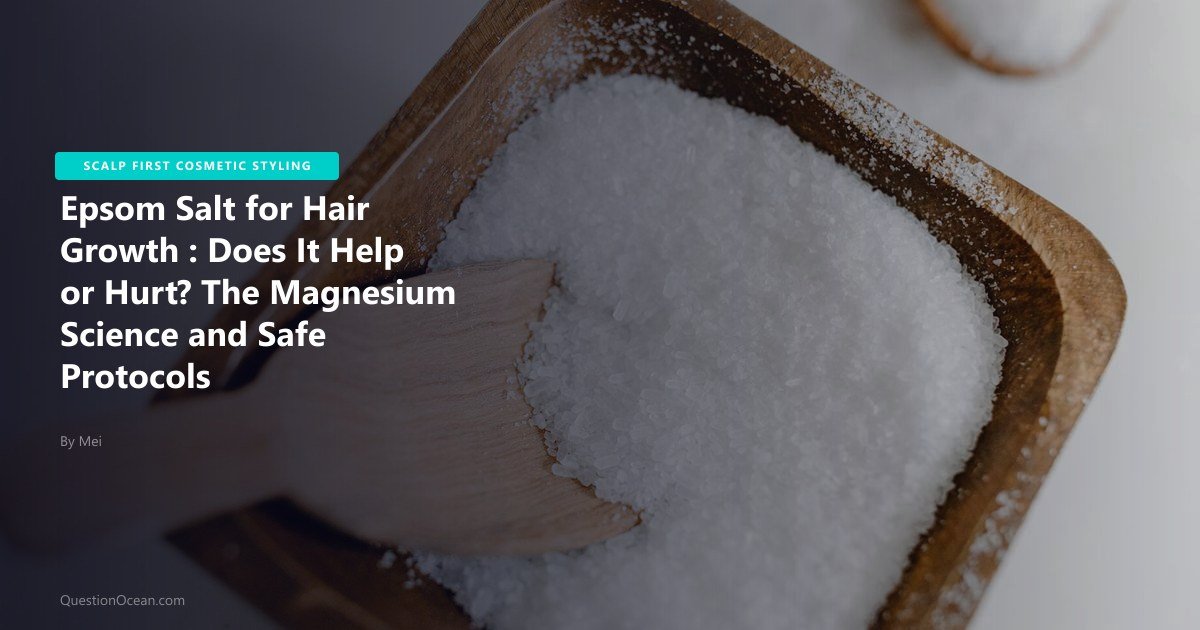
Epsom salt (magnesium sulfate, MgSO₄) appears in hair-care recommendations ranging from “miracle hair growth treatment” to “never put it near your hair”, and both extremes are wrong. The honest assessment is that epsom salt provides two legitimate scalp benefits, magnesium delivery (a mineral involved in hundreds of enzymatic processes including hair follicle cycling) and gentle physical exfoliation that removes scalp buildup, but it also strips natural oils, raises cuticle porosity, and can dehydrate hair when used too frequently or in too-high concentrations, making the protocol (concentration, frequency, application method) the difference between benefit and damage. This guide covers the magnesium science, the safe protocols, the 3 recipes that work, and the situations where epsom salt should be avoided entirely.
The Magnesium Science
Last updated: May 8, 2026
Magnesium is involved in:
- Protein synthesis (hair is 90% protein/keratin)
- Cell division in the hair follicle bulb
- Inflammation regulation (chronic scalp inflammation impairs hair growth)
- Stress hormone modulation (cortisol is a documented hair-loss trigger)
Magnesium deficiency affects an estimated 50% of the US/UK/Canadian population, making it one of the most common mineral deficiencies. Whether topical magnesium (applied to the scalp via epsom salt) absorbs meaningfully through the skin is debated. Some studies show modest transdermal absorption, while others show negligible amounts.
Bottom line: Epsom salt on the scalp probably delivers some magnesium, but the primary benefits come from the exfoliation and the oil-stripping action, not the magnesium delivery.
The 3 Benefits of Epsom Salt for Scalp/Hair
Benefit 1: Scalp Exfoliation
The granular texture of dissolved (but not fully dissolved) epsom salt crystals provides gentle physical exfoliation. This removes:
- Dead skin cells
- Sebum buildup
- Product residue
- Malassezia yeast colonies (associated with dandruff)
Benefit 2. Volume and Texture
Epsom salt temporarily roughens the cuticle and absorbs excess oil. This creates volume, texture, and body. The same principle behind salt sprays for beachy waves.
Benefit 3, Possible Magnesium Delivery
If transdermal absorption is real (debated), the magnesium may support follicle health by participating in protein synthesis and reducing inflammation.
The 3 Risks of Epsom Salt on Hair
Risk 1, Dehydration
Magnesium sulfate is hygroscopic, it absorbs water. On hair, this means it pulls moisture out of the shaft, leaving hair dry, rough, and brittle.
Risk 2, Cuticle Roughening
The physical abrasion of salt crystals and the oil-stripping action lift the cuticle, increasing porosity. For already high-porosity or damaged hair, this compounds existing damage.
Risk 3. Color Fading
The cuticle-lifting effect opens the shaft to color molecule escape. Color-treated hair fades faster with regular epsom salt use.
The 3 Safe Protocols
Protocol 1, Epsom Salt Scalp Scrub (Best Use)
Ingredients:
- 2 tablespoons epsom salt (fine grain)
- 2 tablespoons sulfate-free shampoo
- 1 tablespoon jojoba oil (to offset dehydration)
Method:
- Mix into a paste
- Apply to wet scalp only (NOT the lengths)
- Massage gently with fingertips for 2 minutes
- Rinse thoroughly
- Deep condition immediately after
Frequency: Once every 2 weeks maximum Best for: Scalp buildup, oily scalps, dandruff
Protocol 2 — Epsom Salt Volume Rinse
Ingredients:
- 1 tablespoon epsom salt
- 1 cup warm water
Method:
- Dissolve salt completely in water
- After shampooing and conditioning, pour over the scalp and lengths
- Leave for 2 minutes
- Rinse with cool water
- Apply a leave-in conditioner to the lengths
Frequency: Once every 2 weeks maximum Best for: Fine, limp hair needing volume
Protocol 3. Epsom Salt Pre-Shampoo Treatment
Ingredients:
- 1 tablespoon epsom salt
- 2 tablespoons coconut oil (melted)
Method:
- Mix salt into oil
- Apply to scalp only
- Massage for 3 minutes
- Leave for 10 minutes
- Shampoo normally (may need 2 washes to remove oil)
Frequency: Once every 2 weeks Best for: Scalp exfoliation with built-in moisture protection
Who Should NOT Use Epsom Salt on Hair
- Color-treated hair (accelerates fading)
- High-porosity or damaged hair (worsens dehydration and cuticle roughness)
- Chemically relaxed hair (too harsh for compromised cuticles)
- Dry, brittle hair (epsom salt dehydrates further)
- Sensitive or inflamed scalps (salt on broken skin causes stinging and irritation)
- Anyone using it more than every 2 weeks (cumulative damage)
Epsom Salt vs Sea Salt vs Table Salt for Hair
| Salt Type | Composition | Hair Effect | Recommendation |
|---|---|---|---|
| Epsom salt | Magnesium sulfate | Exfoliation + possible Mg delivery | Best for scalp scrubs |
| Sea salt | Sodium chloride + minerals | Texture + volume, more drying | Best for texture sprays |
| Table salt | Sodium chloride (refined) | Most stripping, no mineral benefit | Avoid for hair use |
| Dead Sea salt | NaCl + Mg + K + Ca | Similar to sea salt, more mineral-rich | Expensive, marginal benefit |
| Himalayan pink salt | NaCl + trace minerals | Marketing-driven, similar to sea salt | No meaningful advantage |
Common Epsom Salt Mistakes
Mistake 1: Using it weekly or more. Every 2 weeks is the maximum safe frequency. More causes cumulative dehydration.
Mistake 2: Applying to the lengths, not just the scalp. The benefits are scalp-focused. The lengths get the damage (cuticle roughening, dehydration) without the benefit.
Mistake 3: Not conditioning after. Always deep condition after any salt treatment to restore moisture stripped during exfoliation.
Mistake 4: Using coarse crystals without dissolving. Large crystals create micro-tears in the scalp. Use fine-grain or partially dissolve before applying.
Mistake 5: Expecting hair growth. No clinical evidence supports epsom salt as a hair growth treatment. It supports scalp health (exfoliation, buildup removal) which may indirectly improve conditions for growth.
Frequently Asked Questions
Q: Does epsom salt help hair growth? A: Indirectly at best. Epsom salt exfoliates the scalp and removes buildup, creating a healthier environment for hair follicles. It doesn’t stimulate hair growth directly. No clinical studies support epsom salt as a hair growth treatment.
Q: Can epsom salt damage hair? A: Yes, when used too frequently (more than every 2 weeks), in too-high concentrations, or on the lengths instead of just the scalp. The dehydrating and cuticle-roughening effects cause damage to already dry, damaged, or color-treated hair.
Q: How often should I use epsom salt on my hair? A: Maximum once every 2 weeks, applied to the scalp only, followed by deep conditioning. More frequent use causes cumulative dehydration.
Q: Is epsom salt good for dandruff? A: The exfoliation removes visible flakes and buildup, providing short-term relief. For the underlying Malassezia yeast that causes most dandruff, a medicated shampoo (ketoconazole, zinc pyrithione) is more effective. Epsom salt is a cosmetic fix, not a treatment.
Q: Can I add epsom salt to my shampoo? A: Yes. The scalp scrub recipe above (2 tbsp epsom salt + 2 tbsp shampoo + 1 tbsp oil) is the safest application method. Don’t add salt to the bottle permanently; mix fresh each time.
Q: Does epsom salt remove hair color? A: Yes, the cuticle-lifting effect allows dye molecules to escape. Avoid epsom salt on color-treated hair.
Q: Is epsom salt the same as regular salt? A: No, epsom salt is magnesium sulfate (MgSO₄), while regular table/sea salt is sodium chloride (NaCl). They have different chemical compositions and different effects on hair.
Q: Can I soak my hair in epsom salt water? A: Not recommended, soaking exposes the entire hair shaft to dehydration for an extended period. The scalp scrub (applied to scalp only, 2-3 minutes) is the safer approach.
Epsom salt has a narrow but real role in hair care: scalp exfoliation and buildup removal, applied to the scalp only, every 2 weeks maximum, followed by deep conditioning. The hair growth claims are overblown, but the scalp health benefits are legitimate when used correctly.
For the dedicated scalp scrub guide, see our cosmetic scalp scrubs guide.