
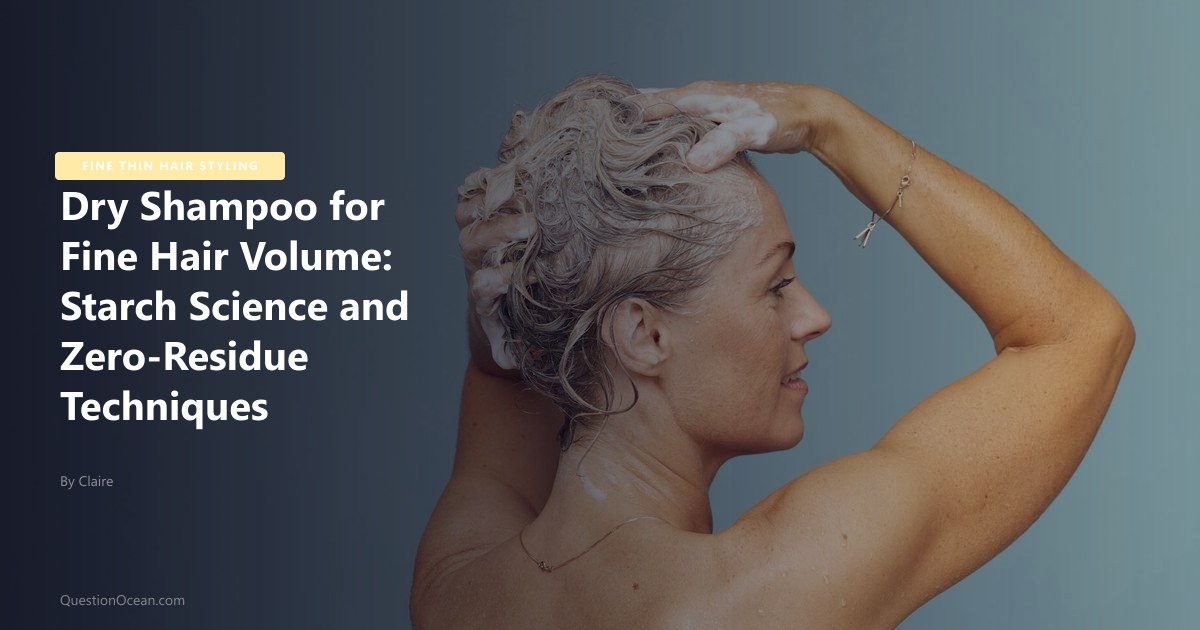
Rice starch absorbs 1.5 times its weight in oil. Roughly three times the absorption rate of talc-based dry shampoos from a decade ago. That absorption capacity is what makes a modern dry shampoo for fine hair volume the single most effective between-wash product for maintaining root lift past day one. The starch particles land at the base of each strand, absorb the sebum that weighs fine hair down, and create a grip-based texture that physically props the root upward.
This guide covers the starch science behind volumizing dry shampoos, the aerosol physics that determine application distance, and the scalp cleansing protocols that prevent the buildup problem that turns a volume tool into a flat, chalky liability.
Rice Starch vs. Tapioca Starch: Which Delivers More Volume
The starch base in a dry shampoo for fine hair volume determines both its oil absorption strength and the texture it leaves on the strand. The two dominant starches in 2026 formulations: rice and tapioca, produce measurably different results on fine hair.
Rice Starch (Oryza Sativa Starch)
Rice starch is the superior volumizing starch for fine hair because its granule size (2-8 microns) and angular shape create maximum inter-strand friction. When rice starch granules land on two adjacent strands at the root, their angular edges lock against each other: preventing the strands from lying flat and parallel. This friction-based separation is the mechanical principle behind the volume boost.
Rice starch also absorbs sebum more aggressively than tapioca, removing the oil-based weight that flattens fine hair within 12-18 hours after washing. The combined effect, friction for separation plus oil absorption for weight reduction, makes rice starch the preferred base for volumizing dry shampoos.
The trade-off is visibility. Rice starch particles are bright white and opaque. On medium to dark hair, incorrect application produces visible white residue at the roots. A problem covered in the application distance section below.
Tapioca Starch (Manihot Esculenta Starch)
Tapioca starch has a larger granule size (10-20 microns) and a rounder shape than rice starch. The rounded granules create less inter-strand friction, which means less mechanical volume boost. However, tapioca starch becomes translucent faster after application, reducing visible residue on dark hair within 2-3 minutes of massaging versus 5-7 minutes for rice starch.
Tapioca-based dry shampoos are best for fine-haired users who prioritize invisible application over maximum volume lift. The oil absorption is adequate (though roughly 30% less aggressive than rice starch), and the translucent finish works well for dark brunette and black hair where white residue is the primary concern.
The Best Formulation: Combined Starches
The most effective 2026 dry shampoo for fine hair volume formulas combine rice and tapioca starch. Rice starch provides the volumizing friction, and tapioca starch accelerates the translucent finish. Look for products that list both starches in the first five ingredients: this indicates a volumizing formula designed for both performance and invisible wear.
Our complete fine hair styling guide positions dry shampoo as the primary between-wash maintenance product in the fine-hair toolkit, used alongside lightweight hold sprays and texturizing products.
Aerosol Physics: Why Application Distance Controls Everything
The distance between the aerosol nozzle and your scalp determines whether dry shampoo for fine hair volume produces invisible, volumizing results or leaves a visible chalky coating that looks worse than unwashed roots.
The optimal application distance for aerosol dry shampoo on fine hair is 8-10 inches from the scalp. At this distance, the propellant gas (typically butane, isobutane, or propane) has fully dispersed, allowing the starch particles to separate into an even, fine mist that lands individually on each strand rather than concentrating in a wet, heavy patch.
What Happens at Different Distances
- 2-4 inches (too close): The propellant has not fully evaporated. The starch lands in a concentrated, wet clump mixed with liquid propellant. This creates visible white patches, a heavy paste-like texture at the root, and zero volume benefit. The wet patch takes 5-10 minutes to dry and often leaves a permanent chalky residue that cannot be massaged away.
- 5-7 inches (marginally close): The propellant has partially dispersed. Starch distribution is uneven: some areas receive too much product while adjacent areas receive none. Volume benefit is inconsistent.
- 8-10 inches (optimal): Full propellant dispersal. Starch particles land individually and evenly across the root zone. The dry powder absorbs oil immediately, creates friction between strands, and becomes invisible within 2-3 minutes of massaging.
- 12+ inches (too far): Too much starch disperses into the air before reaching the scalp. Product waste increases by 40-60%, and insufficient starch reaches the root zone for meaningful oil absorption.
The Two-Second Burst Technique
Rather than holding the nozzle down in a continuous spray, use the two-second burst method:
- Hold the can 8-10 inches from the scalp, angled at the root of a section
- Press the nozzle for exactly 2 seconds, then release
- Move to the next section (2-3 inches along the part line)
- Press for another 2-second burst
- Continue across 4-5 sections at the crown and part line
- Wait 60 seconds for the starch to absorb oil
- Massage the roots with your fingertips using a pressing and lifting motion. Not rubbing
The 60-second wait before massaging is non-negotiable for fine hair. Starch particles need time to absorb the sebum at the root before you disturb them. Massaging immediately smears the still-dry starch across the surface of the hair, creating visible residue. Waiting allows the starch to bond with oil first, after which the massage distributes the absorbed starch-oil compound invisibly into the root zone.
Dry Shampoo for Fine Hair, rice and tapioca starch volumizing formula
Which Dry Shampoo Gives the Most Volume?
Rice starch-based aerosol dry shampoos applied at the correct 8-10 inch distance produce the most volume on fine hair. Among 2026 formulations, products that combine rice starch with silica (a lightweight volumizing mineral) deliver the strongest lift because silica acts as a spacer particle between strands, physically propping them apart at the root.
The volume hierarchy for dry shampoo types on fine hair:
- Most volume: Rice starch + silica aerosol (e.g., Batiste Volume, Klorane with Oat Milk)
- Strong volume: Rice starch-only aerosol (e.g., Living Proof Perfect Hair Day)
- Moderate volume: Tapioca + rice blend aerosol (e.g., Amika Perk Up)
- Light volume: Tapioca-only aerosol or powder (e.g., Drybar Detox)
- Minimal volume: Talc-based or clay-only formulas (heavier particle weight reduces the lift-to-weight ratio)
Powder-format dry shampoos (loose powder in a shaker bottle rather than aerosol) offer an alternative for users who prefer non-aerosol application. These require careful tapping to control the amount dispensed, a single over-tap can deposit 3-4 times the amount needed, creating heavy residue that adds weight rather than removing it.
For how dry shampoo integrates with other volume-building products in the fine-hair routine, texturizing sprays that work on fine hair covers the layering sequence where dry shampoo absorbs oil first and texturizing spray adds hold and separation on top.
Scalp Cleansing Regimens to Prevent Buildup
Dry shampoo for fine hair volume works brilliantly for 2-3 days between washes. Beyond that threshold, starch accumulation at the scalp creates a coating that blocks fresh product from reaching the strand and adds cumulative weight that defeats the volumizing purpose.
The buildup cycle: Day 1 wash, Day 2-3 dry shampoo (volume boost), Day 4 dry shampoo (diminishing returns as starch layers compound), Day 5+ dry shampoo (actively weighing hair down, creating scalp coating that traps oil underneath).
The Clarifying Reset Schedule
Fine-haired dry shampoo users should incorporate a clarifying shampoo into their wash rotation once every 7-10 days. This single clarifying wash strips all accumulated starch, polymer residue from other styling products, and mineral deposits: returning the hair to a zero-buildup baseline.
The clarifying schedule:
- Every 7 days for heavy dry shampoo users (applying dry shampoo 3-4 times between washes)
- Every 10 days for moderate users (applying dry shampoo 1-2 times between washes)
- Follow every clarifying wash with a lightweight conditioner on the mid-shaft and ends to restore moisture stripped by the sulfate-based clarifying formula
Between-Clarifying Maintenance
On regular wash days (non-clarifying), focus the shampoo application on the scalp rather than the lengths. Use your fingertips to massage the shampoo into the root zone for 60 seconds, this mechanical action combined with surfactant chemistry lifts the majority of dry shampoo residue without requiring a full clarifying-strength formula.
For users who build wash-day routines around complete scalp cleansing protocols, the guide to wash day optimization for lasting styles covers the full cleansing-to-styling sequence that maximizes the number of days between washes while preventing the buildup that makes dry shampoo stop working.
Powder vs. Aerosol: Choosing the Right Format
Aerosol Advantages for Fine Hair
- Even distribution when applied at 8-10 inches
- Quick application time (under 60 seconds for full crown coverage)
- Propellant assists in dispersing starch particles across a wider area
- Available in tinted formulas (dark brown, red, blonde) for invisible application on colored hair
Powder Advantages for Fine Hair
- More precise control over the amount applied, tap exactly the amount needed, no propellant overspray
- Longer product lifespan per container (no propellant wasted)
- Travel-friendly, no aerosol restrictions on carry-on luggage for US/UK/CA flights
- Often contain higher starch concentrations without filler ingredients
The Recommendation
Aerosol dry shampoo for fine hair volume is the better choice for daily root volume maintenance at home. The even distribution and controlled application distance produce more consistent results. Powder format is better for travel, touch-ups outside the home, and users who have mastered precise dispensing technique.
Volumizing Dry Shampoo Powder: fine hair formula, travel-friendly
Application Mistakes That Kill Volume on Fine Hair
Even the best dry shampoo for fine hair volume fails when applied incorrectly. These common mistakes produce the opposite of the intended result:
- Applying to freshly washed hair. Dry shampoo needs some oil at the root to activate its absorption mechanism; apply on day two at the earliest for maximum volume effect
- Over-applying and not waiting. More product does not equal more volume; excess starch adds weight that collapses lift
- Brushing through immediately, brushing distributes the concentrated root starch down the hair shaft, creating an overall dull, chalky look and removing the root-specific volume
- Spraying on the lengths. Dry shampoo belongs exclusively at the roots; applying to mid-shaft or ends dehydrates and dulls fine hair
- Skipping clarifying washes, starch buildup after 5+ applications creates a barrier that traps oil at the scalp while adding weight to the strand
For mousse-based wash-day volume that pairs with dry shampoo maintenance, weightless volumizing mousses covers formulas that create day-one lift which dry shampoo then refreshes on days two through four.
Frequently Asked Questions
Q: Which dry shampoo gives the most volume? A: Rice starch-based aerosol formulas combined with silica produce the most volume on fine hair. Products like Batiste Volume and Klorane with Oat Milk use this combination. Apply at 8-10 inches from the scalp and wait 60 seconds before massaging for maximum lift.
Q: How often can I use dry shampoo on fine hair? A: Use dry shampoo 2-3 times between washes for consistent volume without excessive buildup. Beyond 3 applications, starch accumulation adds weight that counteracts the volumizing benefit. Incorporate a clarifying shampoo every 7-10 days to reset.
Q: Does dry shampoo cause buildup on fine hair? A: Starch-based dry shampoo accumulates at the scalp over multiple applications. A regular clarifying shampoo (every 7-10 days for heavy users) removes accumulated starch and restores the clean baseline fine hair needs for maximum volume.
Q: Should I apply dry shampoo before or after styling? A: Apply dry shampoo to day-two or day-three roots before restyling. The starch absorbs oil and adds grip, creating a better foundation for second-day volume. Applying after styling deposits starch on top of finished hair, which can create visible residue.
Q: What is the best dry shampoo for dark fine hair? A: Choose a tinted formula (dark brown or brunette shade) or a tapioca-based formula that turns translucent quickly. Rice starch formulas work on dark hair when applied at the correct 8-10 inch distance and massaged thoroughly after a 60-second absorption wait.
Q: Can dry shampoo replace regular washing for fine hair? A: Dry shampoo extends the time between washes by 1-3 days but cannot replace washing entirely. Fine hair produces visible oil at the root within 24-48 hours, and dry shampoo absorbs this oil cosmetically — but the starch itself accumulates and requires periodic removal with actual cleansing.
The right dry shampoo for fine hair volume transforms the gap between wash days from a period of progressive volume collapse into maintained, refreshed lift. Rice and tapioca starch formulas applied at the correct distance, in controlled two-second bursts, with proper scalp cleansing to prevent buildup, give fine-haired textures 4-5 days of visible root volume from a single wash.