
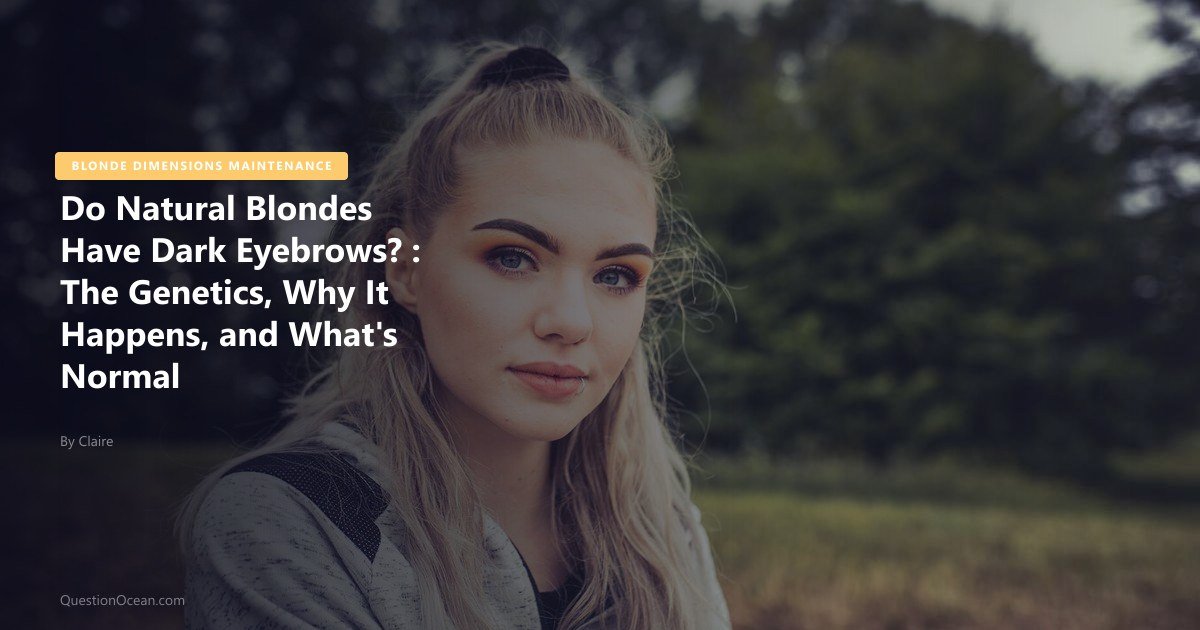
Quick answer: Yes, many natural blondes have eyebrows that are noticeably darker than their head hair. This is genetically normal and common. Eyebrow hair and scalp hair are controlled by overlapping but distinct genetic pathways for melanin production. Eyebrow follicles tend to produce more eumelanin (the dark pigment) than scalp follicles, even in people who are naturally blonde. Eyebrows that are 1-3 shades darker than head hair is the norm for natural blondes, not the exception.
Why Eyebrows Are Darker Than Head Hair
Last updated: August 2, 2026
Hair color varies across the body because different follicle groups have different levels of melanocyte activity. Melanocytes are the cells that produce melanin, and their output isn’t uniform, they produce different amounts of pigment depending on which part of the body they’re located in.
Scalp hair follicles in natural blondes produce low amounts of eumelanin and moderate amounts of pheomelanin (the lighter, warmer pigment). This combination produces blonde.
Eyebrow follicles tend to have higher melanocyte activity than scalp follicles, even in the same person. The eyebrow melanocytes produce more eumelanin than the scalp melanocytes, resulting in a darker shade.
This is similar to how arm hair, leg hair, and pubic hair are often darker than head hair. Each region has its own melanin production level.
How Common Is It?
Surveys of natural blonde populations show that the majority have eyebrows darker than their head hair:
| Eyebrow vs Head Hair | Approximate Percentage of Natural Blondes |
|---|---|
| Eyebrows same shade as head hair | 10-15% |
| Eyebrows 1-2 shades darker | 50-60% |
| Eyebrows 2-3 shades darker (light brown) | 25-30% |
| Eyebrows significantly darker (medium-dark brown) | 5-10% |
A natural blonde with light brown eyebrows is the most typical combination. A natural blonde with eyebrows that exactly match their head hair color is actually less common.
The Genetics Behind It
Multiple genes influence hair color, and they don’t all act uniformly across the body. The key genes involved:
MC1R (Melanocortin 1 Receptor): The primary gene associated with blonde and red hair. MC1R variants reduce eumelanin production in scalp hair. But the MC1R gene’s effect on eyebrow follicles is less pronounced, eyebrow melanocytes are less sensitive to MC1R variants, so they still produce moderate eumelanin even when scalp hair is light.
OCA2 and HERC2: These genes influence the overall level of melanin production. Variants that produce blonde hair still allow higher melanin production in eyebrow follicles.
KITLG: Associated with blonde hair specifically in European populations. Like MC1R, its effect varies by body region.
The result is a mosaic pattern: your body is a patchwork of follicle groups with different melanin outputs, all controlled by the same genes but expressed differently depending on location.
The Age Factor
Eyebrow color in natural blondes often darkens with age, following the same pattern as head hair but more pronounced:
- Childhood (0-10): Both head hair and eyebrows are lightest. Eyebrows may be barely visible.
- Adolescence (10-18): Eyebrows darken noticeably as melanocyte activity increases. Head hair also darkens but typically lags behind eyebrow darkening.
- Adulthood (18-40): Eyebrows stabilize at their darkest. Head hair may be medium to dark blonde while eyebrows are light to medium brown.
- Middle age (40+): Both may begin lightening as melanocyte activity declines, eventually turning gray.
This developmental timeline means a child who has blonde eyebrows may have notably darker eyebrows as an adult while still being a natural blonde.
Dark Eyebrows: Natural Blonde or Dyed Blonde?
People often assume that blonde hair with dark eyebrows means the hair is dyed. While dark eyebrows can be one indicator of colored hair, it’s not reliable on its own because most natural blondes genuinely have darker eyebrows.
Signs that dark brows + blonde hair is natural:
- The brows are light brown (1-3 shades darker than head hair), not dark brown or black
- Body hair (arms, fingers) is also light
- The blonde hair has multi-tonal natural variation
- No visible root line or grow-out
Signs that dark brows + blonde hair may be dyed:
- The brows are very dark (dark brown to black) with very light blonde head hair
- A visible demarcation line at the roots
- Uniform, single-tone blonde color
- Hair texture shows chemical processing (dry, coarse)
For a full breakdown, see our guide to identifying natural blonde hair.
Should Natural Blondes Lighten Their Eyebrows?
This is purely a personal preference. The options:
Leave them natural. Darker eyebrows actually frame the face well and create definition. Many makeup artists and stylists argue that eyebrows 1-2 shades darker than head hair is the most flattering look, as matching eyebrows to very light blonde hair can make features look washed out.
Tint them lighter. Brow tinting ($15-25 at a salon, $8-12 for an at-home kit) lightens brows to better match head hair. Lasts 3-4 weeks. A subtle lightening (not matching exactly, just reducing the contrast) often looks most natural.
Bleach them. Brow bleaching lightens eyebrows significantly. Riskier than tinting because the bleach is near the eyes. Professional application is recommended. Results last until new growth comes in (3-4 weeks).
Use makeup. A blonde brow pencil or powder over natural brows lets you adjust the shade daily. Most flexible option, zero commitment.
Cultural Perception
The “blondes should have light eyebrows” assumption is largely a media construct. In film and television, characters cast as “blonde” often have their eyebrows lightened to match. This creates the impression that matched brows and hair is the natural state, when the reality is that mismatched is far more common.
In recent years, the “dark brow + blonde hair” look has become a recognized and intentional style choice (think Cara Delevingne). The contrast between dark brows and light hair creates a striking frame for the face that many people deliberately cultivate.
Frequently Asked Questions
Q: Do natural blondes have dark eyebrows? A: Most natural blondes have eyebrows that are 1-3 shades darker than their head hair. Eyebrow follicles produce more melanin than scalp follicles in the same person. This is genetically normal.
Q: Why are my eyebrows darker than my blonde hair? A: Eyebrow melanocytes have higher activity than scalp melanocytes, even in people with blonde hair genes. The genes that reduce melanin in scalp hair have a weaker effect on eyebrow follicles.
Q: Is it weird to have blonde hair and brown eyebrows? A: No — it’s the most common combination for natural blondes. Roughly 80-90% of natural blondes have eyebrows darker than their head hair.
Q: Should I dye my eyebrows to match my blonde hair? A: Personal preference. Many stylists recommend keeping eyebrows 1-2 shades darker than head hair for facial definition. Matching exactly can look washed out, especially on fair skin.
Darker eyebrows on a natural blonde is the biological default, not an anomaly. Embrace the contrast or adjust it, but don’t assume it means the blonde isn’t natural.