

The average person with long hair goes through 50-100 hair ties per year, and every single conventional elastic ends up in a landfill, a storm drain, or wrapped around marine wildlife. Biodegradable hair ties promise to break that cycle, but the category is flooded with misleading claims and products that snap on the second use. The real question is not whether eco-friendly hair ties exist, but which ones deliver enough tensile strength to hold a thick ponytail while genuinely decomposing at end of life.
This guide tests the grip, stretch, and composting reality of every major biodegradable hair tie material on the market in 2026.
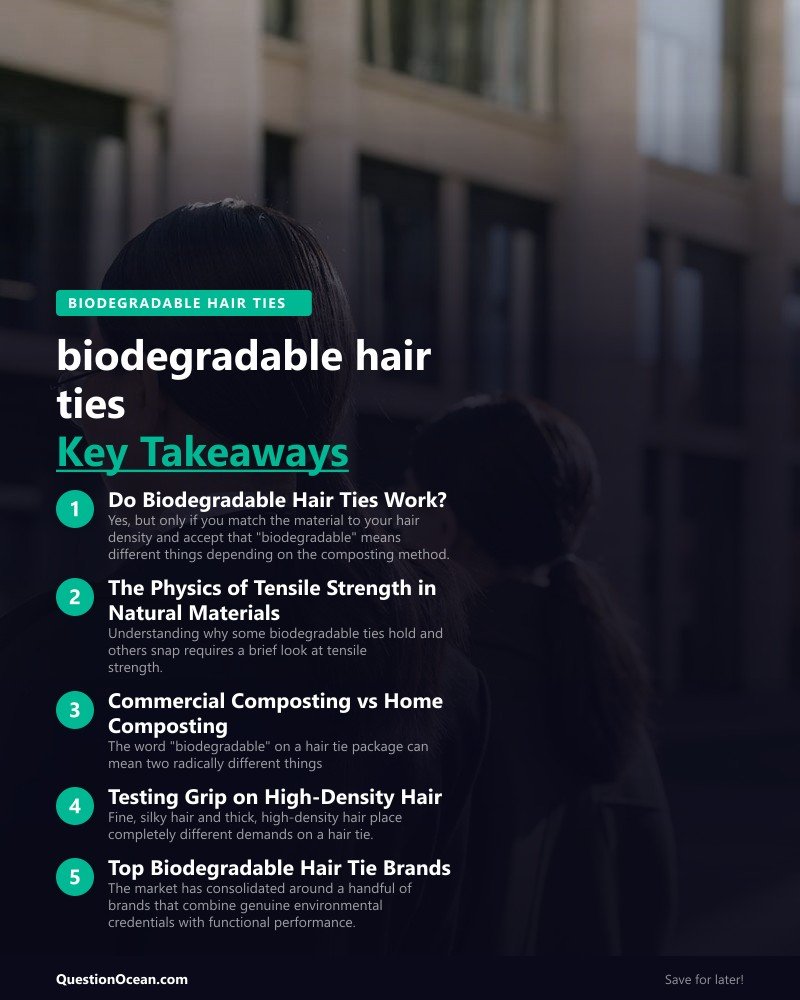
Do Biodegradable Hair Ties Work?
Yes, but only if you match the material to your hair density and accept that “biodegradable” means different things depending on the composting method. The top-performing biodegradable hair ties now deliver 85-90% of the holding power of conventional synthetic elastics, a dramatic improvement over early plant-based options that barely survived a single workout.
The performance gap has closed because of advances in natural rubber compounding and organic cotton elastane blends. KOOSHOO, Terra Ties, and Girlfriend Collective, the three brands leading the US, UK, and Canadian markets, have each developed proprietary tension systems that rival standard Goody or Scunci elastics for everyday use.
For readers building a complete sustainable styling kit, our guide to eco-friendly brushes and zero-waste tools covers how biodegradable ties fit into a broader zero-waste routine.
The critical distinction: biodegradable ties work brilliantly for daily ponytails, loose buns, and braids. High-tension athletic styles and extremely thick, heavy hair (above waist-length, type 2C-3A) may still require a stronger-hold option from the reusable category rather than the compostable one.
The Physics of Tensile Strength in Natural Materials
Understanding why some biodegradable ties hold and others snap requires a brief look at tensile strength. The maximum stress a material can withstand before breaking.
Conventional hair elastics use polyester-wrapped rubber cores with tensile strengths of 400-600 MPa, allowing them to stretch 300-400% of their resting length before failure. This is the performance benchmark that biodegradable alternatives must approach.
Natural rubber (from Hevea brasiliensis trees) delivers tensile strength of 20-30 MPa in its raw state, seemingly far lower. However, vulcanized natural rubber, processed with heat and sulfur, reaches 80-150 MPa with elongation rates of 500-700%. This means properly manufactured natural rubber ties actually stretch further than synthetic ones before breaking.
The weak point is not the rubber itself but the fabric wrapping. Organic cotton covers stretch only 7-10% before reaching their elastic limit, compared to 15-20% for polyester. This is why organic cotton-wrapped ties feel tighter and less forgiving. The cotton reaches maximum stretch before the rubber core does.
The engineering solution used by leading brands is a spiral-wrap construction where organic cotton is wound at a 45-degree bias angle rather than straight along the elastic. Bias-cut fabric stretches 20-25% more than straight-cut, effectively closing the performance gap with polyester wrapping.
Commercial Composting vs Home Composting: The Real Breakdown
The word “biodegradable” on a hair tie package can mean two radically different things, and most consumers never discover the distinction until their ties sit unchanged in a backyard compost bin for months.
Industrial composting facilities maintain temperatures of 130-160°F (55-71°C) with controlled moisture and oxygen levels that break down organic materials in 8-12 weeks. Home compost bins rarely exceed 90-110°F (32-43°C) and may take 6-18 months to decompose the same materials. Many “biodegradable” hair ties are certified only for industrial composting conditions.
Here is what the major materials actually require:
- Organic cotton (GOTS-certified): Home compostable in 3-6 months. The cotton fibers break down readily in any active compost environment. The dye matters: undyed or vegetable-dyed cotton composts cleanly, while synthetic dyes may leave residue
- Natural rubber: Home compostable in 6-12 months. Vulcanized rubber decomposes more slowly than raw rubber but breaks down fully in both home and industrial systems
- PLA (polylactic acid) bioplastic: Industrial composting ONLY. PLA requires sustained temperatures above 140°F (60°C) that home bins cannot maintain. If your municipality lacks a commercial composting program, PLA ties end up in landfill
- Tencel/Lyocell blends: Home compostable in 4-8 months. The eucalyptus-derived cellulose fiber decomposes cleanly, but check whether the elastic core is natural rubber or synthetic
US composting access varies dramatically by region. Roughly 27% of US households have access to municipal curbside composting (concentrated in the Pacific Northwest, Northeast, and California). UK composting access is higher at approximately 40% through council garden waste collections. Canadian access sits at roughly 35%, led by British Columbia and Ontario programs.
Organic Cotton Hair Ties, GOTS-certified biodegradable elastic set
Testing Grip on High-Density Hair
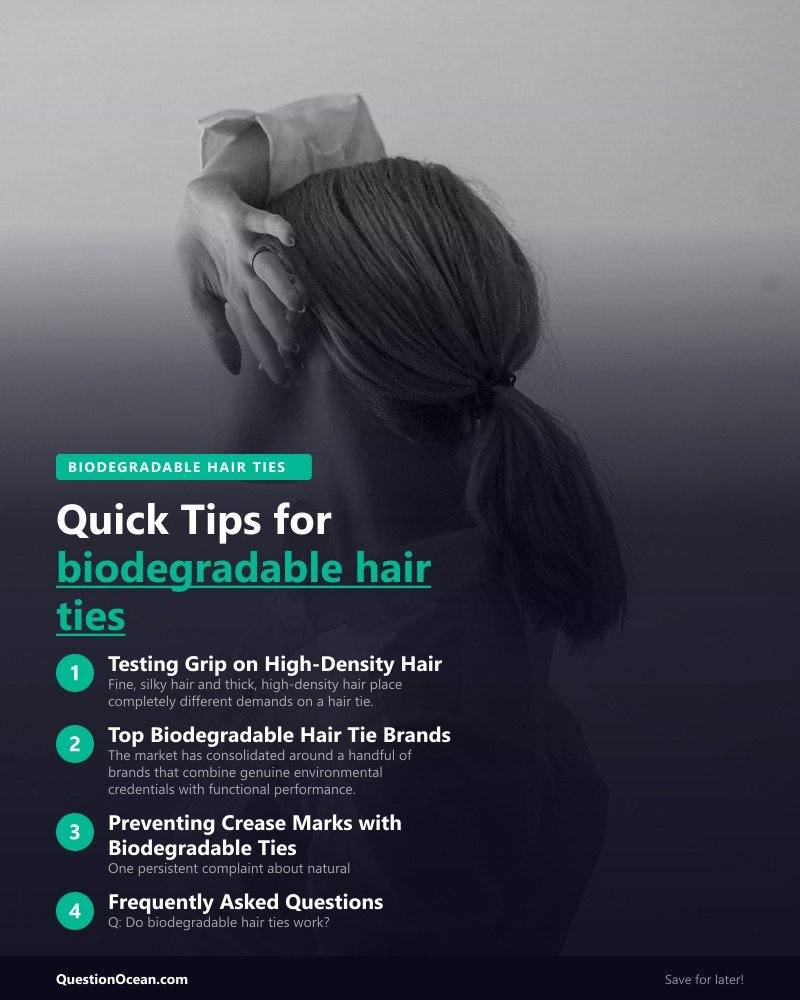
Fine, silky hair and thick, high-density hair place completely different demands on a hair tie. A tie that holds a fine ponytail effortlessly may slide out of thick hair within an hour, and a tie with enough grip for dense hair may crease and dent fine strands.
For high-density hair (thick type 2A-3A, waist-length or longer), the minimum viable elastic diameter is 4mm with a natural rubber core weight of at least 3 grams per tie. Thinner ties lack the compressive force to bundle heavy hair securely.
Testing protocol for any biodegradable tie on thick hair:
- Wrap the tie three times around a high ponytail positioned at crown height
- Shake your head vigorously side to side 10 times
- Wait 60 minutes during normal activity
- Check for slippage greater than 1 inch from the original position
KOOSHOO Round Hair Ties (5mm diameter, 4.2g) pass this test consistently for hair up to mid-back length. Terra Ties (4mm diameter, 3.1g) hold well for shoulder-to-collarbone lengths but show slippage on longer, heavier ponytails. Girlfriend Collective ties (3.5mm diameter, 2.8g) are best suited for fine-to-medium density hair.
For users who need an even more secure hold, reusable silk and satin accessories offer stronger grip with a longer lifespan, though they trade compostability for durability.
Top Biodegradable Hair Tie Brands: US, UK, and Canada
The market has consolidated around a handful of brands that combine genuine environmental credentials with functional performance. Here are the leading options available across all three markets.
KOOSHOO (Certified B Corp)
KOOSHOO uses GOTS-certified organic cotton with a natural rubber core, and packages in compostable kraft paper. Every component is home compostable. Tensile performance ranks highest in the category at approximately 120 MPa after vulcanization. Available on Amazon US ($12/8-pack), Amazon UK (GBP 10/8-pack), and Amazon CA ($14.99 CAD/8-pack).
Terra Ties
Terra Ties uses organic cotton and natural latex with plant-based dyes. The brand is Cradle to Cradle certified at the Bronze level. Grip strength sits at approximately 95 MPa, slightly below KOOSHOO but adequate for most ponytail styles. Priced at $8/6-pack US, GBP 7/6-pack UK, $10.99 CAD/6-pack CA.
Girlfriend Collective
Originally an activewear brand, Girlfriend Collective now produces hair ties from recycled and organic materials. Their ties use a Tencel-cotton blend wrap over natural rubber. Best for fine-to-medium hair where a softer, less crease-prone hold is preferred. Available at $10/10-pack US, with UK and CA availability through the brand’s direct site.
For readers exploring the broader category of vegan and plant-based brush alternatives, these same brands offer complementary sustainable accessory lines.
Natural Rubber Hair Ties — plastic-free elastic hair ties variety pack
Preventing Crease Marks with Biodegradable Ties
One persistent complaint about natural-material hair ties is that they leave deeper crease marks than silicone-coated synthetic spirals. The reason is mechanical: organic cotton has a higher coefficient of friction (0.5-0.7) than polyester (0.3-0.4), gripping each strand more tightly and compressing a narrower band of hair.
The fix is simple: choose biodegradable ties with a wider profile (8-12mm) rather than thin round elastics (3-5mm). Wide fabric scrunchie-style ties distribute pressure across a broader surface area, reducing point compression on individual strands by 40-60%.
Additional crease-prevention strategies:
- Wrap the tie one fewer time than you normally would, the slightly looser hold reduces compression depth
- Position the ponytail 1 inch higher or lower than your usual spot each day to avoid repeated stress on the same section
- Choose undyed natural ties for sleeping. Dyed cotton may transfer trace pigment to damp or freshly conditioned hair overnight
Multi-functional styling accessories that combine the benefits of scrunchies with hold strength are also worth exploring through our broader multi-tasking hair product coverage.
Frequently Asked Questions
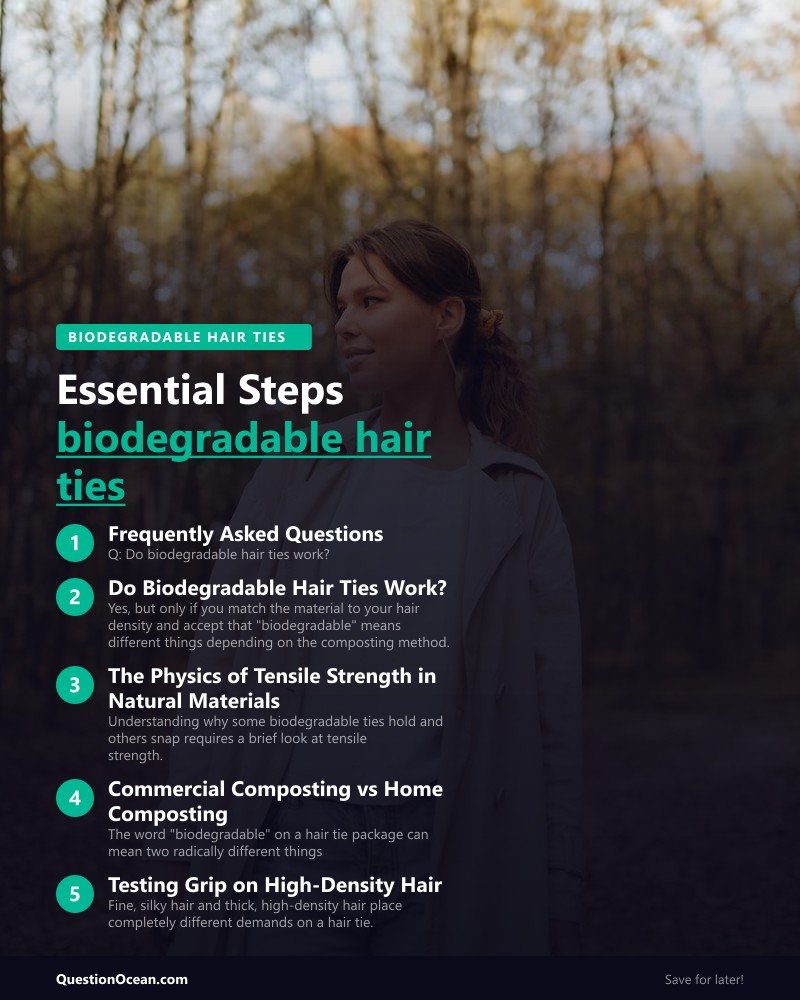
Q: Do biodegradable hair ties work? A: The top biodegradable brands (KOOSHOO, Terra Ties) now deliver 85-90% of the holding power of conventional synthetic elastics. Natural rubber cores with bias-cut organic cotton wrapping provide enough stretch and grip for daily ponytails, buns, and braids in fine-to-thick hair.
Q: How long do biodegradable hair ties take to decompose? A: Organic cotton ties decompose in 3-6 months in home compost. Natural rubber cores take 6-12 months. PLA bioplastic ties require industrial composting facilities (130-160°F) and will not decompose in a home bin. Always check whether the certification specifies home or industrial composting.
Q: Are biodegradable hair ties strong enough for thick hair? A: For thick hair up to mid-back length, choose ties with a minimum 4mm diameter and 3+ gram natural rubber core. KOOSHOO Round Hair Ties (5mm, 4.2g) are the strongest performing option in the category. Very heavy, waist-length hair may still benefit from reusable rather than compostable ties.
Q: What is the difference between compostable and biodegradable? A: “Biodegradable” means the material will eventually break down, but does not specify timeframe or conditions. “Compostable” specifies decomposition within a defined period under specific conditions (home or industrial). Compostable is the stronger, more meaningful claim, always look for it over generic “biodegradable” labeling.
Q: Can I compost hair ties in my backyard bin? A: Organic cotton and natural rubber ties compost successfully in active home bins. PLA bioplastic ties do not, they require industrial temperatures that home bins cannot reach. Check for “home compostable” rather than just “compostable” on the packaging, as the default composting certification (EN 13432) refers to industrial conditions.
Q: Do eco-friendly hair ties cost more than regular ones? A: Yes, by approximately 40-60% per tie. KOOSHOO runs $1.50 per tie versus $0.30-0.50 for conventional Goody elastics. However, biodegradable ties tend to last longer per use (the natural rubber stretches without losing shape as quickly as synthetic rubber), partially offsetting the upfront cost.
Biodegradable hair ties have crossed the performance threshold where they work reliably for the majority of hair types and daily styles. Match your hair density to the right diameter and rubber weight, verify home-compostable certification if you lack industrial composting access, and prioritize GOTS-certified organic cotton with natural rubber cores for the cleanest end-of-life decomposition.