
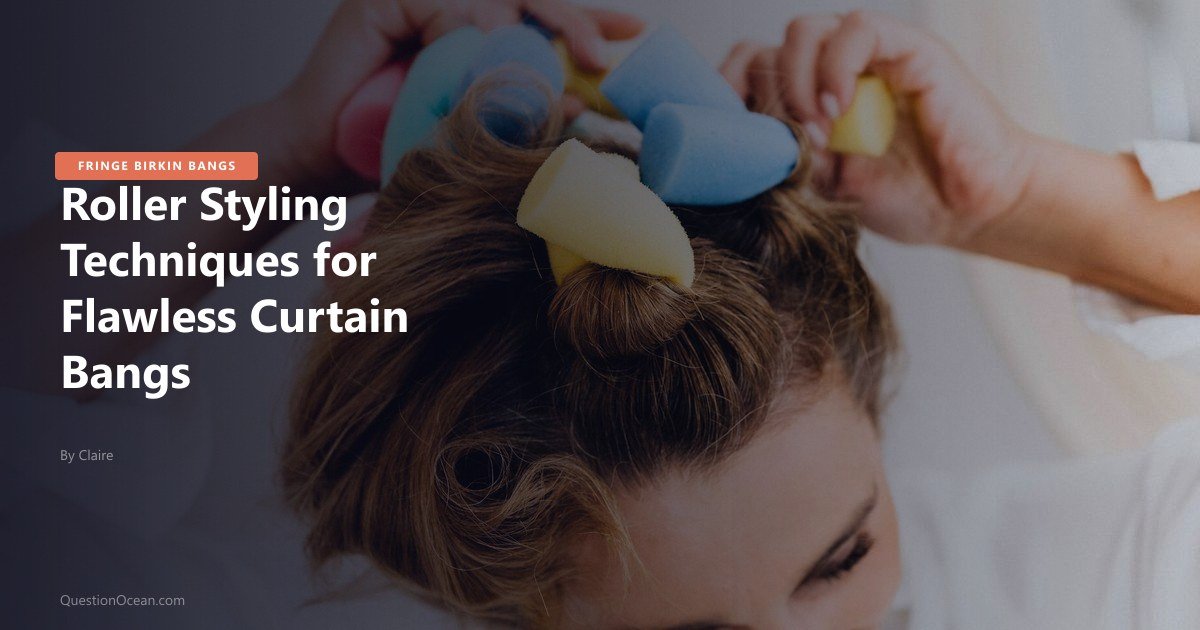
Curtain bangs look effortless on everyone else until you try styling your own with a round brush and end up with a tangled, lopsided mess. Velcro rollers solve that problem by doing the shaping work hands-free while you finish the rest of your routine.
This curtain bangs roller tutorial breaks down exact diameters, root over-direction, grip strategies for fine hair, and the heating-and-cooling physics that lock in that signature center-parted swoop. Every step is designed to give you salon-level framing without a styling degree.
Why Velcro Rollers Beat a Round Brush for Curtain Bangs
Velcro rollers distribute even tension across the entire bang section, eliminating the creases and uneven bends a round brush can leave. A round brush demands coordination between both hands, a dryer nozzle, and precise wrist rotation all at once. Rollers simplify the process to three moves: wrap, clip, cool. The result is symmetrical volume that fans outward from the center part every single time.
Because the roller stays in place during the cooling phase, hydrogen bonds in the hair shaft re-form around that curved shape without you holding anything. That hands-free setting time is what separates a two-hour blowout from a ten-minute roller set. If you are exploring different fringe looks, the 2026 fringe styling guide covers every modern variation and which tools pair best with each.
What Size Rollers for Curtain Bangs?
Roller diameter controls the tightness of your curve, so matching size to bang length is non-negotiable. Here is the breakdown:
- Bangs hitting the eyebrow (2-3 inches long): Use 1-inch diameter rollers for a defined, face-hugging swoop.
- Bangs grazing the cheekbone (3-5 inches long): Use 1.5-inch diameter rollers for a relaxed, open curve.
- Bangs reaching the jawline (5+ inches long): Use 2-inch diameter rollers for a loose, flowing bend that blends into layers.
A common mistake is reaching for jumbo 2.5-inch rollers on shorter bangs. The hair barely wraps halfway around the barrel, which produces zero bend and wasted effort. Conversely, using a 1-inch roller on jaw-length curtain bangs creates a ringlet rather than a sweep. Match the diameter to the length and the curve does the rest.
For volume through the crown and mid-lengths behind your bangs, best velcro rollers for crown volume covers larger-diameter sets and placement maps.
Foam or Velcro Rollers for Curtain Bangs?
Velcro rollers grip the hair shaft on their own, making them the superior choice for bangs that need root lift and directional control. Foam rollers are soft and flexible, which makes them comfortable for overnight sets, but they compress hair flat against the core rather than lifting it away from the scalp.
Here is how the two compare for bangs specifically:
- Grip: Velcro clings to the cuticle layer, holding tension without clips on medium-to-thick hair. Foam requires a snap closure or pin to stay put.
- Root lift: Velcro allows you to over-direct the roller upward past the root, creating lift at the base. Foam rollers sit directly on the scalp and flatten the root area.
- Heat compatibility: Velcro stands up to a blow-dryer nozzle aimed directly at it. Foam can warp or melt under sustained heat.
- Fine hair caveat: Very fine or silky hair may slip off velcro. In that case, a medium-grip foam roller secured with a creaseless clip [AMAZON LINK] is a better option.
If your fine hair struggles with grip on any roller type, the strategies in styling Birkin bangs at home include prep spray recommendations that add texture without weight.
Step-by-Step Curtain Bangs Roller Tutorial
Following this exact sequence ensures symmetrical swoop, root lift, and lasting hold from a single roller set. Gather your velcro rollers [AMAZON LINK], sectioning clips, a blow dryer with a concentrator nozzle, and a light-hold hairspray.
Step 1: Prep Damp Bangs
Start with bangs that are about 80 percent dry. Towel-dried or air-dried to the point where they feel cool and slightly damp is the target. Completely wet hair will take too long to set and may dry with frizz. Completely dry hair will not accept a new shape because the hydrogen bonds are already locked in place.
Step 2: Apply a Root Lift Mousse
Work a marble-sized amount of volumizing mousse into the roots of the bang section only. Distribute it by rubbing your fingertips directly against the scalp in the bang area. This adds cosmetic grip that helps fine or silky hair cling to the velcro surface. Avoid applying mousse to the mid-lengths or ends to keep the finished look soft.
Step 3: Section and Over-Direct
Split your bangs down the center part. Take the right section first. Comb it straight out from the face, then lift the ends upward about 45 degrees past horizontal. This upward over-direction is the single most important move because it builds root lift into the set.
Step 4: Wrap the Roller
Place the roller at the ends of the hair section. Roll inward toward the scalp, keeping consistent tension as you wind. Stop rolling when the roller sits just above the root, tilted slightly upward rather than pressed flat against the head. The gap between the roller and the scalp is what creates volume rather than flatness.
Step 5: Pin and Repeat
If needed, slide a duckbill clip or bobby pin beneath the roller to anchor it. The bobby pin loop hack works well here: slide an open bobby pin under the roller, loop it around the top edge, and press the pin into the hair at the scalp. Repeat the wrap on the left side, matching the same angle and tension.
Step 6: Heat and Lock
Aim a blow dryer with a concentrator nozzle at each roller for 20-30 seconds on medium heat. The heat opens the hydrogen bonds in the hair shaft, allowing them to re-form around the roller shape. After heating, switch to the cool-shot button and blast each roller for 10 seconds. This rapid cooling is what locks the new shape into the strand permanently for the day.
Step 7: Release and Separate
Wait at least five minutes after cooling before removing the rollers. Unwind each roller downward and outward, following the direction of the curtain swoop. Use your fingers to separate the two sections and let them fall naturally to frame your face. A flexible-hold hairspray misted from arm’s length seals the look without crunch.
Thermal Memory Mechanics: Why the Heat-Cool Cycle Matters
Hydrogen bonds in the hair cortex break under heat and re-form during cooling, which is the entire scientific basis for roller styling. When you wrap damp hair around a roller and apply warm air, water molecules evaporate and hydrogen bonds release from their natural configuration.
As the hair cools in its new curved position, those bonds re-form around the roller shape. The faster and more complete the cool-down, the stronger the hold. This is why the cool-shot button is not optional. Removing a roller while the hair is still warm means the bonds have not fully set, and the curl drops within minutes.
Fine hair has fewer cortex layers, which means fewer hydrogen bonds to work with. A lightweight hairspray for wispy fringe adds a secondary hold layer that compensates for that structural disadvantage.
Over-Direction for Crown Lift: The Technique Most Tutorials Skip
Angling the roller 45 degrees upward from the root creates volume at the crown that prevents curtain bangs from falling flat against the forehead. Most tutorials show the roller sitting parallel to the head, which produces a curve in the mid-lengths but zero lift where it counts.
Over-direction means winding the hair in a direction that goes past its natural fall. For curtain bangs, that direction is up and slightly back. When you release the roller, gravity pulls the hair forward and down, but the root retains that upward memory. The result is bangs that arc away from the forehead before sweeping to the sides.
If you skip over-direction, you end up with curtain bangs that curve at the ends but lie flat at the root. That flat-root look reads as limp rather than styled no matter how perfect the swoop is.
Fine Hair Grip Strategies That Actually Work
Fine hair slips off velcro rollers because the cuticle layer is smoother and thinner, but three prep adjustments fix the problem entirely.
- Dry texture spray at the roots before rolling. A light mist of texture spray roughens the cuticle surface just enough for velcro to grab without making the hair feel gritty.
- Use the bobby pin loop hack on every roller. Even if the velcro seems to hold initially, fine hair relaxes and loosens during the setting time. The pin keeps tension constant.
- Choose smaller rollers than your length suggests. Fine hair cannot support the weight of a large roller. Drop down one size from the diameter chart above and the grip improves dramatically.
A volumizing mousse designed for fine hair [AMAZON LINK] applied at the roots before rolling adds structural weight without visible product buildup.
How Long Should Rollers Stay in Curtain Bangs?
Leave heated rollers in for a minimum of ten minutes after the full cool-down to allow hydrogen bonds to fully lock. The most common mistake is removing rollers the moment they feel cool to the touch.
The outer layer of hair cools first, but the inner layers wrapped closest to the roller core retain heat longer. Pulling the roller out early means those inner layers have not finished setting, and the curl loosens from the inside out within an hour.
For maximum hold, leave rollers in for 15-20 minutes. Use that time to do your makeup or pick an outfit. If you are in a rush, the cool-shot technique from Step 6 above can shorten the wait to about eight minutes without sacrificing too much longevity.
Can You Use Rollers on Dry Curtain Bangs?
Yes, but you must re-introduce moisture or heat to break the existing hydrogen bonds before the roller can reshape them. Dry-setting works best as a refresh technique for second-day bangs rather than an initial styling method.
Lightly mist dry bangs with water or a thermal protectant spray, then roll and apply heat from a blow dryer. The water softens the bonds, the heat accelerates the break, and the cooling re-forms them around the new shape. For more second-day revival techniques, styling second-day bangs covers dry shampoo placement and quick re-curling methods.
Completely dry hair with no added moisture will not hold a new shape from rollers alone. The strand simply springs back to its previous position once the roller is removed.
1-Inch vs. 2-Inch Rollers: A Direct Comparison for Bangs
One-inch rollers create a tighter, more defined curve ideal for shorter bangs, while two-inch rollers produce a loose, barely-there bend suited to longer curtain lengths.
| Feature | 1-Inch Roller | 2-Inch Roller |
|---|---|---|
| Best bang length | Eyebrow to mid-nose | Cheekbone to jaw |
| Curl tightness | Defined swoop | Soft wave |
| Root lift | Moderate | High |
| Setting time | 10-12 minutes | 12-15 minutes |
| Fine hair performance | Excellent grip | May slip without prep |
If your bangs fall between categories, test both sizes on opposite sides and compare before committing to a full set. The side that frames your face more naturally wins.
FAQ
How many rollers do I need for curtain bangs?
Two rollers handle most curtain bang sets, one for each side of the center part. If your bangs are very thick, you may need a third roller for the underlayer closest to the forehead.
Do I need to use heat with velcro rollers?
Heat dramatically improves the result, but it is not strictly required. Air-drying in rollers for 30-45 minutes can produce a softer version of the swoop, though the hold will not last as long as a heat-set style.
Can I sleep in velcro rollers to set my curtain bangs?
Velcro rollers are too rigid for comfortable overnight wear and may create pressure dents at the root. Use soft foam rollers or silk-covered rollers if you prefer an overnight set.
Why do my curtain bangs go flat an hour after removing rollers?
The most likely cause is removing the rollers before the hair has fully cooled. The second most common cause is skipping a finishing spray. A flexible-hold hairspray applied immediately after roller removal extends the style by several hours.
What direction should I roll the roller for a curtain bang swoop?
Roll inward, toward the face, starting from the ends. The roller winds up toward the root with the ends tucked under. When released, this inward roll creates the outward-sweeping curtain shape as gravity pulls the hair down and to the side.
Can velcro rollers damage curtain bangs?
Velcro can snag very fine or fragile hair if removed carelessly. Always unwind the roller slowly in the direction of the curl rather than pulling it straight out. If you notice snagging, switch to a smooth-surface foam roller.
Conclusion
Velcro rollers transform curtain bang styling from a high-skill blowout into a simple wrap-and-wait routine. Matching roller diameter to your bang length, over-directing at the root for lift, and respecting the heat-cool cycle are the three pillars of a lasting swoop. Fine hair benefits from texture spray and the bobby pin loop hack, while thicker hair can rely on velcro grip alone. Once you nail the technique, ten minutes in rollers replaces fifteen minutes of round-brush wrestling every single morning.