

Fringe searches jumped 38% between January and March 2026, and the styles dominating salon chairs look nothing like the blunt, heavy bangs of five years ago. This year’s 2026 bang trends favor movement, air, and an almost accidental softness that works whether you have a round face, a high forehead, or fine hair that refuses to cooperate. This guide breaks down every fringe style worth knowing, the maintenance each one demands, and the weather-proofing tricks that keep bangs camera-ready from London drizzle to Texas humidity.
Are Bangs in Style for 2026?
Yes, but the keyword is “soft.” Blunt, box-shaped bangs have stepped aside for wispy, face-skimming layers that blend into the rest of the haircut. Salon data from major booking platforms shows curtain bangs, Birkin bangs, and bottleneck fringe accounting for over 60% of bang-related appointments in Q1 2026.
The shift reflects a broader preference for low-maintenance, lived-in texture. Stylists across New York, Toronto, and London report clients asking for bangs that “look good growing out,” which is exactly what these softer shapes deliver. If you are weighing the decision between a French bob vs Italian bob, adding fringe to either silhouette is the fastest way to update the cut for 2026.
The Four 2026 Bang Trends You Need to Know
Birkin Bangs
Named after Jane Birkin’s effortless 1970s fringe, this cut sits just above the brows with piecey, undone separation. The hair is point-cut at the ends so it never looks blocky. Birkin bangs suit oval, heart, and oblong faces because the slight gaps between strands expose just enough forehead to balance proportions.
Styling is minimal by design. A fine-tooth comb, a blast of cool air, and finger-placement are the entire routine. For a full breakdown, see our guide to styling Birkin bangs at home.
Curtain Bangs 2026
This year’s curtain bangs are longer and thinner than the 2023-2024 versions, grazing the cheekbones rather than stopping at the brow bone. The center part is wider, creating a dramatic opening that frames the face like actual curtains.
They work on nearly every face shape because the length is adjustable. Stylists recommend keeping the shortest interior pieces at nose-bridge level and letting the outer wings blend into face-framing pieces with long layers. Use roller techniques for curtain bangs to set the bend without heat damage.
Bottleneck Bangs
A hybrid between Birkin bangs and curtain bangs, bottleneck fringe is shortest at the center and gradually elongates toward the temples, forming a “bottleneck” shape. The result is a structured frame around the eyes that softens into the rest of the hair.
This style is particularly flattering on square and diamond face shapes because the graduated length rounds the jawline. Bottleneck bangs require slightly more precision than Birkin bangs at the salon, so expect a 15-20 minute add-on to your appointment.
Airy Bixie Fringe
The bixie (bob-pixie hybrid) gets even lighter for 2026 with fringe that is razor-cut to almost transparent thinness. This fringe sits across the forehead with visible scalp peeking through, giving a deliberately deconstructed look.
Airy bixie fringe is the boldest option on this list and pairs best with fine to medium hair density. For those wanting to push boundaries further, micro-fringe is the daring 2026 trend that crops the fringe to mid-forehead.
Birkin Bangs vs. Bottleneck Bangs: Which One Suits You?
The deciding factor is how much eye-framing structure you want. Here is a direct comparison:
| Feature | Birkin Bangs | Bottleneck Bangs |
|---|---|---|
| Length | Uniform, just above brows | Graduated, shortest at center |
| Texture | Piecey, separated | Blended, swooping |
| Best face shapes | Oval, heart, oblong | Square, diamond, round |
| Styling time | 2-3 minutes | 5-7 minutes |
| Grow-out ease | Excellent | Moderate |
| Trim frequency | Every 3-4 weeks | Every 2-3 weeks |
If you want wake-up-and-go fringe, Birkin bangs win. If you want a more sculpted look that narrows a wider face, bottleneck bangs deliver.
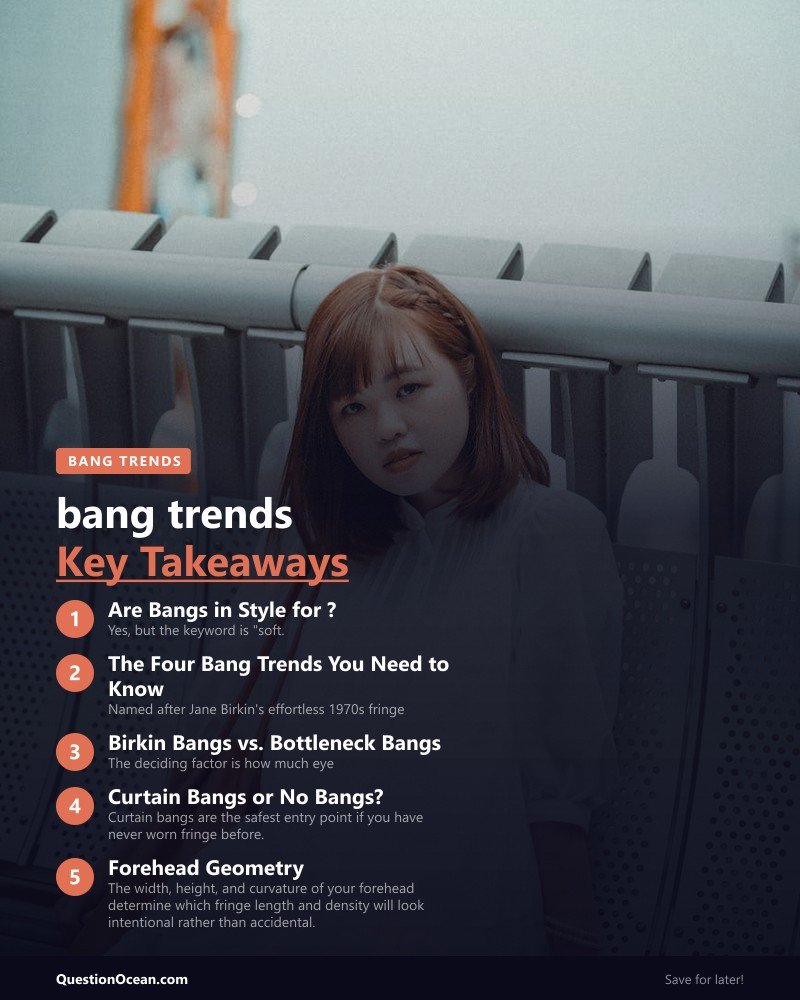
Curtain Bangs or No Bangs?
Curtain bangs are the safest entry point if you have never worn fringe before. Unlike blunt or Birkin bangs, curtain fringe grows out gracefully because the longest pieces already blend with the rest of your layers. There is no awkward in-between phase.
Choose curtain bangs if:
- You want to test fringe without full commitment
- Your hair parts naturally in the center
- You prefer styling versatility (they pin back easily)
- You have a cowlick near the hairline that would disrupt shorter bangs
Skip bangs entirely if your lifestyle involves daily intense cardio that soaks the hairline, or if you genuinely dislike any hair touching your forehead. A no-bang alternative is to ask for face-framing pieces with long layers instead, which gives shape without the forehead coverage.
Forehead Geometry: Matching Bangs to Your Face
The width, height, and curvature of your forehead determine which fringe length and density will look intentional rather than accidental.
- High forehead (more than three finger-widths): Full-coverage Birkin or bottleneck bangs shorten the face visually. Avoid micro-fringe, which emphasizes height.
- Narrow forehead: Wide-set curtain bangs that sweep outward create the illusion of breadth. Keep the center section sparse.
- Round forehead with widow’s peak: Birkin bangs with a slight off-center part work around the natural growth pattern. See our guide to fixing cowlicks in bangs for training the hair.
- Flat forehead: Airy bixie fringe or wispy Birkin bangs add dimension. Dense, straight-across cuts will make a flat forehead look flatter.
Daily Maintenance Breakdown by Bang Type
Every fringe style has a different morning routine, and underestimating the time commitment is the top reason people grow out their bangs prematurely.
Birkin Bangs (2-3 Minutes)
- Mist bangs lightly with water or a dry texture spray
- Finger-comb downward while aiming a dryer on cool setting
- Separate a few pieces with a fine-tooth comb for the signature piecey finish
Curtain Bangs (4-5 Minutes)
- Dampen the fringe section from roots to ends
- Wrap each side around a large velcro roller, rolling away from the face
- Leave rollers in while you finish the rest of your routine, then release and finger-shape
Velcro rollers for fringe volume
Bottleneck Bangs (5-7 Minutes)
- Wet bangs thoroughly at the root to reset the direction
- Use a small round brush to blow-dry from underneath, directing hair forward and then sweeping outward at the temples
- Finish with a single spritz of lightweight hairspray for wispy fringe
Airy Bixie Fringe (1-2 Minutes)
- Shake fringe with fingers straight out of bed
- Apply a rice-sized amount of texture paste to fingertips
- Pinch the ends for piece-y separation
How to Weather-Proof Your Bangs
Humidity and wind are the two forces that destroy a fringe styling faster than anything else.
Humidity Defense
- Apply a silicone-free anti-humidity serum from mid-shaft to ends before styling
- Use a microfiber cloth to blot forehead oil every few hours (forehead sebum reactivates in humid air and flattens bangs)
- Carry a travel-size dry shampoo powder for midday refreshes
Wind Protection
- Secure bangs under a silk-lined cap during commutes
- After arriving, use a fine-tooth comb to redistribute strands
- A light-hold hairspray applied six inches from the hair creates a flexible shield without stiffness
For stubborn second-day fringe, our tips for styling second-day bangs cover overnight preservation techniques.
Combating Oily Foreheads Under Bangs
Oily foreheads are the single biggest complaint from bang-wearers, and the solution starts with your skincare, not your hair products.
- Switch to a mattifying moisturizer on the forehead zone only
- Apply oil-blotting primer across the T-zone before makeup
- Avoid heavy foundations under the fringe line; use a translucent setting powder instead
- Blot the forehead twice daily with oil-absorbing sheets
On the hair side, a translucent dry shampoo powder at the roots absorbs excess oil without leaving white residue. Tap a small amount onto the inner bang section and blend with a fine-tooth comb.
Trim Schedules: How Often to Cut Each Bang Style
Skipping trims is the fastest way to lose the shape of any fringe cut. Here is a realistic schedule:
- Birkin bangs: Every 3-4 weeks. The piecey texture hides slight overgrowth well.
- Curtain bangs: Every 5-6 weeks. The long, blended shape stays wearable longer.
- Bottleneck bangs: Every 2-3 weeks. The graduated layers show growth quickly at the center.
- Micro-fringe: Every 2 weeks. Even a few millimeters changes the look dramatically.
Between appointments, you can handle minor upkeep yourself. Our step-by-step tutorial on trimming bangs between salon visits covers point-cutting techniques that prevent blunt, kitchen-scissors disasters.
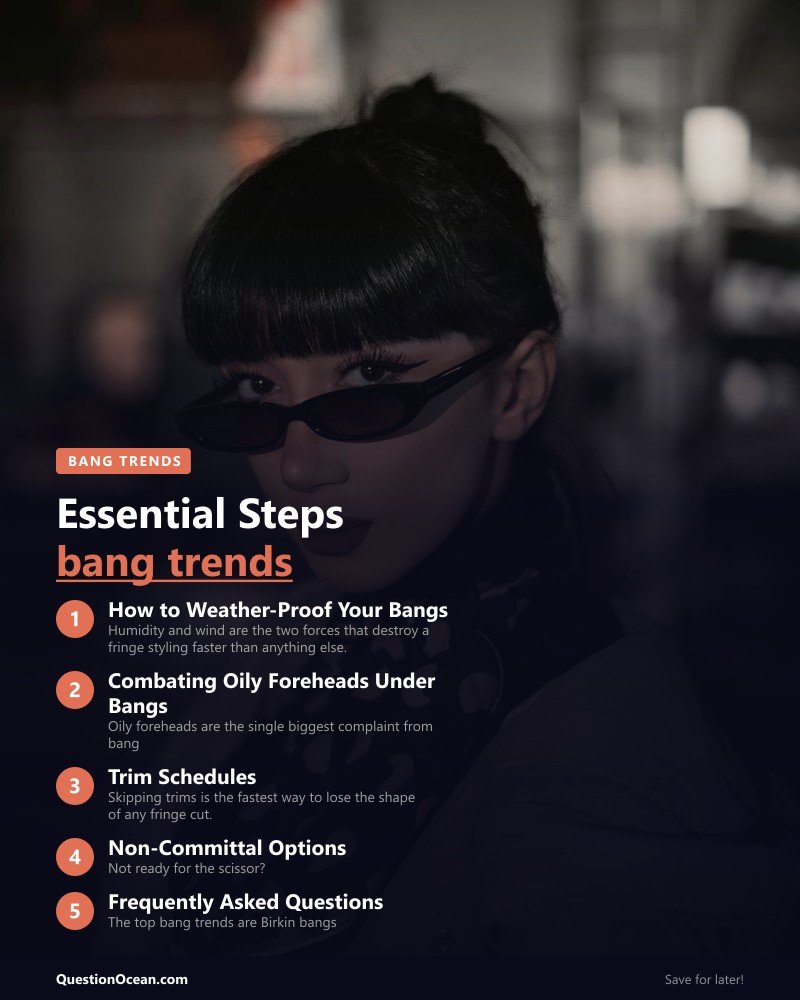
Non-Committal Options: Clip-In Bangs
Not ready for the scissor? Clip-in bangs made from real human hair now look convincing enough to fool stylists. Modern clip-in fringe pieces attach with a pressure-sensitive comb that sits flush against the hairline and blends with a single pass of a flat iron or cool-air dryer.
Clip-ins let you test Birkin, curtain, or blunt styles for weeks before committing. They also solve the grow-out problem entirely since you simply stop wearing them when you want a change. For a curated list of realistic options, check out clip-in bangs real hair options.
Frequently Asked Questions
What are the most popular bang trends for 2026?
The top 2026 bang trends are Birkin bangs, curtain bangs, bottleneck bangs, and airy bixie fringe. All four prioritize softness, movement, and easy grow-out over rigid, blunt shapes. Curtain bangs remain the most-requested style, but Birkin bangs are gaining ground rapidly.
How do I know which bang style suits my face shape?
Match fringe density and length to your forehead proportions. High foreheads benefit from full-coverage Birkin or bottleneck bangs, narrow foreheads suit wide-set curtain bangs, and round faces look best with graduated bottleneck fringe that adds vertical lines.
Can I get bangs if I have fine hair?
Fine hair works exceptionally well with Birkin bangs and airy bixie fringe because both styles rely on visible separation and lightness. Avoid thick, blunt cuts that expose thinness at the edges. A texturizing powder at the roots adds grip and fullness.
How do I stop my bangs from getting greasy during the day?
Start with a mattifying moisturizer on your forehead, apply translucent setting powder under the fringe line, and carry oil-blotting sheets for midday touch-ups. On the hair itself, a tap of dry shampoo powder at the roots absorbs sebum without visible residue.
How often should I wash just my bangs?
Most bang-wearers rinse and restyle their fringe daily even if they wash the rest of their hair every two to three days. A quick splash under the tap, a 30-second blast of cool air, and a comb-through is enough to reset the shape each morning.
Are clip-in bangs noticeable?
High-quality clip-in bangs made from real human hair blend seamlessly when color-matched correctly. The attachment comb sits behind the hairline and is hidden by your natural hair. Most people cannot distinguish clip-in fringe from a real cut at conversational distance.
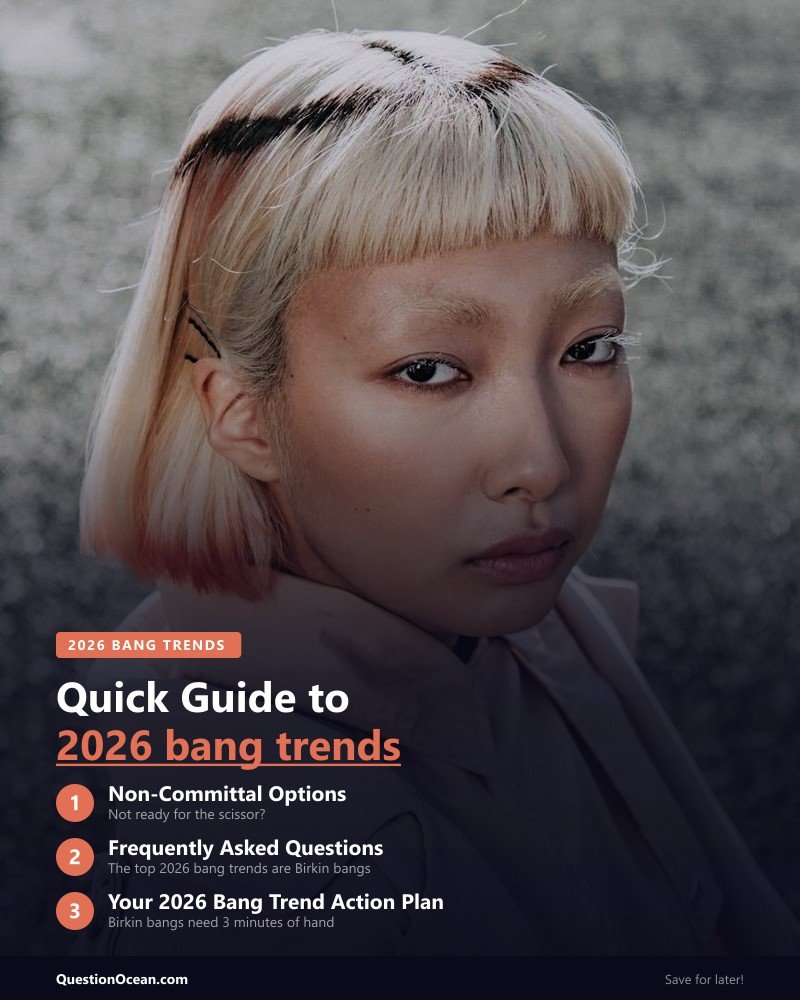
Your 2026 Bang Trend Action Plan
Birkin bangs need 3 minutes of hand-tension styling, curtain bangs need a single velcro roller, and bottleneck fringe needs only a flat iron flick at the cheekbone. Start by identifying your forehead shape and daily time budget, then match those to the bang style that fits. Test with clip-ins if commitment feels risky, and follow a strict trim schedule once you cut. Whether you choose Birkin bangs, curtain bangs, or bottleneck fringe, the right maintenance routine keeps the style looking salon-fresh between appointments.