

The bob accounts for roughly one in four salon appointments across North America and the UK in 2026, yet most clients walk in asking for “a bob” without specifying which architecture they actually want. The result is a coin-flip between two dramatically different silhouettes: the crisp, chin-hugging French bob and the voluminous, neck-grazing Italian bob.
This guide maps the structural DNA of each cut, matches them to specific face shapes, and gives you the exact salon language you need so your stylist delivers precisely what you picture.
The 2026 Bob Era: Why These Two Cuts Dominate
Short, structured bobs have replaced the mid-length “lob” as the default fashion-forward cut this year. Runways in Paris and Milan drew a hard line between two philosophies: minimalist geometry (French) and romantic volume (Italian).
Stylists in New York, London, and Toronto report that clients increasingly reference one of these two silhouettes by name. This guide breaks down every structural detail, face-shape matching, consultation terminology, and daily upkeep — so you walk into the salon knowing exactly what to request.
If you are transitioning from long hair to a bob, knowing which architecture suits you is the single most important decision in the process.
French Bob Architecture: The Blunt Geometry
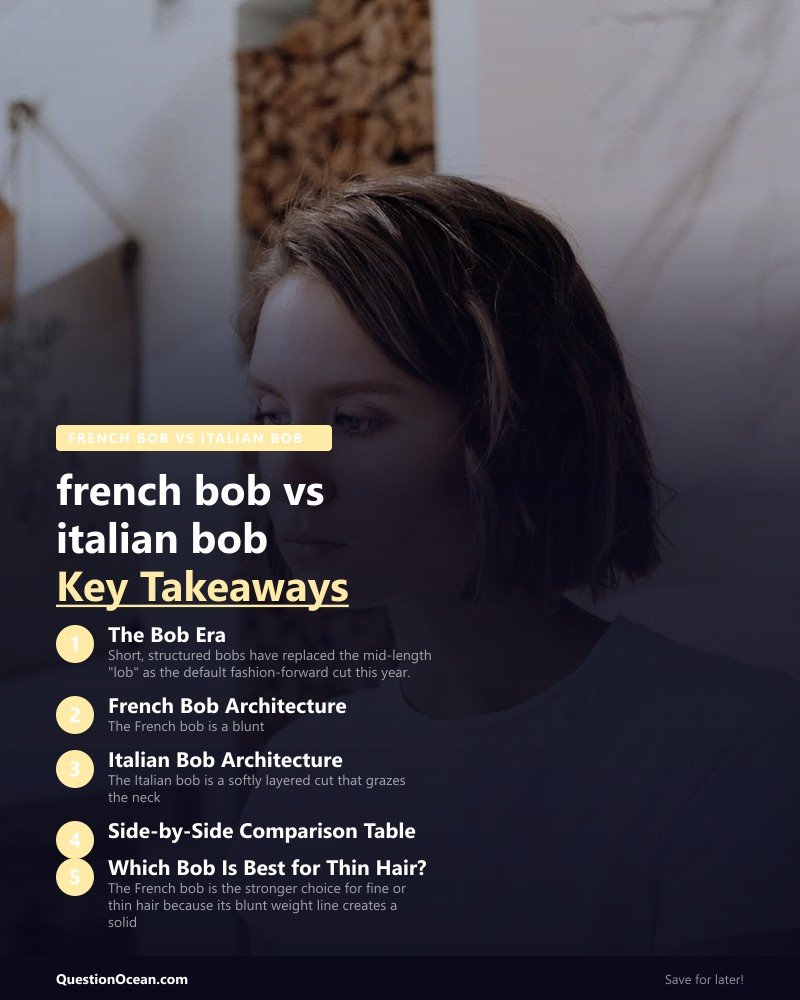
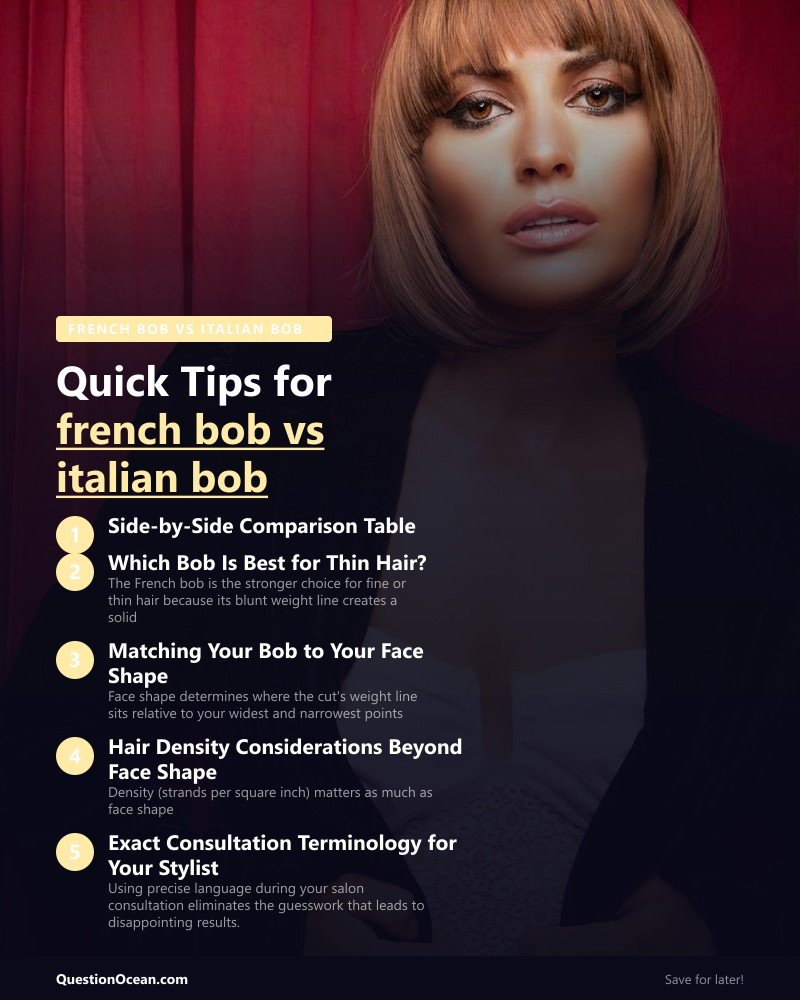
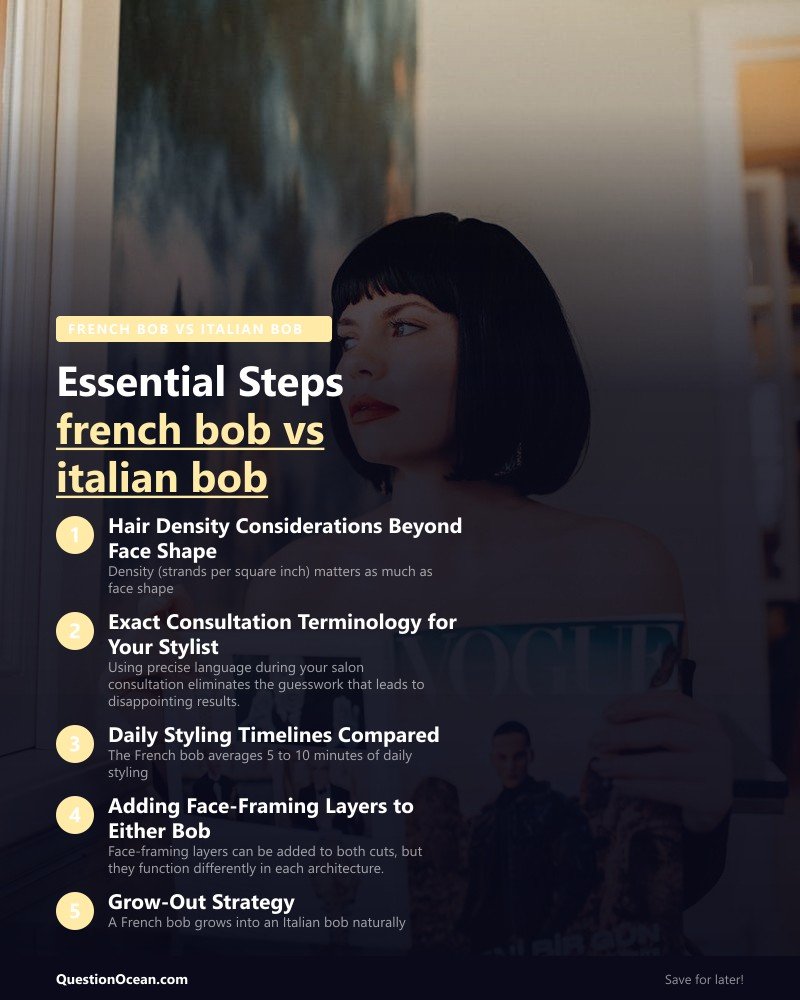
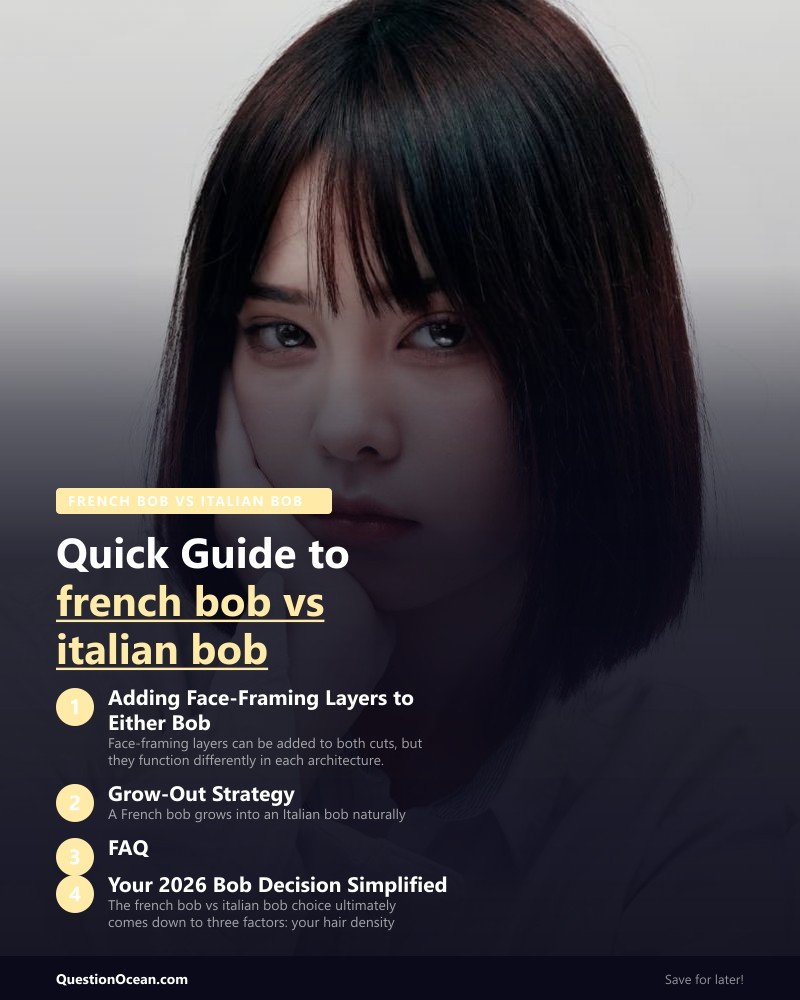
The French bob is a blunt, one-length cut that sits between the earlobe and the jawline, typically paired with a fringe. There is zero layering. The perimeter forms a clean, horizontal weight line that makes hair appear denser and thicker at the ends.
Key structural details:
- Length: Earlobe to jaw, never below
- Perimeter: Blunt, zero graduation
- Fringe: Full or curtain bangs, almost always included
- Texture: Smooth or slightly piecey, never heavily layered
- Silhouette from the side: A clean rectangle from ear to jaw
This architecture works because the blunt weight line prevents thin ends from tapering into nothing. For fine-haired clients, the French bob creates an illusion of thicker hair that layered cuts simply cannot replicate.
Learn more about styling a blunt French bob for fine hair to maximize this density effect.
Italian Bob Architecture: The Volumetric Sweep
The Italian bob is a softly layered cut that grazes the neck, built around internal movement and outward volume rather than a single blunt line. It typically sits one to two inches below the jaw and features face-framing pieces that blend into the overall shape.
Key structural details:
- Length: Jaw to collarbone, most commonly chin-to-neck
- Perimeter: Soft, slightly graduated or point-cut
- Fringe: Optional; curtain layers more common than a full fringe
- Texture: Bouncy, voluminous, blow-dry dependent
- Silhouette from the side: A rounded, bell-like shape
The Italian bob demands regular blow-drying with a round brush to maintain its signature bounce. See the best round brushes for Italian bob guide for tool recommendations.
Side-by-Side Comparison Table
| Feature | French Bob | Italian Bob |
|---|---|---|
| Length | Earlobe to jaw | Jaw to mid-neck |
| Layers | None (blunt) | Internal layers throughout |
| Bangs | Almost always | Optional |
| Volume | Flat to moderate | High, rounded |
| Styling time | 5-10 min daily | 15-25 min daily |
| Key tool | Flat iron or air-dry | Round brush + blow dryer |
| Grow-out grace | 6-8 weeks before reshaping | 8-10 weeks before reshaping |
| Best density | Fine to medium | Medium to thick |
| Salon trim cycle | Every 5-6 weeks | Every 6-8 weeks |
Which Bob Is Best for Thin Hair?
The French bob is the stronger choice for fine or thin hair because its blunt weight line creates a solid, dense perimeter. Layered cuts like the Italian bob can leave fine hair looking sparse at the ends, since each layer removes weight the hair cannot afford to lose.
If your hair is fine but you still want movement, ask your stylist for a blunt French bob with flat iron bends for a straight bob. This adds visual interest without sacrificing the density of the blunt line.
For the Italian bob to work on thinner hair, your stylist would need to keep layers minimal and concentrated around the face. Even then, daily round-brush styling is non-negotiable to prevent the shape from falling flat.
Matching Your Bob to Your Face Shape
Face shape determines where the cut’s weight line sits relative to your widest and narrowest points, which controls the overall balance of the silhouette. Use the geometry chart below to narrow your choice.
Oval Face
- French bob: Highly compatible. The jaw-length perimeter frames without shortening.
- Italian bob: Equally strong. Volume at the sides enhances natural symmetry.
- Verdict: Either cut works; choose based on styling commitment.
Round Face
- French bob: Request length that hits below the widest point of the cheeks. A side-parted curtain bang elongates.
- Italian bob: Volume at the crown paired with length below the jaw creates vertical pull.
- Verdict: Italian bob with crown height edges ahead for visual elongation. Avoid chin-length French bobs that mirror the face width.
Square Face
- French bob: Softened with a textured fringe and texturizing sprays for short hair to break the hard horizontal line.
- Italian bob: The rounded silhouette softens angular jawlines naturally.
- Verdict: Italian bob is the default recommendation. French bob works if the fringe is soft and the perimeter is kept slightly below the jaw.
Heart Face
- French bob: Chin-length bobs add width at the narrowest point of a heart face, creating balance.
- Italian bob: Volume below the ears fills out the lower third.
- Verdict: Both cuts balance a heart shape. French is lower maintenance; Italian gives more drama.
Oblong / Long Face
- French bob: A full fringe shortens the visual length of the face. Keep the bob at or above the jaw.
- Italian bob: Side volume widens the face, but avoid too much length that elongates further.
- Verdict: French bob with a thick fringe is the strongest option for reducing perceived face length.
For a bold alternative that plays with asymmetry on any face shape, explore asymmetrical bobs for a bold look.
Hair Density Considerations Beyond Face Shape
Density (strands per square inch) matters as much as face shape, yet most comparison guides ignore it entirely. Here is how density shifts the recommendation:
- Low density: French bob, always. The blunt line is non-negotiable for visual fullness.
- Medium density: Either cut. French for ease, Italian for movement.
- High density: Italian bob thrives here. Layers manage bulk and prevent a triangular shape. A blunt French bob on very thick hair can create an unwanted helmet effect unless the stylist adds internal texturizing.
If you sit between low and medium density, consider the micro bob jaw-length trend, which borrows the French bob’s blunt perimeter but sits slightly shorter for a modern edge.
Exact Consultation Terminology for Your Stylist
Using precise language during your salon consultation eliminates the guesswork that leads to disappointing results. Print this section or screenshot it for your appointment.
For a French Bob, Say:
- “I want a blunt, one-length bob at my jawline with zero graduation.”
- “No layers. I want all the weight sitting at the perimeter.”
- “I’d like a [full / curtain] fringe that hits just below my eyebrows.”
- “Keep the nape clean; I want a sharp horizontal line at the back.”
For an Italian Bob, Say:
- “I want a layered bob that grazes my neck, about one to two inches below the jaw.”
- “Build internal layers for movement, but keep the perimeter soft, not blunt.”
- “I want face-framing pieces that blend from cheekbone length into the overall shape.”
- “The silhouette should be rounded, not flat. Think volume, not sleekness.”
For Either Cut, Clarify:
- “I part my hair on the [left / right / center].”
- “My cowlick sits [here]. How will that affect the fringe?”
- “My daily styling time is [X] minutes.”
This level of specificity matters especially in North American and UK salons where “French bob” and “Italian bob” are not yet universally standardized terms. Bringing reference photos alongside these phrases ensures alignment.
Daily Styling Timelines Compared
The French bob averages 5 to 10 minutes of daily styling; the Italian bob demands 15 to 25 minutes. Here is a realistic breakdown for each.
French Bob Morning Routine (5-10 Min)
- Mist damp hair with a lightweight texturizing spray.
- Rough-dry with fingers or air-dry for natural texture.
- Optional: run a flat iron once through the ends for a polished bend.
- Finish with a small amount of dry texture spray for separation.
Italian Bob Morning Routine (15-25 Min)
- Apply volumizing mousse to towel-dried hair from roots to mid-lengths.
- Blow-dry using a medium round brush, lifting each section away from the scalp.
- Direct airflow under the ends to create the signature flip.
- Set volume at the crown with a velcro roller for 5 minutes while doing makeup.
- Finish with a flexible-hold hairspray.
For clients who want the Italian bob silhouette with less effort, a Dyson Airwrap cuts blow-dry time roughly in half by combining airflow and barrel-wrap in one step.
Adding Face-Framing Layers to Either Bob
Face-framing layers can be added to both cuts, but they function differently in each architecture. On a French bob, face-framing pieces soften the blunt line without removing overall density. On an Italian bob, they are already built into the structure.
If you want to push the layering further, explore face-framing layers for a modern lob, which bridges the gap between a structured bob and a longer, more relaxed shape.
Grow-Out Strategy: Planning Your Next Six Months
A French bob grows into an Italian bob naturally, which makes the French bob the smarter starting point if you are unsure. Here is the typical grow-out arc:
- Weeks 1-6: French bob holds its shape well. Minimal maintenance.
- Weeks 6-10: The blunt line softens. You can either trim back to French or let it evolve.
- Weeks 10-16: The length reaches Italian bob territory. A single layering appointment converts the shape.
- Weeks 16+: The Italian bob grows into a lob. Add face-framing layers for a modern lob to keep the shape intentional.
This means you are never locked into one cut permanently. The two bobs exist on the same continuum.
FAQ
Is a French bob high maintenance?
A French bob is relatively low maintenance day to day, requiring only 5 to 10 minutes of styling. However, the blunt perimeter shows growth quickly, so plan on salon trims every 5 to 6 weeks to keep the line crisp. Between appointments, flat iron bends and texturizing spray keep the shape looking intentional.
Can I get an Italian bob without bangs?
Yes. The Italian bob does not require a fringe. Most versions use curtain-style face-framing layers instead of a true bang. Discuss with your stylist whether face-framing pieces starting at cheekbone length will give you the movement you want without a commitment to fringe maintenance.
Which bob is cheaper to maintain?
The French bob typically costs less over time because the simple blunt cut is faster in the salon chair and requires fewer products at home. The Italian bob often needs a round brush, volumizing mousse, and more frequent blow-dry sessions, which adds up in both time and product spend.
How do I know if my hair is fine or thick enough for each bob?
Isolate a single strand and roll it between your fingers. If you can barely feel it, your hair is fine; choose the French bob. If the strand feels like a thread with noticeable texture, your density can support the Italian bob’s layers. A stylist can also measure density with a strand-count test during your consultation.
Will a bob make my face look wider?
It depends on the length and volume placement. A chin-length bob that ends at your face’s widest point can emphasize width. To avoid this, request a French bob that sits just below the jaw or an Italian bob with volume concentrated at the crown rather than the sides. Your stylist can adjust the architecture to elongate rather than widen.
Can I air-dry an Italian bob?
Air-drying an Italian bob is possible but produces a different result: a relaxed, undone texture rather than the classic bouncy silhouette. If you prefer that lived-in look, read the guide on air-drying a bob for natural texture for product and technique recommendations.
Your 2026 Bob Decision Simplified
The french bob vs italian bob choice ultimately comes down to three factors: your hair density, your daily styling budget in minutes, and whether you prefer geometric precision or romantic volume. Start with the French bob if you want simplicity and density, or commit to the Italian bob if you love a blow-dry routine and have medium-to-thick hair. Either way, bring the consultation phrases from this guide to your next appointment and use those exact phrases at your next appointment.