

The French bob has dominated salon trend boards from Manhattan to Manchester since late 2025, and there is a structural reason why it works better for fine hair than almost any other cut on the market. A french bob for thin hair concentrates every available strand into a compact, jaw-length shape that physically stacks hair at its densest possible point. Unlike longer styles that spread fine strands over greater surface area, the French bob compresses volume into a tight frame that reads as thick, polished, and intentional.
This guide covers the physics of why stacking works, the jawline width illusions the cut creates, and the precise styling protocols that keep a French bob looking full between washes.
The Physics of Stacking Hair at the Jawline
The French bob typically falls between the earlobe and the chin, with a blunt baseline that terminates every strand at roughly the same length. This is where the volume illusion begins. When 80,000-100,000 individual strands all end within a half-inch vertical zone, they overlap and compress against each other, creating visible density at the perimeter.
The stacking effect doubles or triples the perceived thickness at the cut line compared to the same hair worn at shoulder length. At longer lengths, strands spread apart under gravity, revealing gaps between individual hairs. At jaw length, that spreading is physically limited. The strands simply do not have enough distance to separate.
The blunt edge is critical. Any texturizing, razoring, or point-cutting at the perimeter breaks up this stacking effect and reintroduces the sparse, wispy appearance that fine hair is prone to. A skilled stylist cutting a French bob for fine hair will use shears in a straight line and avoid thinning shears entirely.
For a complete overview of why blunt baselines outperform layered cuts for fine hair, see our guide to the best haircuts and products for fine hair.
Jawline Width Illusions: How the French Bob Reshapes Your Face
Beyond hair density, the French bob creates a powerful facial width illusion that benefits most face shapes. The horizontal weight line at the jaw draws the eye outward, visually widening the lower face. For heart-shaped and oval faces, this balances a narrower chin.
The jaw-length cut creates a frame effect, your face appears to sit within a wider border, which makes both the face and the hair look proportionally larger. This is the same principle portrait photographers use when adjusting framing ratios.
The French bob includes a slight forward angle in its classic form, with the front pieces hanging roughly 1 centimeter longer than the back. This forward graduation adds to the facial framing effect and keeps the cut from looking boxy when viewed from the side.
- Oval faces gain balanced framing that enhances cheekbones without adding excessive width
- Heart-shaped faces benefit most. The jaw-length weight line fills out the narrower lower third
- Round faces can wear a French bob with a deep side part and slight length extension past the chin to add vertical dimension
- Square faces pair the cut with soft, bend-out styling at the ends to soften angular jawlines
Does a French Bob Work for Thin Hair?
A French bob is one of the top three most effective cuts for creating the appearance of thicker hair. The compact length, blunt perimeter, and jawline stacking combine to maximize visual density from every available strand. Fine-haired clients across US, UK, and Canadian salons consistently report that the French bob makes their hair look and feel fuller than any previous cut.
The cut works particularly well for fine hair because it eliminates the number-one enemy of perceived volume: excessive length. Every inch of length beyond the jaw adds gravitational pull that stretches fine strands apart. The French bob removes that pull entirely, keeping strands compressed and visually dense.
There are two scenarios where the French bob requires modification for fine hair. First, if your hair is both fine and very low density (fewer than 80,000 total strands), adding a subtle interior layer 2 inches above the baseline creates internal body without sacrificing the blunt edge. Second, if you have a strong cowlick at the nape, the stylist may need to adjust the back length to accommodate the growth pattern.
For face-framing adjustments that complement the French bob on fine hair, see our guide to strategic layering and face-framing techniques.
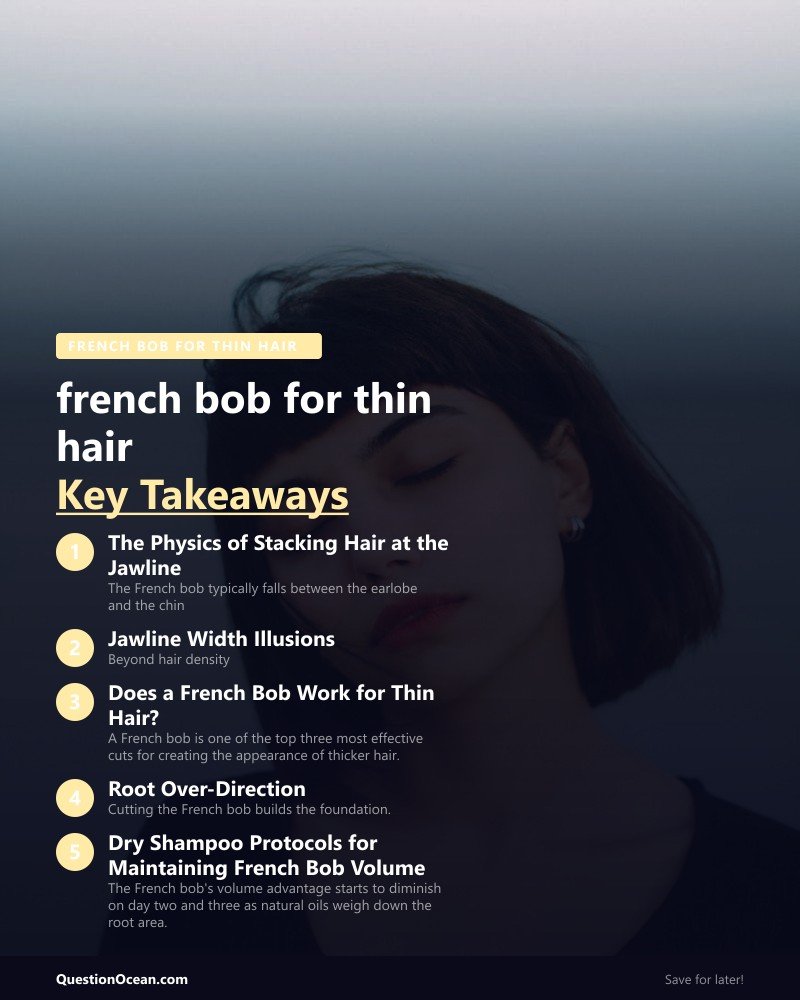
Root Over-Direction: The Blow-Dry Technique That Doubles Volume
Cutting the French bob builds the foundation. Root over-direction during blow-drying builds the volume. This technique involves drying the roots in the opposite direction of their natural fall, creating a lifted base that holds all day.
- Start with towel-dried hair and apply a golf-ball-sized amount of volumizing mousse directly to the roots
- Flip your part to the opposite side of where you normally wear it
- Using a small round brush, lift 1-inch sections at the crown and direct them straight up and over to the opposite side while blow-drying on medium heat
- Once fully dry, flip the part back to its original position
- The roots will hold that over-directed lift for 8-12 hours
Root over-direction works because fine hair retains shape from heat styling more easily than thick hair. The hydrogen bonds in each strand reform quickly at lower temperatures, which means medium heat is sufficient, high heat risks cuticle damage without adding extra hold.
This technique pairs exceptionally well with a lightweight mousse applied before drying. Our guide to weightless volumizing mousses covers the best formulas that add lift without stiffness or residue.
Lightweight Root Volumizing Spray, heat-activated lift for fine hair
Dry Shampoo Protocols for Maintaining French Bob Volume
The French bob’s volume advantage starts to diminish on day two and three as natural oils weigh down the root area. A targeted dry shampoo routine preserves the lift between washes and can even enhance the cut’s texture.
Apply dry shampoo the night before you need it, not the morning of. Nighttime application gives the starch-based powder 6-8 hours to absorb oil while you sleep. Morning application often leaves visible residue that has not had time to blend into the hair.
Section the crown into four quadrants and spray each section 6 inches away from the scalp. Focus on the roots only, mid-length application on a French bob will create chalky, stiff ends that lose the cut’s natural movement.
For fine hair specifically, choose dry shampoos that contain rice starch or tapioca starch over those formulated with talc. Talc particles are larger and heavier, which adds weight that fine strands cannot absorb without flattening. Rice starch absorbs oil effectively while weighing approximately 30% less per application.
On day three, add a light texturizing spray at the mid-lengths to restore the movement and separation that dry shampoo alone cannot provide. This two-product approach, dry shampoo at roots, texture spray at mids. Keeps the French bob looking intentional rather than overdue for a wash.
Avoiding Weight-Inducing Products on a French Bob
The compact length of a French bob means product mistakes are more visible and more damaging to volume than on longer styles. Heavy creams, oil-based serums, and thick leave-in conditioners will collapse the carefully constructed stacking effect within minutes of application.
The total amount of styling product on a French bob should never exceed one tablespoon across all products combined. Fine hair at jaw length simply does not have enough surface area to distribute heavier loads without visible product buildup.
Products to avoid on a fine-haired French bob:
- Smoothing creams containing dimethicone or cyclomethicone: these coat strands and eliminate the air space between them
- Hair oils applied from mid-length to ends — even a small amount collapses the blunt edge
- Wax-based texturizers that create hold through weight rather than grip
- Heavy-hold gels that dry rigid and pull fine strands downward
Products that support the French bob’s volume:
- Volumizing mousse applied only at the roots before blow-drying
- Dry texture spray misted at mid-lengths after styling
- Root-lifting powder pressed into the crown for targeted lift
- Lightweight flexible-hold hairspray applied from 12 inches away as a final step
The styling approach for the French bob on fine hair shares several principles with bob styling techniques for fine hair, including the emphasis on lightweight formulas and root-focused application.
Dry Texture Spray. Weightless grip for fine bob styles
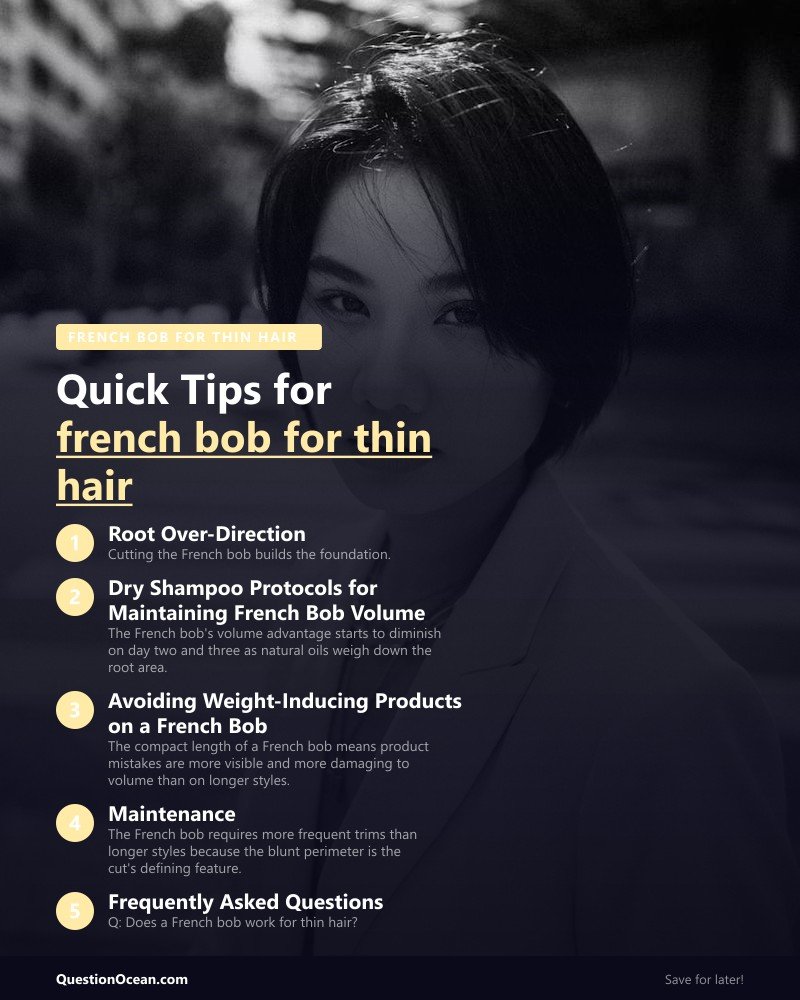
Maintenance: Keeping the Blunt Edge Sharp
The French bob requires more frequent trims than longer styles because the blunt perimeter is the cut’s defining feature. On fine hair, even 2-3 weeks of growth can soften the baseline enough to reduce the stacking effect.
Schedule trims every 6-8 weeks to maintain the crisp jawline edge that creates the thickness illusion. Between appointments, avoid any at-home trimming of the perimeter, the straight, level baseline is nearly impossible to replicate without professional tools and training.
If your hair grows quickly and the back begins to lose its shape before your next appointment, a quick blow-dry with a round brush can restore the tucked-under curve that keeps the French bob looking structured. Wrap the ends under using a 1-inch round brush while applying medium heat, holding for 3 seconds at the end of each section.
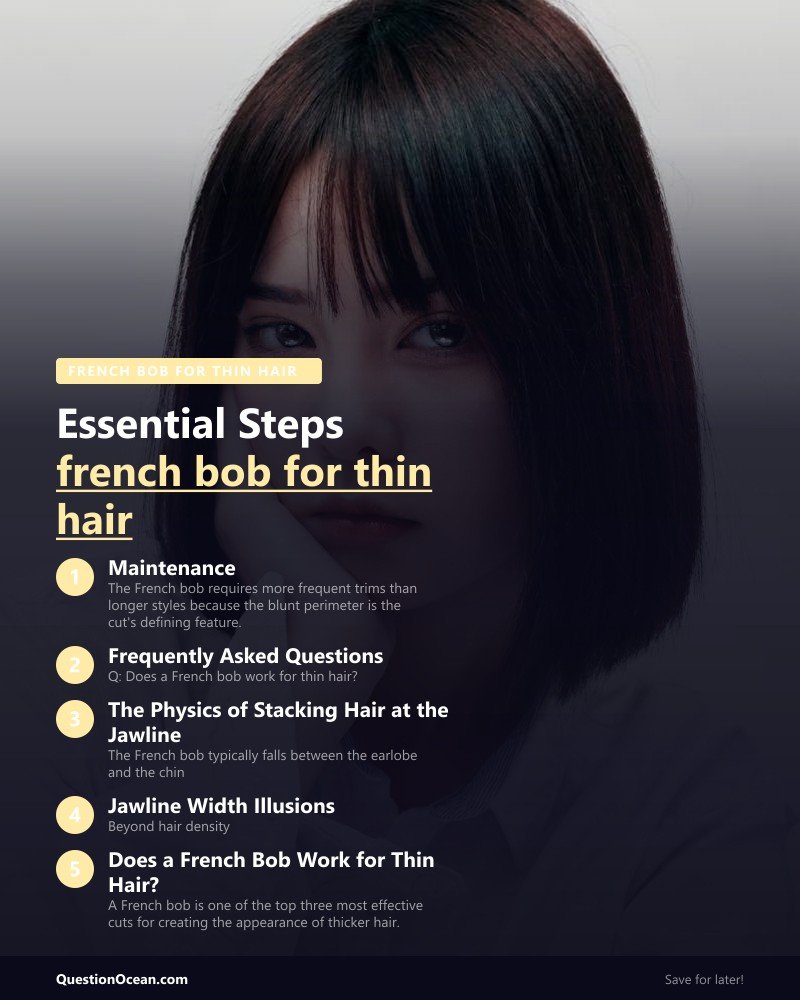
Frequently Asked Questions
Q: Does a French bob work for thin hair? A: A French bob is one of the most effective cuts for fine or low-density hair. The jaw-length blunt baseline stacks all available strands at a single termination point, creating maximum visual density. The compact length also prevents gravity from pulling strands apart the way longer cuts do.
Q: How do I add volume to a French bob? A: Root over-direction during blow-drying is the most effective technique. Dry roots in the opposite direction of their natural fall using a small round brush, then flip back to your normal part. Apply volumizing mousse at the roots before drying and finish with dry texture spray at the mid-lengths.
Q: Will a French bob make my face look wider? A: The French bob creates a horizontal weight line at the jaw that does add width to the lower face. This is flattering for heart-shaped and oval faces. If you have a round face and want to minimize width, ask your stylist for a slightly longer version that extends 1-2 centimeters past the chin, and style it with a deep side part.
Q: How often does a French bob need trimming? A: Every 6-8 weeks for fine hair. The blunt perimeter is the structural feature that creates the thickness illusion, and even minor growth softens the stacking effect. Regular trims keep the jawline edge sharp and the volume illusion intact.
Q: Can I air-dry a French bob on fine hair? A: Air-drying a French bob on fine hair typically results in flat roots and a shapeless perimeter. The cut’s volume potential depends on blow-drying with root over-direction and a round brush. If you prefer low-maintenance styling, apply mousse to damp roots, flip your head upside down, and blow-dry the roots only: this takes under 5 minutes and preserves most of the cut’s lift.
The french bob for thin hair delivers one of the strongest visual volume effects available from a single haircut. Combine the stacking geometry with root over-direction, lightweight products, and consistent trims to maintain a look that reads as full, polished, and effortlessly thick.