
Fine hair has a diameter roughly 50% thinner than medium-density strands, which means every styling decision either amplifies or flattens whatever volume you start with. The right haircuts for fine thin hair 2026 rely on optical illusions built directly into the cut itself, blunt weight lines, internal texture, and strategic length placement that trick the eye into seeing density that the strand count alone cannot deliver. This guide breaks down the geometry behind volume-boosting cuts, the 2026 styles dominating salon chairs across the US, UK, and Canada, and the lightweight products that support fullness without dragging strands flat.
From the resurgence of the Bixie to the physics of why V-layers destroy fine ends, every recommendation here serves one goal: making your hair look and feel twice as thick as it measures.
The Optical Illusion of Thickness: Why Your Cut Matters More Than Your Products
Most fine-haired clients spend heavily on volumizing products while overlooking the single biggest factor in perceived thickness: the baseline of the cut. A blunt, one-length baseline creates a solid visual edge that reads as dense. By contrast, heavily layered or razored ends scatter that visual edge, revealing scalp and spacing between strands.
The key principle is weight-line placement. The horizontal line where the bulk of the hair sits. When a stylist cuts a clean, blunt perimeter at jawline or collarbone length, all the strands terminate at roughly the same point. This stacking effect doubles the perceived density at the ends compared to a graduated or feathered finish.
Thick, coarse hair can absorb layers without losing density at the perimeter. Fine hair cannot. Every layer removed from the baseline is volume subtracted from the visual edge. This is why so many fine-haired clients leave salons feeling deflated after requesting “lots of layers for movement.”
Why V-Layers Thin the Ends of Fine Hair
V-shaped layering. Where the back hangs longer than the sides in a pointed shape. Is one of the most requested cuts across US and UK salons. For medium to thick hair, it creates beautiful cascading movement. For fine hair, it creates a wispy, see-through perimeter that highlights low density.
V-layers remove the heaviest concentration of hair from the sides and front, leaving the thinnest strands at the longest points. The visual result is a triangle of sparse, separated ends that no amount of volumizing mousse can correct.
The alternative is a U-shaped or blunt baseline that keeps perimeter density intact. If you want movement, ask your stylist for internal layers: sometimes called invisible layers. That sit 2-3 inches above the baseline. These create lift and shape without sacrificing the solid edge that fine hair depends on.
For more on strategic placement, see our guide to strategic layering and face-framing for fine hair.
The 2026 Bixie Cut: Why Stylists Recommend It for Fine Hair
The Bixie, a hybrid between a pixie and a bob, has surged across salon trend reports in New York, London, and Toronto throughout early 2026. For fine hair specifically, the Bixie works because it concentrates all available density into a compact shape above the jawline.
Shorter cuts reduce the distance that fine strands must travel, which means gravity has less opportunity to pull volume flat. A Bixie typically keeps the back cropped close while leaving the front and top long enough for directional styling. This creates the illusion of fullness through stacking at the crown and nape.
Styling a Bixie on fine hair requires minimal product: a pea-sized amount of lightweight mousse or root powder at the crown delivers all the lift most textures need. Heavier waxes and pomades flatten the cut instantly.
The Bixie also suits face shapes that benefit from width at the cheekbone, particularly oval and heart-shaped faces. Round faces may want to keep slightly more length through the front to create a lengthening visual line.
Volumizing Root Lifting Spray, lightweight formula for fine hair
What Haircut Makes Thin Hair Look Thicker?
A chin-length blunt bob is the single most effective haircut for making fine hair appear thicker. By terminating every strand at the same length along the jaw, the cut creates maximum density at the perimeter. The jawline serves as a natural visual anchor, drawing the eye to the thickest horizontal line the hair can produce.
The blunt bob works across all three major face shapes that fine-haired clients tend to have. For oval faces, a straight-across chin cut balances proportions. For long faces, the horizontal line of a bob visually widens the lower third. For heart-shaped faces, the jaw-length weight line fills out the narrower chin area.
Beyond the blunt bob, several other cuts amplify perceived density. Our guide to the French bob illusion of thicker hair details how stacking at the jawline creates one of the most convincing volume effects available. The collarbone lob with blunt ends offers a longer alternative for those who prefer below-shoulder length but still want that solid perimeter edge.
Face-Shape Matching for Fine Hair Cuts in 2026
Choosing a volume-boosting cut requires matching the shape to your facial proportions. What creates fullness on an oval face can overwhelm a round face, and vice versa.
- Oval faces suit almost every fine-hair cut, from the Bixie to the collarbone lob; the balanced proportions mean width or length adjustments work equally well
- Round faces benefit from cuts that add height at the crown and length past the chin, such as a textured lob with face-framing pieces; avoid chin-length bobs that emphasize width
- Heart-shaped faces look balanced with jaw-length bobs that fill out the narrow chin; the French bob is particularly effective here
- Square faces pair well with soft layers around the cheekbone and a length that falls just past the jaw, softening angular lines without removing perimeter density
- Long/oblong faces need horizontal volume at the sides. A classic bob with slight bend creates width that shortens the visual length of the face
For specific layering techniques tailored to face-framing, explore our guide to face-framing layers for fine hair.
Weight Lines and Internal Texture: The Technical Details
The weight line is the heaviest horizontal section in any haircut: the point where the most hair accumulates. In a blunt bob, the weight line sits at the perimeter. In a layered cut, the weight line shifts upward toward the shortest layer.
For fine hair, keeping the weight line as low as possible preserves the stacking effect that mimics thickness. Raising the weight line through short layers removes bulk from where the eye naturally looks for density.
Internal texture, created through point cutting, notching, or slide cutting within the interior of the hair. Adds movement and body without disturbing the perimeter weight line. A skilled stylist can remove internal bulk (useful for fine hair that lies flat against the head) while leaving the baseline untouched.
Ask your stylist for “internal texture with a solid perimeter.” This single request communicates exactly what fine hair needs: shape and movement through the mid-lengths with maximum density at the ends.
Lightweight Products That Support Volume-Boosting Cuts
The best haircut for fine hair loses its effect entirely under heavy styling products. Silicones, thick creams, and oil-based serums coat fine strands and eliminate the air space between them that creates perceived volume.
The ideal fine-hair product weighs less than 1 gram per application, dries without residue, and adds grip or texture rather than moisture. This means prioritizing mousses, root powders, and dry texture sprays over creams, oils, and gel-based stylers.
Our guide to weightless volumizing mousses covers the flexible-hold polymers that lift roots without stiffness. For targeted density at the part line, hairline powder for cosmetic root thickening delivers instant visual fullness. And for all-over texture and grip, texturizing sprays designed for fine hair add body without the weight penalty.
Product layering for fine hair should follow this order:
- Apply volumizing mousse to damp roots
- Blow dry with a round brush, directing roots away from the scalp
- Finish with a light texturizing spray at the mid-lengths
- Touch up the part line with hairline powder if needed
For more on the blow-dry step, see our guide to ceramic round brushes for fine hair blowouts.
Lightweight Volumizing Mousse: alcohol-free flexible hold
Avoiding the Products That Flatten Fine Hair
Not all “volumizing” products deliver on their promise. Many formulas marketed for volume contain dimethicone, cyclomethicone, or heavy conditioning agents that coat the strand and pull it downward under its own weight.
Read ingredient lists before purchasing: if a silicone appears in the first five ingredients, the product will likely weigh fine hair down regardless of what the front label claims. Our guide to avoiding heavy silicones in your styling routine provides a complete ingredient breakdown.
Between washes, dry shampoos formulated specifically for fine hair absorb oil and add micro-texture that prevents mid-day flattening. Look for formulas containing rice starch or tapioca starch rather than talc, which can leave visible residue on darker shades.
Root volume also starts at the scalp. Cross-cluster techniques from the scalp-first cosmetic styling approach, including clarifying washes and root-lifting serums: remove the buildup that weighs fine strands down before styling even begins.
Advanced Techniques: Teasing, Backcombing, and Root Direction
For occasions that demand maximum volume, mechanical techniques like teasing and backcombing add instant lift that products alone cannot match. The key is technique: aggressive teasing damages the cuticle and leads to breakage, while controlled backcombing at the crown creates sustainable volume.
Our dedicated guide to teasing techniques that prevent breakage walks through the exact motions, tools, and finishing steps that professional stylists use.
Root over-direction during blow-drying is another underused technique for fine hair. By drying roots in the opposite direction of their natural fall, you create lift that holds for 8-12 hours. Flip your part to the opposite side while blow-drying, then flip back once fully dry. The roots will retain that lifted position throughout the day.
The bob variations that work best for fine hair. Including the French and Italian bobs, rely heavily on root direction and round-brush technique to maximize their volume potential.
Haircuts for Fine Thin Hair 2026: Building Your Complete Routine
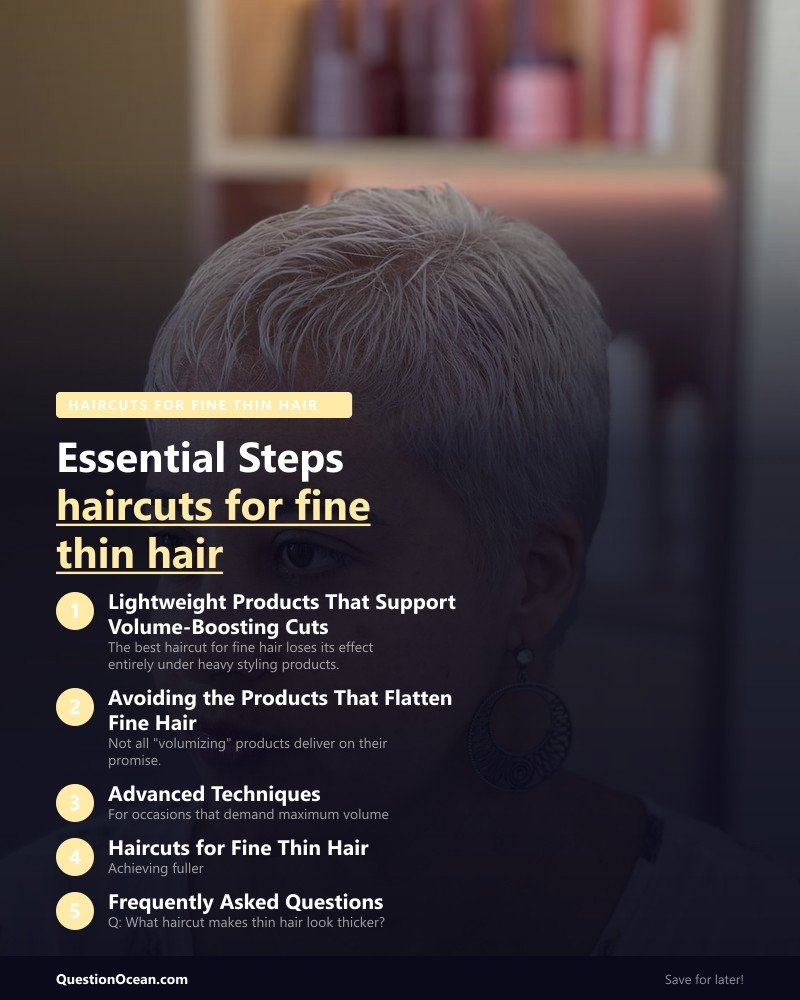
Achieving fuller-looking fine hair requires alignment between cut, products, and technique. The best haircuts for fine thin hair 2026 share three traits: a solid blunt baseline, internal texture for movement, and a length that works with gravity rather than against it. Pair a volume-boosting cut with lightweight mousses, root powders, and silicone-free formulas to maintain that fullness from wash day through day three and beyond.
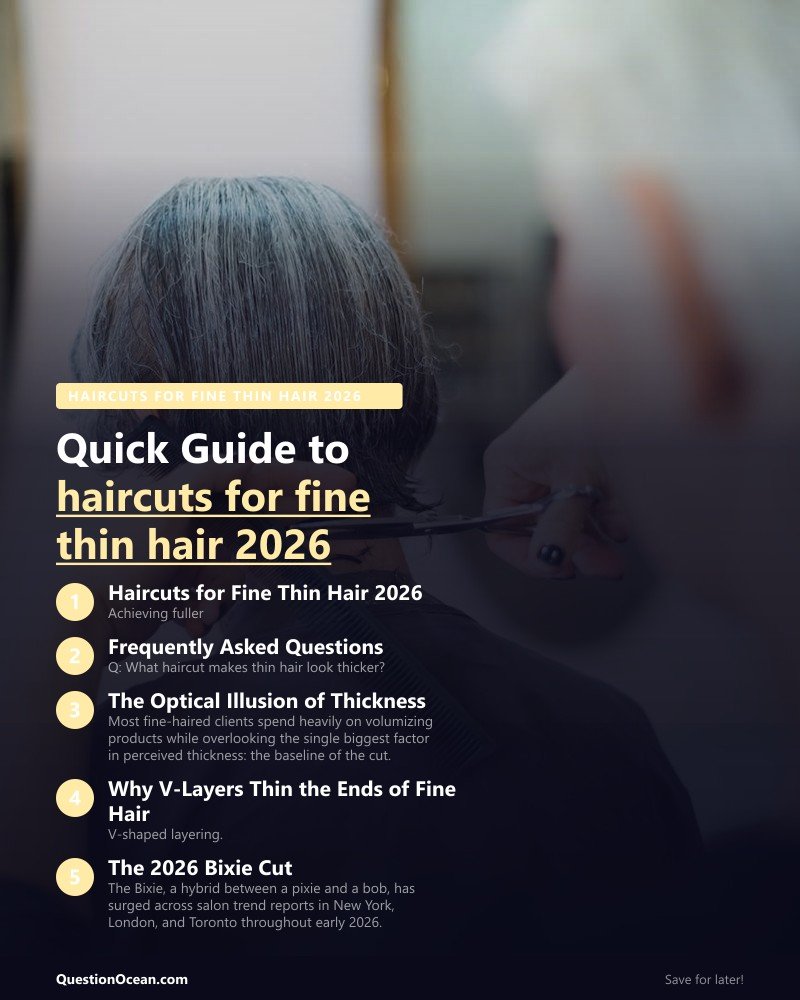
Frequently Asked Questions
Q: What haircut makes thin hair look thicker? A: A chin-length blunt bob creates the strongest illusion of thickness by stacking every strand at the same termination point along the jaw. The solid perimeter line reads as dense, and the short length prevents gravity from pulling volume flat. For a slightly longer option, a collarbone lob with blunt ends achieves a similar effect.
Q: Are layers good or bad for fine hair? A: Long, visible layers typically remove density from fine hair’s perimeter, making it look thinner. Internal layers, cut 2-3 inches above the baseline without disturbing the blunt edge — add movement and body without sacrificing the visual density at the ends. Ask for “invisible layers” at your next appointment.
Q: How often should fine hair be trimmed? A: Fine hair benefits from trims every 8-10 weeks to maintain a clean, blunt baseline. Split ends on fine strands are more visible than on thicker hair because each strand carries less bulk to camouflage damage. Regular trims keep the perimeter looking solid and full.
Q: Does the Bixie cut work for all face shapes? A: The Bixie is most flattering on oval and heart-shaped faces, where its compact volume adds balance. Round faces may want a slightly longer version with more length through the front. Square faces benefit from softening the Bixie’s edges with textured pieces around the cheekbone.
Q: Can fine hair look good long? A: Fine hair can look beautiful at longer lengths if the baseline is kept blunt and the total length does not extend past the collarbone. Beyond that point, gravity stretches fine strands too far apart, revealing scalp and spacing. A collarbone lob with one-length ends is the longest cut that reliably maintains the appearance of fullness.
Q: What is the best styling product for fine hair volume? A: Lightweight volumizing mousse applied to damp roots before blow-drying delivers the most consistent lift for fine hair. Mousse adds grip and body without the weight of creams or serums. Follow with a texturizing spray at the mid-lengths for additional fullness throughout the day.
The right haircuts for fine thin hair 2026 transform how your strands look and move by building volume directly into the geometry of the cut. Start with a blunt baseline, support it with weightless products, and let the shape do the heavy lifting.