
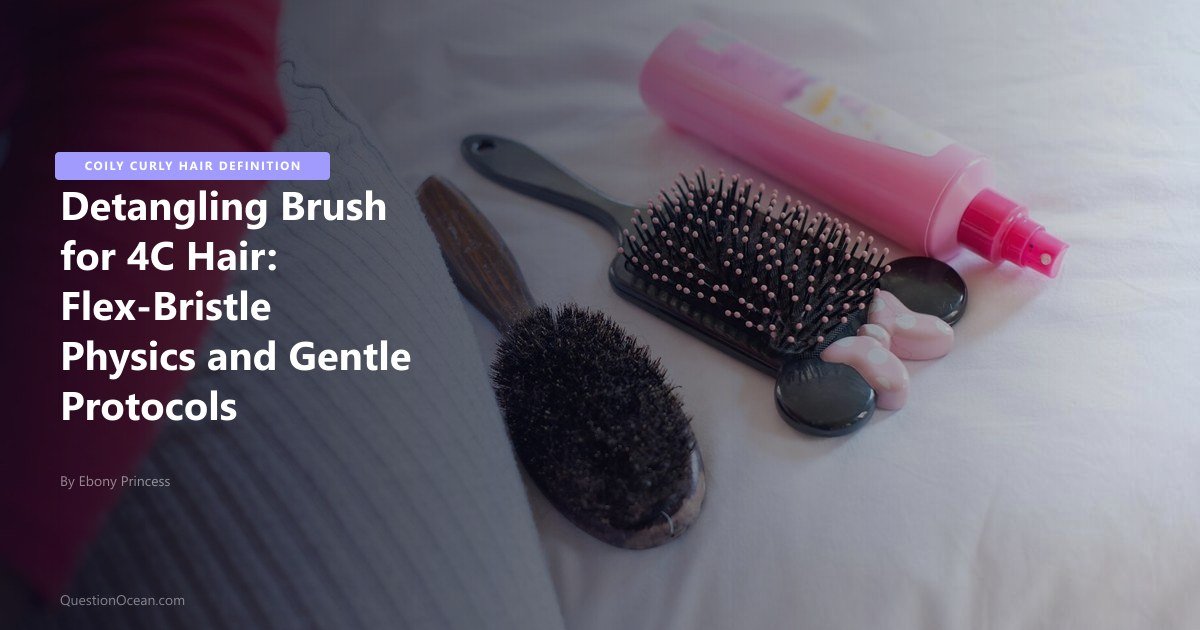
Type 4C hair experiences more mechanical breakage during detangling than any other texture, and the wrong brush is almost always the root cause. The tightly coiled Z-pattern of 4C strands creates interlocking points every few millimeters where adjacent coils wrap around each other, forming knots that resist separation. A proper detangling brush for 4c hair uses flexible bristles that bend around these knot points instead of ripping through them. Switching from a rigid-bristle brush or fine-tooth comb to a flex-bristle detangling brush reduces breakage by an estimated 50-70% per session, according to texture-specific testing by independent hair care analysts.
This guide covers the physics behind flex-bristle technology, the slip your hair needs for safe wet detangling, the bottom-up brushing protocol that protects every strand, and how to maintain your detangling brush so it performs consistently.
Understanding Mechanical Tension During Detangling
Every brush stroke applies mechanical tension to the hair strand. The amount of tension determines whether the knot separates cleanly or whether the strand snaps at the weakest point along its length.
Type 4C hair has the smallest coil diameter of any hair texture, which means more interlocking points per square inch of scalp than type 3 or type 4A-4B hair. Each interlocking point acts like a tiny knot, and the cumulative tension required to pull through dozens of these knots in a single stroke can exceed the strand’s tensile strength, approximately 60 grams of force for healthy hair, less for chemically processed or weathered strands.
Rigid-bristle brushes and fine-tooth combs force their way through these interlocking points by brute mechanical pressure. The strand either separates or breaks. There is no flex, no give, and no accommodation for the complex three-dimensional path that each 4C coil follows.
This mechanical damage is cumulative. Each detangling session that snaps even a few strands shortens the overall hair length over months and creates split ends that travel upward if not trimmed. For readers building a complete care routine around minimizing breakage, our type 3 and type 4 hair care pillar guide covers moisture layering, porosity mapping, and styling approaches that complement gentle detangling.
How Flex-Bristle Physics Protects 4C Coils
Flex-bristle detangling brushes, brands like the Tangle Teezer, Felicia Leatherwood Detangler, and Wet Brush Pro: use bristles made from thermoplastic elastomers or specially molded nylon that bend under lateral pressure rather than holding rigid.
When a flex bristle encounters a knot:
- The bristle bends laterally (sideways) as it meets resistance, deflecting around the knot rather than pushing straight through it.
- The bent bristle slides past the interlocking point, separating the strands on the outer edge of the knot first.
- As the brush continues its downward stroke, successive bristles work on the same knot from slightly different angles, gradually loosening it from the outside in.
- The knot separates in stages rather than being forced apart in a single high-tension stroke.
This staged separation mechanism distributes the total mechanical force across multiple bristles and multiple passes, keeping the tension on any single strand well below its breaking point. The physics is similar to how a flexible saw blade cuts through material more safely than a rigid one, deflection absorbs energy that would otherwise transfer entirely to the workpiece.
Bristle Spacing and Row Configuration
Bristle spacing matters almost as much as flexibility. Brushes with widely spaced bristles (3-4mm gaps) work best for initial detangling of heavily matted sections, while closer spacing (1.5-2mm) provides finer separation for finishing passes and product distribution.
Some detangling brushes feature multiple bristle lengths in alternating rows. The longer bristles reach through the section first, separating major tangles, while the shorter bristles follow behind and smooth the interior strands. This tiered design reduces the number of passes required and shortens detangling time by approximately 20-30%.
Flex-Bristle Detangling Brush, designed for type 4 natural hair
What Is the Best Detangling Brush for 4C Hair?
The best detangling brush for 4c hair combines maximum bristle flexibility, wide bristle spacing for initial passes, and an ergonomic handle that reduces hand fatigue during 20-30 minute sessions. Three brushes consistently rank highest across product testing and community reviews for type 4C hair:
- Felicia Leatherwood Detangler Brush: Features rows of flexible plastic bristles with wide spacing and a flat paddle design. The bristles flex in all directions, making it exceptionally gentle on tight coils. The wide paddle covers more surface area per stroke, reducing total session time. Available across US, UK, and CA retailers.
- Tangle Teezer The Wet Detangler: Uses two-tier bristle technology with long flexible bristles for separation and short bristles for smoothing. Compact, ergonomic shape fits comfortably in the palm. Performs best on soaking wet, heavily conditioned hair. Widely available at Boots (UK), Target (US), and Shoppers Drug Mart (CA).
- Wet Brush Pro Detangler: Features IntelliFlex bristles that bend under resistance. The cushioned bristle pad absorbs some of the downward pressure, adding another layer of tension reduction. The longer handle provides better leverage for reaching the back sections.
All three require adequate slip (see the next section) to perform at their best. Without slip, even flex bristles generate enough friction to cause breakage on type 4C hair.
Slip Required for Safe Wet Detangling
Slip: the slippery, gliding quality that a conditioner or detangling product provides, is not optional for 4C detangling. It is a functional requirement. Without sufficient slip, the friction between interlocking strands exceeds what flex bristles alone can compensate for, and breakage occurs despite using the correct brush.
What Creates Slip
Slip comes from long-chain fatty alcohols (cetearyl alcohol, cetyl alcohol) and silicones (dimethicone, cyclomethicone) in conditioner formulations. These ingredients coat each strand with a thin, slippery film that allows adjacent coils to slide past each other instead of catching.
Products that provide exceptional slip for type 4C detangling:
- Rich rinse-out conditioners with cetearyl alcohol listed in the first five ingredients. Apply generously and do not rinse before detangling.
- Dedicated detangling sprays that layer additional slip on top of conditioner for extremely matted sections.
- Leave-in conditioners with dimethicone for post-wash detangling sessions where rinse-out conditioner has already been removed.
How Much Slip Is Enough
Your brush should glide through each section with minimal resistance after conditioner application. If you feel the brush catching, tugging, or producing that high-pitched friction sound, the section needs more product. Apply additional conditioner directly to the knot zone and work it in with your fingers before attempting another brush pass.
The cost of using more conditioner is negligible compared to the cost of breakage. A single detangling session with insufficient slip can snap hundreds of strands. Use generous amounts. A palm-sized quantity per section for dense type 4C hair is appropriate.
Slippery Detangling Conditioner. Rich slip formula for coily hair
The Bottom-Up Brushing Protocol
The direction of brushing determines whether knots release safely or compound into larger, tighter tangles. Always brush from the ends upward toward the roots. Never from the roots down. This principle is the single most important technique for preventing breakage during detangling.
Why Top-Down Brushing Causes Damage
Starting at the roots and brushing downward pushes every knot you encounter toward the ends. The knots stack on top of each other, compressing into a dense, interlocking mass at the ends that requires extreme force to separate. That force snaps strands.
The Correct Bottom-Up Sequence
- Section your hair into manageable portions — 2-inch sections for dense 4C hair. Use heavy-duty duckbill clips to hold sections out of the way. For detailed sectioning strategies, our guide to sectioning curly hair covers the eight-section grid and layer-by-layer methods.
- Saturate the section with water and apply a generous amount of slippery conditioner from ends to roots.
- Hold the section firmly at the mid-shaft with one hand. This anchor point absorbs tension so it does not transfer to the root.
- Begin brushing at the very tips. The last 2-3 inches of the strand.
- Once the tips move freely, extend your brush strokes to include the next 2-3 inches higher.
- Continue working upward in 2-3-inch increments until the brush glides smoothly from root to tip.
- Release your anchor grip only after the entire section is tangle-free.
Each section should take 2-4 minutes for medium-length 4C hair. Rushing through a section increases the force per stroke and reintroduces the breakage risk that gentle technique is designed to avoid. A full-head detangling session for waist-length 4C hair typically runs 25-40 minutes.
Detangling Frequency: How Often Is Safe for 4C Hair
Over-detangling causes as much damage as under-detangling. Every brushing session, no matter how gentle, removes some shed hair and applies some mechanical stress. The goal is finding the minimum frequency that prevents matting while preserving strand integrity.
- Wash day only (every 7-10 days): The recommended baseline for most type 4C hair. Detangle during the conditioning step when the hair is saturated with slip. This approach minimizes total mechanical contact while preventing severe matting.
- Mid-week touch-up (day 3-4): Appropriate if you wear your hair in a loose, undefined style and experience moderate tangling between washes. Use a leave-in conditioner for slip and detangle only the sections that have knotted.
- Daily detangling: Generally not recommended for type 4C hair. Daily brushing accumulates mechanical stress faster than strands can recover, and the constant disruption of curl clumps prevents definition from setting.
If your hair mats severely between weekly washes, the issue is more likely insufficient overnight protection than insufficient detangling. A satin bonnet or satin pillowcase dramatically reduces friction-based tangling during sleep.
Cleaning Your Detangling Brush for Consistent Performance
Product residue, shed hair, and lint accumulate in the bristle bed after each use. A dirty detangling brush loses its flexibility because caked-on product stiffens the bristles at their base, and trapped hair between the bristles increases friction during the next session.
Weekly Cleaning Routine
- Remove all visible hair from the bristles by hand after every use. Pull shed strands from the bristle base, do not leave them to accumulate.
- Once a week, fill a bowl with warm water and a squirt of clarifying shampoo or gentle dish soap.
- Submerge the bristle end of the brush and swirl it gently for 30-60 seconds to dissolve product buildup.
- Use an old toothbrush to scrub between the bristle rows, dislodging any residue stuck to the bristle pad.
- Rinse thoroughly under running warm water until no soap residue remains.
- Shake off excess water and lay the brush bristle-side down on a clean towel to air-dry completely before the next use.
Never soak a cushioned-pad brush for more than 2 minutes. Extended soaking allows water to seep behind the rubber cushion, creating mold or mildew growth inside the brush head. Brushes with solid (non-cushioned) bases tolerate longer soaking without risk.
When to Replace Your Brush
Replace your detangling brush when:
- Bristles no longer flex back to their original position after bending. This means the thermoplastic has fatigued and the bristle has lost its tension-absorbing ability.
- The bristle tips develop rough edges or burrs that catch on strands.
- The cushion pad separates from the brush body or develops soft spots.
- Mold or persistent odor develops despite proper cleaning.
Most quality flex-bristle brushes last 10-14 months with weekly use and proper cleaning. Budget alternatives may need replacing every 4-6 months.
For readers interested in eco-friendly brush alternatives, our guide to sustainable hair brushes and zero-waste tools covers biodegradable and recyclable detangling options available in the US, UK, and Canada.
Detangling Products That Complement Flex-Bristle Brushes
The right product and brush pairing maximizes slip and minimizes breakage. For type 4C hair, the conditioner does most of the work; the brush is simply the delivery mechanism for controlled separation.
- For wash-day detangling: Use a thick, rinse-out conditioner with cetearyl alcohol and behentrimonium methosulfate high in the ingredient list. Apply to soaking wet hair. Do not rinse until detangling is complete.
- For mid-week refreshing: Use a lightweight leave-in conditioner or detangling spray. Apply to dry or slightly dampened sections before brushing.
- For heavily matted sections: Layer a detangling spray on top of rinse-out conditioner for double slip. Work the knot gently with your fingers before introducing the brush.
For readers comparing hold products to pair with their detangling routine, our guide to custards versus gels for coil definition covers how different styling products interact with freshly detangled hair.
Wide-Tooth Detangling Comb, seamless carbon fiber for zero snag
Frequently Asked Questions
Q: What is the best detangling brush for 4c hair? A: The Felicia Leatherwood Detangler, Tangle Teezer Wet Detangler, and Wet Brush Pro Detangler consistently rank highest for type 4C hair. All three use flex-bristle technology that bends around knots instead of ripping through them. Choose based on your preference for paddle shape (Felicia Leatherwood) versus palm grip (Tangle Teezer) versus handled design (Wet Brush Pro).
Q: Should I detangle 4C hair wet or dry? A: Always detangle on soaking wet hair with generous conditioner for slip. Dry detangling 4C hair multiplies friction and breakage dramatically because the coils interlock more tightly without water and conditioner to lubricate the separation.
Q: How often should I detangle 4C hair? A: Once per week during your wash-day conditioning step is the recommended baseline. Mid-week touch-ups are acceptable for loose styles that tangle, but daily detangling is not recommended due to cumulative mechanical stress on the strands.
Q: Why does my detangling brush pull out so much hair? A: You are likely seeing shed hair (strands that have already released from the follicle) rather than breakage. Type 4C coils trap shed hair within the curl mass, and detangling releases multiple days of accumulated shed at once. If the strands have a white bulb at the root end, they are shed hairs. Not broken strands.
Q: Can I use a wide-tooth comb instead of a detangling brush? A: Wide-tooth combs work but provide less gentle separation than flex-bristle brushes because comb teeth are rigid and cannot deflect around knots. If using a comb, choose one with seamless (molded) teeth rather than stamped teeth, which have micro-rough seams that catch and snag strands.
Q: How do I clean product buildup out of my detangling brush? A: Remove shed hair after every use. Once a week, soak the bristle end in warm water with clarifying shampoo for 60 seconds, scrub between rows with an old toothbrush, rinse thoroughly, and air-dry bristle-side down. Never soak cushioned brushes for more than 2 minutes to prevent mold growth inside the pad.
The right detangling brush for 4c hair paired with generous slip and a disciplined bottom-up technique transforms detangling from a breakage-heavy ordeal into a gentle, controlled process that preserves every strand. Invest in a quality flex-bristle brush, master the sectioned bottom-up protocol, and detangle only on soaking wet, conditioned hair to protect your length and maintain strong, defined coils.