
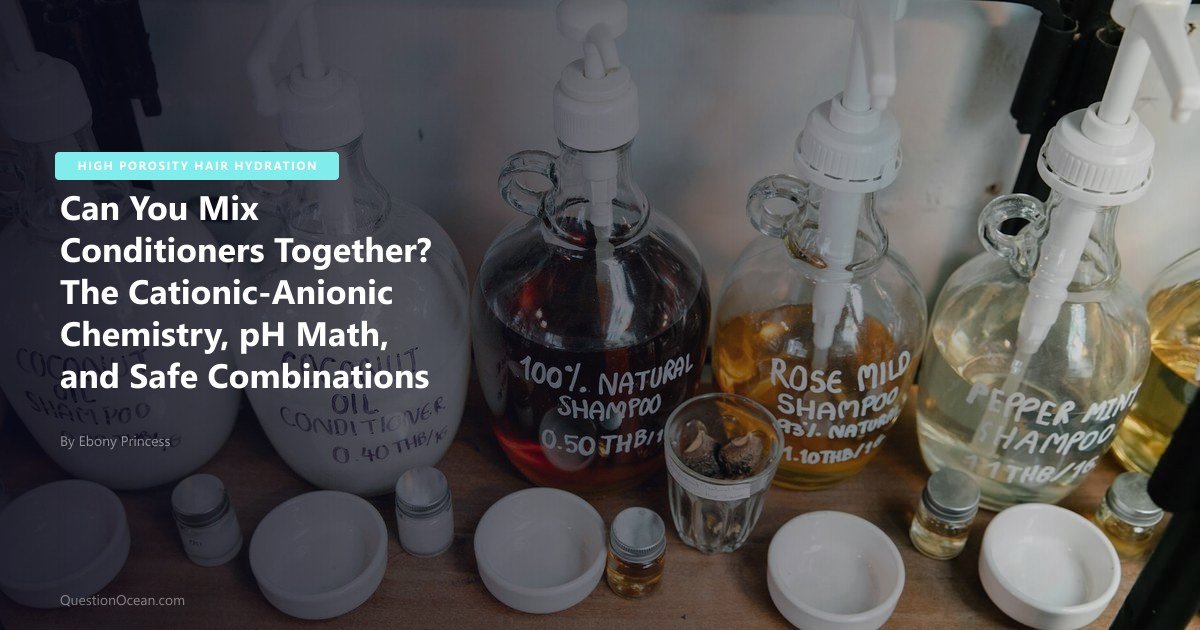
The conditioner-cocktailing trend looks creative. Combine a protein conditioner with a moisture conditioner, add a slip product, layer in some leave-in, but the chemistry behind whether two conditioners actually work together when blended isn’t covered in any of the viral tutorials. Most conditioners share a common backbone of cationic surfactants (positively charged molecules that bind to the negatively charged hair cuticle), and when two cationic systems are combined the result is usually fine, but when a cationic conditioner meets an anionic surfactant, which exists in some cleansing conditioners and co-washes, the two charge classes neutralize each other within seconds, forming a cloudy precipitate that won’t deposit on hair at all. You can mix conditioners together safely as long as both products are in the same surfactant class (almost all rinse-out conditioners are cationic), the pH values are within 1 unit of each other, and you mix immediately before application rather than storing the blend — but mixing a regular conditioner with a cleansing conditioner, low-poo, or any product containing sulfates or sulfonates causes a chemical reaction that wastes both products and can leave hair coated in inert gunk.
This guide breaks down which combinations actually work, which destroy each other in the bottle, and the protein-plus-moisture cocktailing protocol that high-porosity hair benefits from most.
For the full hydration framework that explains why high-porosity hair benefits from conditioner cocktailing in the first place, see our pillar guide to high porosity hair care.
The Surfactant Chemistry That Decides Compatibility
Last updated: May 20, 2026
Every hair product is built around surfactants, molecules with one water-loving end and one oil-loving end. They’re sorted into three classes by electrical charge (the Cosmetic Ingredient Review maintains the safety profiles for each):
| Surfactant Class | Charge | Common Examples | Found In |
|---|---|---|---|
| Cationic | Positive (+) | Behentrimonium chloride, cetrimonium chloride, polyquaternium-10 | Rinse-out conditioners, leave-ins, deep conditioners |
| Anionic | Negative (–) | Sodium lauryl sulfate, sodium laureth sulfate, ammonium lauryl sulfate | Most shampoos, cleansing conditioners, some co-washes |
| Nonionic / Amphoteric | Neutral or both | Cocamidopropyl betaine, cocamide MEA, decyl glucoside | Baby shampoos, sulfate-free cleansers, some co-washes |
The compatibility rule: Cationic + cationic = compatible. Cationic + nonionic = compatible. Cationic + anionic = incompatible. They neutralize each other within seconds, forming a cloudy precipitate that has no conditioning effect.
Why the Cationic-Anionic Reaction Matters
The reason cationic conditioners work in the first place is electrostatic attraction. Hair’s cuticle carries a slight negative charge (especially on damaged or porous hair), and the positively charged head of a cationic conditioner is drawn to that negative surface like a magnet. Once attached, it deposits the conditioning ingredients along the hair shaft.
When you introduce an anionic surfactant into the same blend, the negative charges on the anionic molecule grab the positive charges on the cationic molecule before either can reach the hair. They form an inert salt-like complex that:
- Doesn’t deposit on hair. The charge is neutralized so there’s no electrostatic attraction
- Looks cloudy or grainy. Visible precipitation in the bottle or palm
- Can leave a film. The inert complex sometimes does coat hair, but as a sticky residue rather than smooth conditioning
This is the same chemistry behind why you can’t mix a regular conditioner with a clarifying shampoo: they’ll cancel each other out.
The pH Compatibility Rule
Beyond surfactant class, pH matching matters for hair health. Hair’s cuticle responds to pH:
- pH 4.5-5.5 (slightly acidic): cuticle stays closed and smooth: the natural state
- pH 6.0-7.0 (neutral): cuticle is mildly open: most rinse-out conditioners sit here
- pH 7.5+: cuticle lifts, color treatments and relaxers operate here
- pH 9.0+: cuticle severely lifted, bleach territory
The pH-mixing rule: Conditioners within 1 pH unit of each other can be mixed without disturbing the cuticle. If you mix a pH 4.5 product with a pH 6.5 product, the resulting blend lands at roughly pH 5.5: neutral effect on the cuticle. But mixing a pH 4.0 acidic deep conditioner with a pH 8.0 alkaline mask creates an unstable blend that can either spike open the cuticle or precipitate out.
How to find the pH: Most brands don’t list pH on the label. You can buy pH test strips ($8-15) and dab the conditioner directly onto a strip with a damp finger. Within 30 seconds, the strip changes color and you can read the pH.
pH Testing Strips Hair Conditioner
The Combinations That Work
Combo 1, Protein + Moisture (the classic)
Why it works: Protein conditioners (rich in hydrolyzed wheat, keratin, silk amino acids) and moisture conditioners (rich in glycerin, panthenol, fatty alcohols) are both cationic and typically sit at pH 4.5-5.5. They blend cleanly and address both halves of high-porosity hair’s needs in one application.
How to mix: 50/50 in your palm immediately before application. For protein-sensitive hair, shift to 25 protein / 75 moisture.
For the full balance protocol, see our protein vs moisture balance guide.
Combo 2. Two Moisture Conditioners
Why it works: Stacking two moisture-focused conditioners (e.g., one shea-butter-based and one glycerin-based) gives you complementary humectants and emollients. Both are cationic and neutral pH.
How to mix: 50/50 in palm. Best for very dry, high-porosity, or coily hair.
Combo 3: Conditioner + Plant Oil
Why it works: Plant oils (argan, jojoba, coconut, avocado) are nonionic, they have no electrical charge, so they can be added to any cationic conditioner without disrupting the surfactant chemistry. The oil adds slip and seals the cuticle after the conditioner deposits.
How to mix: Add 3-5 drops of oil per tablespoon of conditioner. More than that creates greasy residue.
Combo 4: Conditioner + Honey or Aloe
Why it works: Honey and aloe vera gel are both natural humectants that pull moisture into the hair shaft. Honey is mildly acidic (pH 3.5-4.5) so use sparingly to avoid lowering the blend’s pH too much. Aloe is closer to pH 4.5-5.5, perfect for blending.
How to mix: 1 teaspoon honey OR 1 tablespoon aloe gel per 2 tablespoons conditioner.
Combo 5, Deep Conditioner + Leave-In
Why it works: Mixing a small amount of leave-in conditioner into your rinse-out deep conditioner extends the conditioning effect after rinsing because some leave-in residue persists. Both are cationic.
How to mix: 80% deep conditioner + 20% leave-in.
Deep Conditioner Protein Moisture
The Combinations That Don’t Work
Bad Combo 1: Conditioner + Cleansing Conditioner (Co-Wash)
Why it fails: Many co-washes contain mild anionic surfactants (sodium cocoyl isethionate, sodium lauryl sulfoacetate) to provide gentle cleansing. These react with the cationic ingredients in regular conditioner.
Visible signs: The blend looks lumpy, grainy, or oddly thick. After rinsing, hair feels coated and dull.
Bad Combo 2, Conditioner + Sulfate Shampoo
Why it fails: This is the textbook anionic-cationic reaction. Don’t mix shampoo and conditioner together, they cancel each other out. (This is also why “2-in-1 shampoo + conditioner” products work poorly compared to using the two separately.)
Bad Combo 3: Acidic Vinegar Rinse + Alkaline Conditioner
Why it fails: ACV rinses sit at pH 3.0-3.5. Most conditioners are pH 4.5-6.0. The 1.5+ pH gap can destabilize the conditioner emulsion, causing it to break down in your palm.
Workaround: Use the ACV rinse separately as a final step, not blended with conditioner.
Bad Combo 4. Conditioner + Hair Dye
Why it fails: Hair dye is alkaline (pH 9-10) and contains chemicals designed to lift the cuticle. Mixing it with conditioner dilutes the dye, prevents proper deposition, and the conditioner ingredients can interfere with the dye’s developer reaction. (Adding conditioner to dye to “soften” it is a persistent myth that ruins color results.)
Bad Combo 5. Two Protein Conditioners
Why it fails: Both products being protein-heavy doubles the protein load on the hair, which can cause protein overload, hair feels stiff, brittle, and breakage-prone within 3-5 uses. Stick to one protein source per application.
The Cocktailing Protocol for High-Porosity Hair
High-porosity hair is the type that benefits most from conditioner cocktailing because its raised cuticle absorbs and releases moisture too quickly with any single product. The protocol:
Pre-Mix Setup
- Identify your “moisture base”: your primary daily/weekly conditioner (look for labels saying “moisturizing,” “hydrating,” “deep moisture”)
- Identify your “protein add-in”. A separate protein-rich conditioner you’ll use as a complement (look for “strengthening,” “reconstructing,” “protein treatment”)
- Confirm both are cationic: check the ingredient lists for behentrimonium chloride, cetrimonium chloride, or behenamidopropyl dimethylamine. If either contains “sulfate,” “sulfonate,” or “isethionate” early in the list, do NOT mix.
The 3-Step Mix
Step 1: Palm test (one-time only): First time mixing a new pair, place a quarter-sized dollop of each in your palm and stir with a finger. If the blend stays smooth and the same color as the original products, you’re compatible. If it turns grainy, lumpy, cloudy, or significantly changes color, the products are incompatible, don’t use.
Step 2, Mix immediately before application: Combine 70% moisture base + 30% protein add-in for normal high-porosity hair, OR 50/50 for severely damaged or color-treated hair. Mix in your palm; never store the blend in a jar.
Step 3. Apply, leave for 15-20 minutes, rinse cool. Cool water helps the cuticle close and lock in the conditioning ingredients.
Why never store the blend: Mixing two preserved products dilutes both preservative systems. The blend’s preservative concentration may drop below the threshold needed to prevent bacterial growth, so a stored blend can develop bacteria within 1-2 weeks even though each individual product would have been fine for months. Mix per session.
The “Mix in the Palm vs Mix in a Bottle” Question
Stylists who cocktail products professionally always mix per session in the palm. Hobbyists sometimes try to save time by pre-mixing in a small bottle.
Pros of pre-mixing:
- Faster application during routine
- Consistent ratios every time
Cons of pre-mixing:
- Preservative dilution (see above). Bacterial growth risk within 1-2 weeks
- pH drift. The blend’s pH can shift over days as ingredients interact
- Emulsion separation. Some blends look uniform initially but separate within hours
- Reduced active ingredient potency — proteins and humectants can degrade faster in a blend than in their original buffered formulas
Verdict: Pre-mix only if you’ll use the entire blend within 5-7 days, store it in a refrigerator, and add a drop of vitamin E oil as an extra antioxidant. Otherwise mix per session.
Frequently Asked Questions
Q: Can you mix two conditioners together? A: Yes, if both are in the same surfactant class (almost all rinse-out conditioners are cationic) and within 1 pH unit of each other. Mix in your palm immediately before application. Never store the blend long-term because preservative dilution can lead to bacterial growth. A 50/50 protein-moisture mix is the most common and effective combination for high-porosity, color-treated, or damaged hair.
Q: Is it bad to mix conditioner brands? A: Not inherently. Different brands often use the same backbone ingredients (cationic surfactants, fatty alcohols, humectants). The brand difference matters less than the surfactant class and pH compatibility. As long as both are rinse-out conditioners (not cleansing conditioners), they can usually be mixed.
Q: Can I mix conditioner with shampoo? A: No. Shampoo contains anionic surfactants and conditioner contains cationic surfactants. They neutralize each other on contact, forming an inert precipitate that doesn’t clean OR condition. This is also why 2-in-1 products typically underperform separate products. Use them sequentially, not blended.
Q: Can I mix a protein treatment with my regular conditioner? A: Yes. This is the most common cocktailing application. Use 30% protein treatment + 70% moisture conditioner for high-porosity hair, or 50/50 for severely damaged hair. Don’t mix two protein treatments together; stack one protein source per application to avoid protein overload.
Q: Will mixing conditioners cause an allergic reaction? A: Mixing doesn’t create new allergens, but it doubles your exposure to potential triggers. If you’re sensitive to fragrance, dye, or specific preservatives, mixing two products doubles your exposure to those ingredients per application. Patch test any new combination on your inner elbow before applying to scalp.
Q: Can I mix deep conditioner with leave-in conditioner? A: Yes, and it’s a common technique to extend conditioning effect. Use 80% deep conditioner + 20% leave-in. Both are cationic so they’re chemically compatible.
Q: What happens if I mix a conditioner with sulfates by accident? A: The blend will look cloudy, grainy, or lumpy almost immediately. Don’t apply it to your hair. It won’t condition or clean effectively. Wash it out of your palm and start over with a different product. No long-term damage from one accidental mix, but the products you used are wasted.
Q: Can I add oil to my conditioner? A: Yes. Plant oils (argan, jojoba, coconut, avocado, olive) are nonionic, they don’t have an electrical charge, so they can be added to any cationic conditioner without disrupting the chemistry. Use 3-5 drops per tablespoon of conditioner.
Q: Can I mix conditioners and store the blend in the fridge? A: For up to 5-7 days, yes, if you add a drop of vitamin E oil for antioxidant support. Beyond a week, preservative dilution makes bacterial growth a real risk. Better to mix per session.
For the full deep conditioning routine that uses cocktailed conditioners as part of a porosity protocol, see our deep conditioners for porous hair guide.
The mix-conditioners-together question has a clean answer once you understand the surfactant chemistry: cationic-plus-cationic blends work; cationic-plus-anionic blends don’t. Almost all rinse-out conditioners are cationic, so the trick is just avoiding the small category of cleansing conditioners and 2-in-1 products that contain anionic surfactants. Protein-plus-moisture cocktails are the highest-value application for high-porosity hair, and the rule of “mix in palm immediately before applying, never store” prevents the preservative-dilution problem that ruins pre-mixed blends within days.