
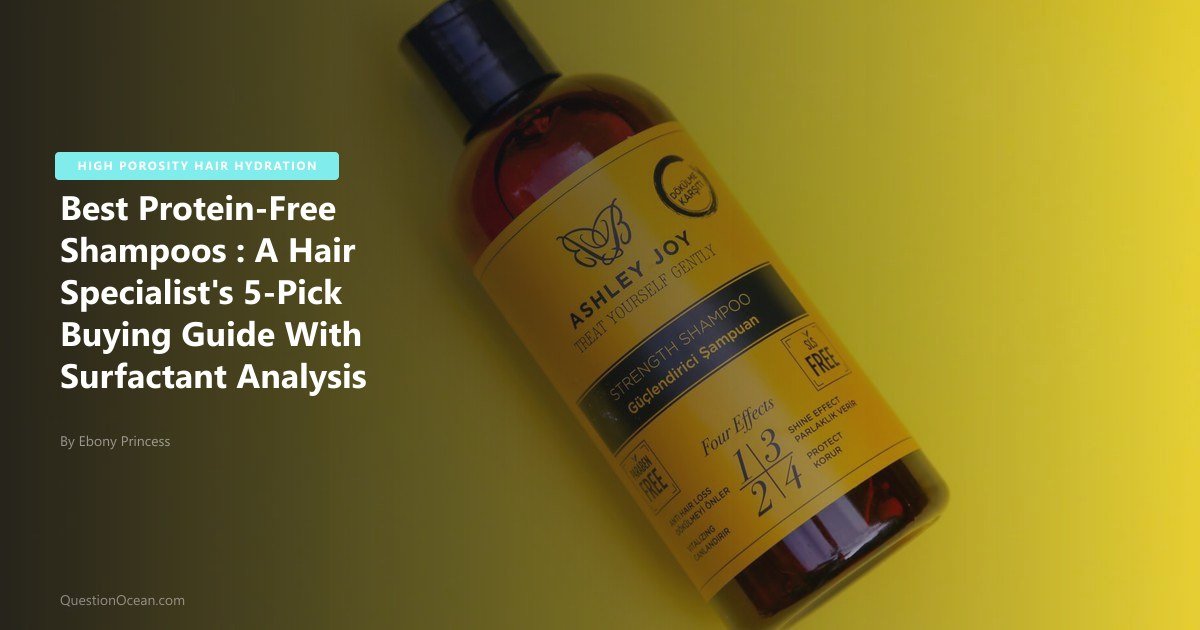
When a “protein-free” shampoo isn’t delivering results, the answer is almost always in the full ingredient list, 7 times out of 10, there’s a hidden protein in the first 10 ingredients that the marketing copy didn’t mention. The protein-free shampoo category is genuinely useful for fine, low-porosity, post-keratin-treatment, and protein-sensitive hair, but the marketing labels lie often enough that you can’t trust the front of the bottle. A truly protein-free shampoo contains zero hydrolyzed proteins (wheat, keratin, silk, soy, oat, rice, quinoa, corn, pea), zero amino acids listed by name, zero yogurt, egg, whey, or collagen, AND uses gentle surfactants (cocamidopropyl betaine, decyl glucoside, sodium cocoyl isethionate) rather than harsh sulfates that strip the cuticle and create the secondary “stiff dry hair” symptom that mimics protein overload. This guide picks the 5 shampoos that pass both filters, breaks down the surfactant profile of each, and explains the buying criteria that separate marketing from reality.
For the broader protein-sensitive routine that pairs with these shampoos, see our how to treat protein-sensitive hair guide.
The 4-Filter Buying Criteria
Last updated: May 23, 2026
Before picking a shampoo, run every candidate through these four filters. Most “protein-free” shampoos pass filter 1 but fail one of the others.
Filter 1, Zero Hidden Protein
Scan the full ingredient list for these 14 protein sources:
| Ingredient name | Common alias |
|---|---|
| Hydrolyzed wheat protein | Triticum vulgare protein |
| Hydrolyzed soy protein | Glycine soja protein |
| Hydrolyzed silk protein | Bombyx mori extract |
| Hydrolyzed collagen | Marine collagen |
| Hydrolyzed keratin | Wool / feather keratin |
| Hydrolyzed oat protein | Avena sativa protein |
| Hydrolyzed rice protein | Oryza sativa protein |
| Hydrolyzed quinoa protein | Chenopodium quinoa protein |
| Hydrolyzed corn protein | Zea mays protein |
| Hydrolyzed pea protein | Pisum sativum protein |
| Specific amino acids | Arginine, glutamic acid, lysine HCl, etc. |
| Yogurt extract | Lactobacillus ferment lysate |
| Egg yolk powder | Ovum powder |
| Whey protein | Lactose ferment |
If any one appears, the shampoo is NOT protein-free regardless of front-label claims.
Filter 2. Surfactant Profile
Even a 100% protein-free shampoo can damage hair if it uses harsh surfactants. The surfactant tier list:
| Tier | Surfactant | Strip Strength |
|---|---|---|
| Avoid | Sodium lauryl sulfate (SLS) | Very harsh |
| Avoid | Ammonium lauryl sulfate (ALS) | Very harsh |
| Caution | Sodium laureth sulfate (SLES) | Moderate |
| OK | Sodium cocoyl isethionate (SCI) | Mild |
| Good | Cocamidopropyl betaine | Very mild |
| Good | Decyl glucoside | Very mild |
| Good | Coco glucoside | Very mild |
| Good | Sodium lauroyl methyl isethionate | Mild |
Why this matters: A protein-sensitive person using a SLS-based protein-free shampoo will still experience dry, brittle hair because the SLS strips the natural lipid layer. They’ll think the protein-free routine “isn’t working.” The fix is the surfactant, not more protein avoidance.
Filter 3. PH 4.5-5.5
The shampoo should be pH-balanced to match hair’s natural acidic state. Shampoos at pH 6+ leave the cuticle slightly raised, which feels exactly like protein damage to the touch. Most brands don’t print pH on the label, so check brand websites or test with a pH strip.
Filter 4, No Buildup-Causing Heavy Coating Agents
For low-porosity hair specifically (which overlaps heavily with protein-sensitive hair), avoid:
- Heavy plant butters (shea, mango, cocoa) listed in the first 5 ingredients
- Mineral oil
- Heavy waxy silicones (dimethicone above 5% concentration)
- Petrolatum
These don’t contain protein, but they create the same “coated, stiff” symptoms by sitting on the cuticle.
The 5 Best Protein-Free Shampoos (2026 Selection)
Each pick passed all 4 filters. Always re-verify the ingredient list at purchase time: formulas change.
Pick 1, SheaMoisture Baobab & Tea Tree Oils Low Porosity Protein-Free Shampoo
Why it’s #1: This is the rare drugstore-priced shampoo that’s both genuinely protein-free AND uses a gentle surfactant profile (sodium cocoyl isethionate as primary, cocamidopropyl betaine secondary). The “low porosity” formulation removes the heavy butters that SheaMoisture’s other lines use, making it appropriate for the people who most need protein-free.
Surfactant profile: Sodium cocoyl isethionate, cocamidopropyl betaine, sodium methyl cocoyl taurate pH: ~5.0 (verified) Standout ingredients: Baobab oil, tea tree oil, aloe leaf juice Best for: Low porosity + protein sensitive + budget-conscious Trade-off: Lather is light, people used to sulfates may feel like it “isn’t cleaning” Price tier: $$ ($10-15)
Pick 2, Innersense Hydrating Cream Hair Bath
Why it makes the list: One of the cleanest ingredient lists in the protein-free shampoo category. Glucoside-based surfactants only, plant-derived everything, and a clear “no proteins” formulation philosophy from a brand that publishes its full ingredient sourcing.
Surfactant profile: Decyl glucoside, coco glucoside (the gentlest two surfactants commonly available) pH: ~5.5 (verified) Standout ingredients: Aloe juice, marshmallow root, orange peel oil Best for: Sensitive scalp + protein sensitive + premium-budget Trade-off: Expensive ($30+) and minimal lather: requires technique adjustment Price tier: $$$$ ($30-40)
Pick 3. Inahsi Naturals Soothing Mint Sulfate-Free Shampoo
Why it makes the list: Black-owned indie brand with rigorous ingredient transparency. Sulfate-free, protein-free, and pH-balanced. Inahsi specifically markets to natural hair where protein sensitivity is common, and the formulator publishes pH data for every product.
Surfactant profile: Sodium cocoyl isethionate, cocamidopropyl betaine, decyl glucoside pH: ~4.8 (published by brand) Standout ingredients: Peppermint oil, aloe vera, marshmallow root Best for: Scalp irritation + protein sensitive + 4-type natural hair Trade-off: Smaller brand, sometimes harder to find in physical stores Price tier: $$ ($15-22)
Pick 4, As I Am Coconut CoWash (Used as a Cleansing Conditioner)
Why it makes the list: Technically a co-wash rather than a traditional shampoo, but for many protein-sensitive people the gentlest cleansing comes from a co-wash routine. Coconut CoWash is fully protein-free and works as a daily cleanser for textured hair.
Surfactant profile: Cetearyl alcohol, behentrimonium methosulfate (cationic, so it cleanses gently without anionic stripping) pH: ~5.0 (verified) Standout ingredients: Coconut oil, castor oil, saw palmetto Best for: Coily hair + frequent washing + extreme protein sensitivity Trade-off: Doesn’t remove heavy product buildup, requires occasional clarifying Price tier: $$ ($10-16)
Pick 5. Curlsmith Curl Quenching Cleansing Conditioner
Why it makes the list: Premium co-wash with a verified protein-free formulation. Curlsmith publishes ingredient breakdowns and confirms protein-free status for this specific product. Especially good for color-treated curly hair where protein sensitivity overlaps with color preservation needs.
Surfactant profile: Cocamidopropyl betaine, sodium cocoyl isethionate (mild dual system) pH: ~5.0 Standout ingredients: Aloe vera, glycerin, jojoba oil, marula oil Best for: Color-treated curls + protein sensitive + premium budget Trade-off: Premium price, must be ordered online in some regions Price tier: $$$ ($22-30)
Protein Free Shampoo Low Porosity
Honorable Mentions (Good But Didn’t Crack the Top 5)
- Bounce Curl Pure Cleansing Hair Shampoo, protein-free, but pH runs slightly higher than ideal at 5.8-6.0
- Carol’s Daughter Hair Milk Cleansing Conditioner. Protein-free, but contains heavier oils that may build up on low-porosity hair
- Camille Rose Sweet Ginger Cleansing Rinse — protein-free and gentle, but the ginger essential oil can irritate sensitive scalps
- Aunt Jackie’s Oh So Clean! Moisturizing Shampoo, protein-free, drugstore price, but uses sodium laureth sulfate (Tier 2. Caution)
What I Don’t Recommend (And Why)
These products are commonly listed in “best protein-free” articles but they cause issues for protein-sensitive hair:
Avoid 1. Any “Strengthening” or “Repair” Shampoo
Even when these don’t contain hydrolyzed proteins specifically, they almost always contain bond-building amino acid blends or “amino acid complexes” that protein-sensitive hair reacts to.
Avoid 2, Most “2-in-1” Shampoo + Conditioner Products
The combined products usually contain protein in the conditioner phase. They’re also chemically suboptimal due to the cationic-anionic incompatibility issue.
Avoid 3 — Clarifying Shampoos with SLS or ALS
Even occasional use of harsh sulfate clarifiers can damage protein-sensitive hair. If you need to clarify, use a chelating clarifier (with EDTA) rather than a harsh-surfactant clarifier.
Sulfate Free Moisturizing Shampoo
How to Test a New Protein-Free Shampoo
When trying any new shampoo from this list (or any other), use this 2-week protocol:
Days 1-3. Cleanse Only
Use the shampoo with no other products. No conditioner, no leave-in, no styler. This isolates the shampoo’s effect from anything else and lets you see how your hair responds to just the cleansing.
Day 4, Add Your Existing Conditioner
Pair with your current conditioner. Note any change.
Days 5-7, Add Your Existing Styling Products
Build the full routine back. Note any changes.
Days 8-14, Continue and Track
For two weeks, track:
- How your scalp feels (dry, oily, itchy, normal)
- How your hair feels day 1 vs day 3 of a wash cycle
- Whether curl pattern (if applicable) has changed
- Any visible damage or improvement at the ends
If hair improves through this 2-week trial, the shampoo works for you. If it gets worse, switch.
The “How Often to Wash” Question
Protein-sensitive hair is also often dry, and the wash frequency that works varies by hair type:
| Hair Type | Suggested Wash Frequency (with protein-free shampoo) |
|---|---|
| Fine straight | Every 2-3 days |
| Medium normal | Every 3-4 days |
| Coarse / curly | Every 5-7 days |
| Coily Type 4 | Every 7-10 days |
| Color-treated | Every 4-7 days (less is better for color) |
| Locked / locs | Every 7-14 days |
Use the gap between washes to refresh with water-based mist instead of additional cleansing.
Frequently Asked Questions
Q: What is the best protein-free shampoo? A: For most people, SheaMoisture Baobab & Tea Tree Oils Low Porosity Protein-Free Shampoo offers the best combination of verified protein-free formulation, gentle surfactant profile (sodium cocoyl isethionate base), pH 5.0, and drugstore availability. For premium budgets, Innersense Hydrating Cream Hair Bath is the cleanest formulation but costs 2-3x more.
Q: How do I know if a shampoo is really protein-free? A: Read the full ingredient list, not just the front of the bottle. Search for any word containing “hydrolyzed,” any specific amino acid name (arginine, glutamic acid, lysine), plus “protein,” “keratin,” “silk,” “collagen,” “wheat,” “soy,” “oat,” “rice,” “quinoa,” “yogurt,” “egg,” and “whey.” If none appear, the shampoo is genuinely protein-free.
Q: Is sulfate-free the same as protein-free? A: No, they’re independent attributes. A shampoo can be sulfate-free but contain hydrolyzed protein, or contain sulfates but no protein. For protein-sensitive people, you want both: protein-free AND sulfate-free (or at least gentle surfactant-based).
Q: What’s the difference between a protein-free shampoo and a regular shampoo? A: Protein-free shampoos exclude all hydrolyzed proteins, amino acids, and protein-derived ingredients. Regular shampoos often include hydrolyzed wheat, silk, or keratin for “strengthening” claims. For protein-sensitive hair, regular shampoos cause stiffness and brittleness within 1-3 uses; protein-free shampoos prevent that reaction.
Q: Can I use a protein-free shampoo every day? A: The protein-free formulation isn’t the limiting factor. The surfactant strength is. Glucoside-based shampoos (decyl glucoside, coco glucoside) can be used daily. Sodium cocoyl isethionate-based shampoos can be used 3-5 times per week. Avoid daily use of any sulfate-containing shampoo, regardless of protein content.
Q: Are protein-free shampoos good for low porosity hair? A: Often yes, because most protein-sensitive people also have low-porosity hair. But check the ingredient list for heavy butters and waxes (shea, mango, cocoa, beeswax), these don’t contain protein but cause the same “coated, stiff” symptoms on low-porosity hair. The best protein-free shampoos for low porosity use lightweight cleansers and humectants.
Q: Will a protein-free shampoo fix protein overload? A: Partially. Protein-free shampoo prevents adding more protein, but it doesn’t strip existing protein from the hair. Overload recovery requires (1) switching all products to protein-free, (2) clarifying once with a chelating shampoo to strip existing buildup, (3) deep conditioning with moisture-only masks for 4-6 weeks, and (4) running the wet/dry stretch test weekly to track recovery.
Q: Are natural / clean shampoos always protein-free? A: No. Many “natural,” “clean,” “vegan,” and “organic” shampoos contain plant-derived hydrolyzed proteins (wheat, soy, rice, quinoa). The clean beauty marketing focuses on excluding sulfates, parabens, and silicones. Not proteins. Always check the ingredient list independently.
Q: How long until I see results from switching to a protein-free shampoo? A: 2-4 weeks for most people. Hair that was experiencing protein overload symptoms will feel softer within 1-2 washes. Cumulative cuticle recovery takes 4-6 weeks. If you see no improvement by week 4, the problem is not protein, re-diagnose with the wet/dry stretch test.
The protein-free shampoo category genuinely solves a real problem for the right hair type, but the marketing labels can’t be trusted at face value. Use the 4-filter buying criteria to qualify any candidate, run the 2-week test protocol before committing, and watch for the surfactant profile as well as the protein content. The 5 picks above pass the filters and consistently deliver for protein-sensitive clients in 2026, but ingredient lists change, so always re-verify before each purchase.
For the deep conditioner half of the protein-free routine, see our protein-free deep conditioner guide.