
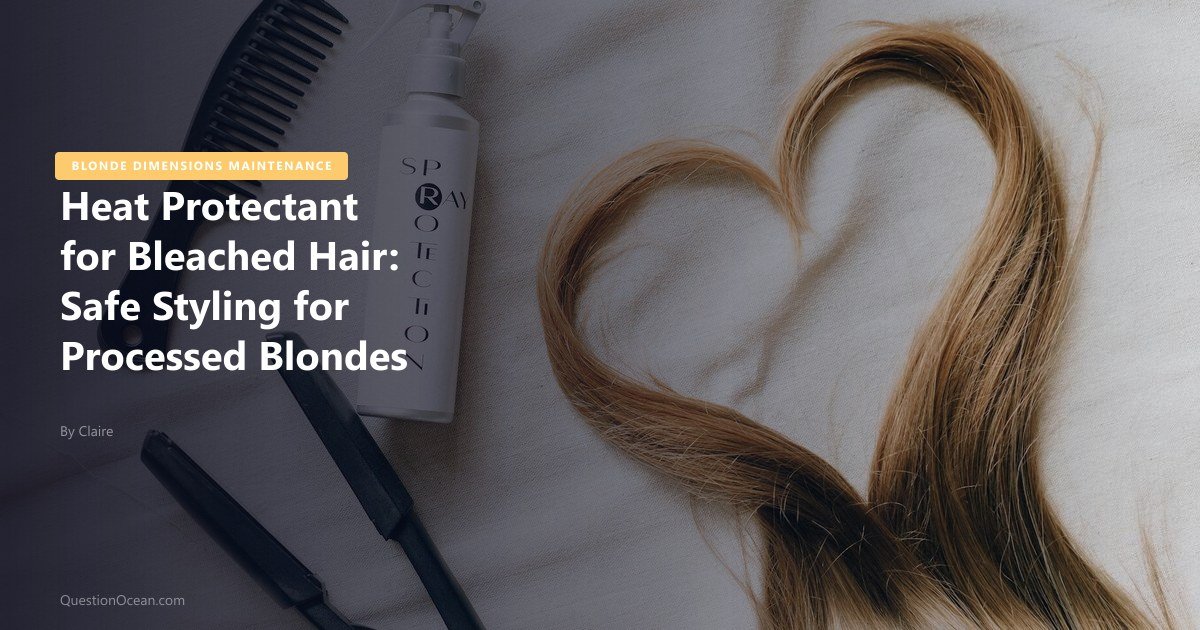
Bleached hair loses 20-30% of its internal protein structure during the lightening process, and every pass of a flat iron or curling wand above 300°F accelerates that structural compromise. A heat protectant for bleached hair is not an optional styling extra. It is the barrier between a luminous, healthy-looking blonde and brittle, yellowed, breakage-prone strands. The right thermal shield reduces measurable heat damage by 50-70%, yet most blondes apply it incorrectly, use the wrong formula type, or rely on products that cannot withstand the temperatures their tools actually reach.
This guide covers the silicone chemistry that creates thermal barriers, the critical temperature thresholds every bleached blonde needs to understand, the cream versus spray debate, and the specific products and ingredients that protect without yellowing.
Silicone Shielding Chemistry: How Heat Protectants Work
Heat protectants function through three primary mechanisms: thermal barrier formation, moisture retention, and surface smoothing. The first mechanism. Barrier formation. Does the heavy lifting on bleached hair.
Silicone-based polymers (dimethicone, cyclomethicone, and amodimethicone) create a thin film over the hair shaft that distributes thermal energy across a wider surface area. Instead of a concentrated 410°F hotspot at the point of contact between the iron plate and the strand, the silicone layer spreads that heat laterally, reducing the peak temperature experienced by any single section of the cuticle by 30-50%.
Dimethicone is the most common heat-protective silicone, forming a continuous film with a thermal stability threshold of approximately 400°F (204°C). Above that temperature, the silicone begins to degrade, releasing the protective barrier and exposing the hair to direct thermal contact. Cyclomethicone evaporates during the initial heat pass, providing temporary protection that does not build up between washes.
For bleached hair: which has a more open, porous cuticle structure than virgin hair — the silicone film also seals the cuticle flat, preventing moisture from escaping during heat application. This dual function (thermal barrier + moisture seal) makes silicone-based protectants the gold standard for chemically lightened strands.
For an overview of how heat styling fits into the broader blonde maintenance framework, see our 2026 blonde hair color trends guide.
Best Heat Protectant for Bleached Blonde Hair?
The best heat protectant for bleached blonde hair combines high-molecular-weight dimethicone for thermal shielding with lightweight humectants (panthenol, glycerin) for moisture retention, and carries zero yellow-tinted oils or amber-colored ingredients that can stain light hair. Products meeting all three criteria include:
- GHD Heat Protect Spray: Rated to 392°F (200°C), clear formula, no color distortion. Available across US, UK, and CA Amazon.
- Chi 44 Iron Guard Thermal Protection Spray: Rated to 450°F (232°C), lightweight spray, contains silk and ceramic for added smoothing.
- Living Proof Restore Instant Protection: Contains their patented OFPMA molecule that creates a non-silicone thermal barrier, suitable for blondes who prefer silicone-free routines.
- Olaplex No. 7 Bonding Oil: Bond-building protection with a lightweight oil base, though the slight amber tint requires careful application on platinum and pearl blondes.
The product’s rated temperature protection must match or exceed the temperature you actually use on your styling tools. A protectant rated to 350°F provides zero additional benefit when used with a flat iron set to 410°F. The barrier has already broken down 60 degrees below your operating temperature.
Heat Protectant Spray, thermal protection for bleached and lightened hair
Thermal Capacity and the 450°F Threshold
Bleached hair has a lower thermal tolerance than virgin hair because the lightening process removes melanin granules and protein bonds that normally absorb and distribute thermal energy. Where virgin hair can withstand brief exposure to 420-450°F (215-232°C) without visible damage, bleached hair begins showing signs of thermal degradation at 350-370°F (177-188°C).
The practical maximum temperature for heat styling bleached hair is 350-375°F (177-190°C) with a heat protectant applied, or 300°F (149°C) without protection. Temperatures above 400°F cause rapid vaporization of internal moisture, creating visible steam that represents irreversible protein damage at the cortex level.
Most professional flat irons and curling wands reach temperatures up to 450°F (232°C), a setting designed for coarse, virgin, resistant hair. Bleached blondes should never need to exceed 375°F, and many achieve excellent results at 330-350°F with a slower, more deliberate pass speed.
Temperature Guidelines by Blonde Type
- Platinum and Pearl (Level 9-10, heavily lightened): Maximum 330°F (166°C). Use the slowest possible pass speed to compensate for lower temperature.
- Suede and Sandy Blonde (Level 8-9, moderate lightening): Maximum 360°F (182°C). One pass per section is sufficient with proper protectant application.
- Butter Gold and Balayage (Level 7-8, partial lightening): Maximum 375°F (190°C). The darker root sections can tolerate slightly higher temperatures than the lightened ends.
For a deep dive into the tools themselves and their built-in temperature regulation features, see our guide on hot tools for preventing heat damage.
Cream vs. Spray: Choosing the Right Formula
The cream-versus-spray debate is not about personal preference, it is about hair porosity, density, and the specific styling tool being used. Each formula type distributes thermal protection differently across the strand.
Spray Formulas
Heat protectant sprays deliver a fine, even mist that coats strands without adding weight or altering texture. They work best for:
- Fine, thin bleached hair that collapses under heavy products
- Blowout styling where the protectant needs to coat all strands evenly before high-velocity airflow
- Quick touch-ups where only a few sections need protection
- Layering under other styling products without creating buildup
Sprays typically contain lighter silicones (cyclomethicone, dimethiconol) that evaporate partially during heat application. Their protection is effective but shorter-lived than cream formulas. One pass of a hot tool may consume most of the protective barrier.
Cream Formulas
Heat protectant creams deliver a thicker, more concentrated barrier that remains on the strand through multiple heat passes. They work best for:
- Thick, coarse bleached hair that needs sustained protection through longer styling sessions
- Flat ironing and curling where the tool makes direct, prolonged contact with the strand surface
- Very porous, high-porosity bleached hair that absorbs and depletes spray formulas before the tool even makes contact
- Overnight or leave-in protection for next-morning heat styling
Creams contain higher concentrations of dimethicone and amodimethicone, providing a more robust thermal barrier that withstands 2-3 passes per section. The trade-off is added weight. 0.5-1.5 grams per application. Which can flatten fine hair if over-applied. Use a pea-sized amount for fine hair (shoulder length) or a nickel-sized amount for thick, long hair.
Heat Protectant Cream, concentrated thermal shield for processed and bleached hair
Avoiding Yellow-Tinted Oils on Blonde Hair
Certain natural oils and product ingredients carry a visible yellow, amber, or orange tint that transfers to blonde hair during heat application. Heat amplifies this color transfer by opening the cuticle and allowing the tinted molecules to penetrate deeper into the strand.
Oils to avoid on light blonde hair:
- Argan oil: Naturally amber-tinted. Safe on dark blondes (level 7-8) but can warm up platinum and pearl blondes.
- Marula oil: Golden hue that intensifies under heat. Avoid on anything lighter than level 8.
- Coconut oil (unrefined): Slight yellow cast when heated. Refined coconut oil is clear and safe for blonde use.
- Moringa oil: Deep golden tint. Not recommended for any blonde shade.
Safe, color-neutral alternatives:
- Grapeseed oil: Clear, lightweight, high smoke point. Excellent for blonde hair.
- Jojoba oil: Nearly colorless, closely mimics natural sebum. Low viscosity works well under heat protectant sprays.
- Squalane: Completely clear, non-comedogenic, and thermally stable up to 460°F. The safest oil option for platinum and pearl blondes.
Always check the color of the product in the bottle before applying to light blonde hair. If the formula appears yellow, amber, or golden, test it on a single inconspicuous strand before full application.
Vaporization of Moisture in Porous Bleached Hair
When a hot tool contacts bleached hair, internal moisture vaporizes, turning from liquid water to steam. On virgin hair with an intact cuticle, this steam is partially contained, limiting the moisture loss to 5-8% per heat pass. On bleached hair with a lifted, porous cuticle, the steam escapes freely, resulting in 15-25% moisture loss per pass.
This is why bleached hair feels significantly drier after heat styling than virgin hair does. The open cuticle structure cannot retain the internal moisture that provides flexibility, shine, and elasticity.
Heat protectants address this in two ways:
- Humectant ingredients (panthenol, glycerin, hyaluronic acid) attract and hold ambient moisture within the strand, partially replacing what is lost during vaporization
- Film-forming silicones physically seal the cuticle, reducing the rate at which steam can escape
The combination of humectant + silicone provides the most complete protection for porous bleached hair. Products containing only silicone protect against thermal damage but do nothing to prevent moisture loss. Products containing only humectants retain moisture but lack the thermal barrier to prevent direct heat contact.
Pre-styling hydration also matters. Applying a heat protectant to completely dry, dehydrated hair is less effective than applying it to slightly damp or leave-in-conditioned hair. The base layer of moisture gives the humectant ingredients something to work with during the vaporization process.
For restoring moisture after heat styling sessions, our guide to hydrating masks for chemically lightened hair covers post-heat deep conditioning protocols.
Building a Heat Styling Routine for Bleached Hair
A safe, effective heat styling session for bleached blonde follows a specific product and tool sequence.
- Start with clean, conditioned hair. Residual styling products create unpredictable interactions with heat protectants. Use a sulfate-free shampoo and a moisture-rich conditioner.
- Apply a leave-in conditioner or lightweight serum to damp hair. This base layer provides the moisture foundation that heat protectants build upon.
- Apply heat protectant evenly. For sprays, hold the bottle 6-8 inches from the hair and mist in sweeping motions. For creams, emulsify between palms and distribute from mid-lengths to ends, then lightly through the root area.
- Blow-dry on medium heat (250-300°F airflow temperature) until 80% dry. Switch to cool shot for the final 20% to seal the cuticle before hot tool contact.
- Section hair and apply additional heat protectant to each section before iron or wand contact. The initial application may have been partially depleted during blow-drying.
- Style at the lowest effective temperature. Begin at 330°F and increase by 10-degree increments only if the style does not hold after one pass.
- Finish with a cool-shot or cold-air blast to lock the style and close any remaining cuticle lift.
Never pass a hot tool over the same section more than twice. Each additional pass depletes the protectant barrier and vaporizes internal moisture without proportional styling benefit.
Purple shampoo toning after a heat-heavy styling week helps counteract any warmth shift caused by thermal stress, our guide on purple shampoo frequency and technique covers the ideal schedule for heat-styled blondes.
Frequently Asked Questions
Q: Best heat protectant for bleached blonde hair? A: Products combining high-molecular-weight dimethicone with humectants like panthenol and no yellow-tinted oils perform best. GHD Heat Protect Spray, Chi 44 Iron Guard, and Living Proof Restore Instant Protection are top options available on Amazon US, UK, and CA.
Q: What temperature should I use on bleached hair? A: Maximum 350-375°F with a heat protectant applied. Platinum and pearl blondes should stay at or below 330°F. Never exceed 400°F on any bleached hair, regardless of the protectant used.
Q: Does heat styling make blonde hair yellow? A: Repeated high-temperature styling above 375°F can accelerate toner fade and expose underlying warm pigments, creating a yellow or brassy appearance. Using a heat protectant and staying within the recommended temperature range significantly reduces this effect.
Q: Should I use a cream or spray heat protectant on bleached hair? A: Sprays work best for fine, thin bleached hair and blowout styling. Creams provide more robust, longer-lasting protection for thick, coarse hair and direct flat iron or curling wand contact. Very porous hair benefits from cream formulas that resist absorption before heat application.
Q: Can I skip heat protectant if I use a low temperature? A: Bleached hair shows thermal degradation starting at 300°F without protection. Even “low” temperature settings on most tools exceed this threshold. Always apply a heat protectant regardless of your temperature setting: the product also provides moisture retention benefits beyond thermal shielding.
Q: How often should I heat style bleached hair? A: Limit direct hot tool contact (flat irons, curling wands) to 2-3 times per week maximum. Use heatless styling methods for the remaining days. Blow-drying on medium heat is less damaging than direct iron contact and can be done more frequently with proper protectant application.
The right heat protectant for bleached hair matches your formula type to your porosity, your temperature setting to your lightening level, and your application technique to your specific tool. Combined with the lowest effective temperature and a maximum of two passes per section, these adjustments preserve the structural integrity, color vibrancy, and moisture balance that keep processed blonde looking luminous rather than damaged.