
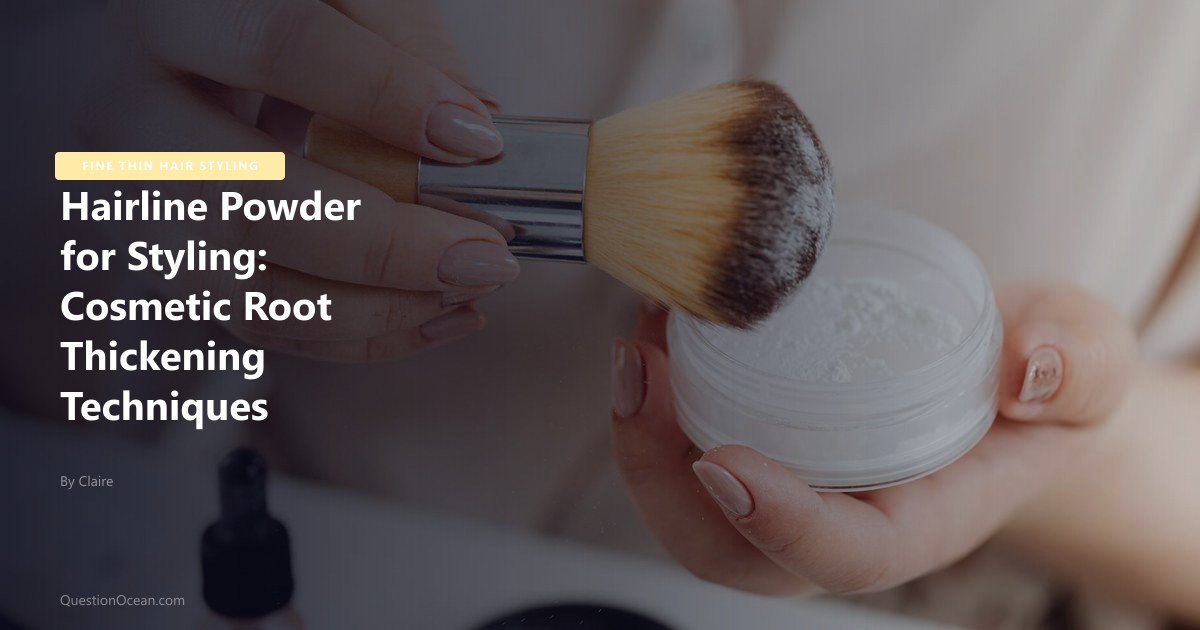
A visible part line on fine hair exposes scalp in a way that no volumizing mousse or blow-dry technique can fully disguise. Hairline powder for styling solves this specific problem through cosmetic contouring — depositing color-matched micro-particles directly onto the exposed scalp and sparse root zone to create the visual appearance of denser, fuller growth. This is a purely cosmetic technique used by editorial stylists, red-carpet hairdressers, and everyday users across the US, UK, and Canada to instantly refine the look of any part line or temple area.
This guide covers the blending process, sweat-resistant formulas, multidimensional color matching, and the ingredient considerations that keep this cosmetic tool effective without clogging the scalp.
Purely Cosmetic Contouring: How Hairline Powder Creates Fullness
Hairline powder works on the same principle as face contouring makeup. By depositing pigmented powder on exposed scalp along the part line, hairline, or temple zones, the visual contrast between hair and skin decreases. The eye perceives a more uniform surface of color, which reads as denser coverage.
The powder does not interact with hair strands at all. It sits on the scalp surface and the base of existing strands, reducing the visible gap between each hair. This makes it fundamentally different from volumizing products that work by expanding individual strand diameter.
The contouring effect is strongest when applied along the part line, at the temples, and around the front hairline where scalp exposure is most visible on fine hair. These three zones account for roughly 80% of the perceived density difference between fine and medium-density hair.
For a complete approach to volume-boosting techniques including cuts and products, see our guide to the best haircuts and products for fine hair.
Blending the Scalp Line: Application Technique
Effective hairline powder application requires precision. Over-application creates an opaque, painted look that draws attention. Under-application fails to close the visual gap between strands. The technique professional stylists use takes under 90 seconds and produces natural results.
- Part your hair where you normally wear it and clip sections away from the application zone
- Using the applicator brush (included with most powder compacts) or a small eye shadow brush, pick up a thin layer of powder
- Tap the brush once against your wrist to remove excess: this single step prevents over-application
- Press the brush gently along the part line in short, 1-inch strokes, following the natural direction of your hair
- Release the clipped sections and use your fingertips to lightly blend the powder into the root zone by pressing (not rubbing) along the treated area
The pressing motion in step 5 is critical, rubbing displaces the powder from the scalp onto the strand surface, where it becomes visible as a dusty residue. Pressing transfers just enough contact to blend the color boundary between scalp and powder.
For the temple area, use the same press-and-tap method but apply the powder in a feathered pattern that follows the natural hairline shape. Temples require approximately half the powder density of the part line because the skin in that zone is thinner and absorbs pigment differently.
Hairline Filling Powder Compact, multi-shade with applicator brush
Sweat-Proof Formulas: What to Look For
Standard hairline powders dissolve and streak within minutes during exercise, humid weather, or any activity that produces scalp perspiration. For reliable all-day wear in Canadian summers, UK rain, or US southern heat, sweat-proof formulation is essential.
Sweat-proof hairline powders use hydrophobic binding agents, typically dimethicone or silica, that repel water at the scalp surface and prevent pigment migration. Standard formulas rely on loose starch or talc that absorbs moisture and dissolves on contact with sweat.
Key ingredients that indicate sweat resistance:
- Silica coats each powder particle in a water-repelling shell
- Dimethicone creates a breathable barrier between the scalp and the powder layer
- Iron oxides provide stable, water-resistant pigmentation that does not bleed when wet
- Nylon-12 adds slip and adhesion without absorbing moisture
Ingredients that signal poor sweat resistance:
- Talc as the primary ingredient absorbs moisture and breaks down within 1-2 hours of perspiration
- Cornstarch clumps when wet and leaves visible white residue on darker hair
- Loose mineral pigments without a binding agent migrate along sweat channels and stain the hairline
For gym sessions or outdoor summer events, apply a thin layer of mattifying face primer to the scalp along the part line before dusting on hairline powder. The primer creates an additional adhesion layer that extends wear time by 3-4 hours.
Matching Multidimensional Hair Color
Single-shade hairline powders work for uniform, solid-color hair. For highlighted, balayaged, or multidimensional brunette and blonde shades, a single powder shade creates an obvious, flat patch that looks artificial against the varied tones surrounding it.
The solution is layering two complementary powder shades, a base tone matching the darkest strands and a lighter tone matching the highlights. Applied in alternating strokes along the part line. This mimics the natural color variation visible in multidimensional hair and prevents the “filled-in” look.
Steps for multidimensional color matching:
- Identify your base shade by looking at the darkest strands closest to the scalp
- Identify your highlight shade by examining the lightest strands at the part line
- Apply the base shade first in continuous strokes along the entire part line
- Apply the highlight shade in intermittent, scattered strokes over the base layer, covering approximately 30-40% of the treated area
- Press gently with fingertips to blend the two layers together
Most hairline powder compacts available on Amazon US, UK, and CA now include 2-4 shade pans specifically for this layering technique. Look for compacts labeled “multidimensional” or “buildable coverage” rather than single-shade options.
For readers whose fine hair is enhanced with face-framing highlights or dimensional color, the techniques in our guide to strategic layering and face-framing for fine hair complement hairline powder beautifully.
Does Hairline Powder Affect the Scalp?
When formulated with non-comedogenic ingredients and removed during regular washing, hairline powder is a standard cosmetic product comparable to face powder or bronzer. It sits on the skin surface without penetrating the scalp or interacting with hair follicles.
The concern some users raise about pore-clogging is valid only when powder is left on the scalp for multiple days without washing, or when the formula contains heavy comedogenic oils or waxes. Modern hairline powders designed for daily cosmetic use are formulated to be removed with standard shampoo and do not require special cleansing.
To maintain a clean, comfortable scalp while using hairline powder regularly:
- Wash hair every 2-3 days maximum when using hairline powder daily. This prevents any accumulation of pigment in the scalp’s surface texture
- Use a gentle clarifying shampoo once per week to fully remove any mineral or silica residue
- Avoid applying powder to an oily or sweaty scalp. Oil causes powder to clump and become difficult to remove
- Remove powder before bed when possible, using a dry cotton pad pressed along the part line to lift excess pigment
The overlap between hairline powder and scalp-care practices connects directly to the root-lifting serums for fine hair approach, where clean, product-free roots serve as the foundation for both volume and cosmetic concealment.
Avoiding Common Application Mistakes
Three application errors account for nearly every complaint about hairline powder on fine hair. Each has a simple correction.
Mistake 1: Applying to oily roots. Oil on the scalp prevents powder adhesion and creates clumping. Always apply hairline powder to clean, dry roots, or at minimum, roots treated with dry shampoo to absorb surface oil before powder application. Our guide to dry shampoos formulated for fine hair covers the best prep options.
Mistake 2: Using the wrong brush size. Large kabuki brushes deposit powder over too wide an area, creating an unnaturally uniform zone that draws attention. Use a brush no wider than a pencil eraser for the part line and a slightly wider brush (eye shadow size) for temple coverage.
Mistake 3: Choosing a shade too dark. Users instinctively reach for a darker shade to maximize coverage, but powder one shade darker than your base creates a harsh, shoe-polish effect on the scalp. Match to your lightest root shade, not your darkest. The layering of fine hair strands over the powder naturally darkens the visible result.
Root Touch-Up Volumizing Powder, sweat-resistant with buildable coverage
Beyond the Part Line: Temple and Crown Application
The part line is the primary application zone, but two other areas benefit equally from hairline powder on fine hair: the temples and the crown whorl.
The temple area on fine hair often shows the most visible scalp, particularly when hair is pulled back or styled away from the face. A light dusting of powder along the natural temple hairline, applied in short, feathered strokes that follow the growth direction. Fills in sparse zones without creating an obvious cosmetic edge.
The crown whorl is the spiral growth pattern at the top of the head where strands radiate outward. On fine hair, the whorl exposes a circular patch of scalp that no amount of volumizing product can cover. A targeted application of powder at the center of the whorl closes this visual gap instantly.
Apply crown powder with a tapping motion using just the tip of the brush, building coverage in thin layers rather than one heavy application. The spiral growth pattern means hair lies in multiple directions at the crown, so any heavy application will show from at least one angle.
Frequently Asked Questions
Q: Does hairline powder cause any scalp issues? A: When formulated with non-comedogenic ingredients and washed out during regular shampooing every 2-3 days, hairline powder is a cosmetic product that sits on the scalp surface without affecting it. Choose formulas free of heavy oils or waxes, and follow a weekly clarifying wash to prevent any residue accumulation.
Q: How long does hairline powder last during the day? A: Standard formulas last 6-8 hours under normal conditions. Sweat-proof formulas containing silica or dimethicone binding agents extend wear to 10-12 hours. Applying a thin layer of mattifying primer to the scalp before powder adds an additional 3-4 hours of hold.
Q: Can I use eyeshadow instead of hairline powder? A: Matte eyeshadow in a matching shade can work as a temporary substitute, but it lacks the scalp-specific adhesion agents found in dedicated hairline powders. Eyeshadow tends to transfer onto pillows and clothing more readily and does not resist perspiration as effectively.
Q: Will hairline powder transfer to my hands if I touch my hair? A: High-quality formulas with proper binding agents set within 60 seconds and resist transfer from normal touching. If you experience transfer, the formula likely lacks sufficient binding agent. Allow 2 minutes of set time before touching the treated area, and avoid rubbing or scratching the part line.
Q: What shade should I choose if I have highlighted hair? A: Use a multi-shade compact and layer two tones. A base shade matching your darkest roots and a lighter shade matching your highlights. Apply the base first for coverage, then scatter the lighter shade on top for dimension. This prevents the flat, single-color look that makes powder application obvious.
Hairline powder for styling delivers the fastest, most targeted cosmetic fullness available for fine hair. Match the right shade, apply with precision at the part line and temples, and choose a sweat-resistant formula for all-day confidence that no camera angle or overhead lighting can compromise.