
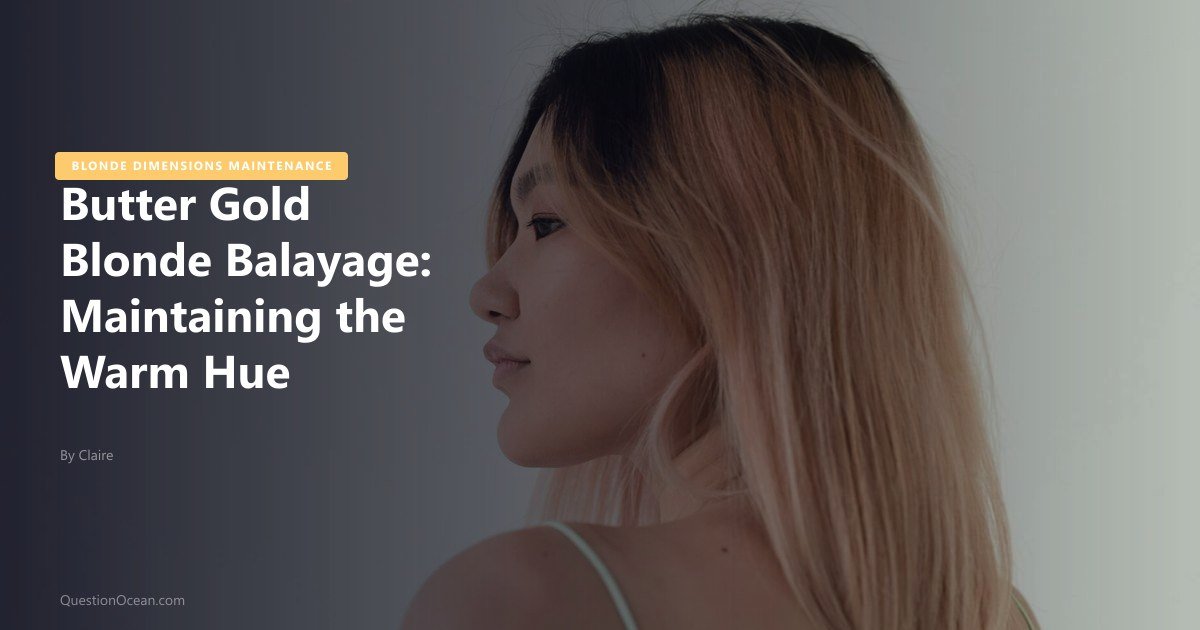
The difference between a radiant butter gold blonde and a brassy, orange-tinted mess comes down to approximately two shades on the tonal spectrum, and most of the maintenance work happens at home, not in the salon chair. Butter gold blonde balayage has emerged as the most requested warm blonde service of 2026, sitting at a level 8 with saturated golden-yellow undertones that mimic candlelight on the hair. Getting there is the easy part; keeping it requires a specific weekly rotation of toning, hydrating, and glossing.
This guide covers the precise differences between gold and brass, the root melting technique that makes this shade low-maintenance, and the exact product rotation that prevents warmth from tipping into unwanted territory.
What Is Butter Gold Blonde?
Butter gold blonde lives in a narrow band between honey blonde (level 7, heavier caramel tones) and pale golden blonde (level 9, cooler yellow). The shade draws its name from the rich, saturated warmth of actual butter: a deep golden hue with no ash, no beige, and no copper-orange undertones. Under natural daylight, it appears as a warm, creamy gold; under indoor tungsten lighting, it deepens to a rich amber-touched blonde.
The defining characteristic is saturation without brassiness. Brass tones carry orange and red undertones that create a muddy, flat appearance. Butter gold maintains pure yellow-gold pigment, which reads as luminous rather than dull. The difference is visible when you place a brass-toned swatch next to a true gold swatch under natural light, brass appears cloudy while gold appears clear.
For a complete overview of where butter gold sits among the dominant blonde shades this year, see our 2026 blonde hair color trends guide.
The Fine Line Between Gold and Brass
Every warm blonde sits on a gradient that runs from pure gold to orange-brass, and the slide from one to the other happens gradually over 3-6 weeks without intervention. Understanding why this shift occurs is the first step in preventing it.
Lightened hair contains residual pigment molecules, primarily yellow and orange melanin fragments: that were not fully dissolved during the bleaching process. Freshly toned butter gold hair has a professional toner overlay that neutralizes the orange fragments while allowing the yellow-gold tones to shine through.
As the toner fades, typically 50% loss within 4-6 washes: those underlying orange molecules become increasingly visible. The result is a gradual warm shift from gold toward copper-orange. Hard water minerals (calcium and iron) accelerate this process by depositing metallic residue that amplifies warm undertones.
The preventive approach uses two tools: a violet-pigmented shampoo to neutralize emerging orange tones, and a glossing treatment to re-deposit gold pigment. Neither tool works well in isolation. Purple shampoo alone strips warmth too aggressively, and gloss alone cannot counteract mineral buildup.
Root Melting: The Key Application Technique
Root melting is the balayage technique that makes butter gold blonde sustainable for 8-12 week salon intervals. Unlike traditional foil highlights that create a visible line of regrowth at 3-4 weeks, root melting applies a semi-permanent or demi-permanent color 1-3 inches from the scalp, graduating seamlessly into the lighter butter gold mid-lengths.
The root color typically sits 2-3 levels darker than the lightest blonde sections: usually a dark honey or light caramel shade at level 6-7. As natural roots grow in, they blend with the melted section rather than contrasting against it, creating a soft shadow effect that actually improves with time.
Root melting reduces annual salon visits from 6-8 (traditional highlights) to 4-5, saving $300-600 per year across US, UK, and Canadian pricing. The technique works best when the colorist uses a clear or gold-toned demi-permanent glaze over the entire head after the melt application, unifying the transition from dark root to golden mid-lengths to lighter ends.
Ask your colorist for “a level 6 warm root melt transitioning to level 8 butter gold, with no ash or cool tones in the formula.” This phrasing prevents the common mistake of using a neutral root shade that clashes with the warm blonde lengths.

Glossing Routines for Sustained Warmth
Professional glossing appointments and at-home glossing products serve different functions, and the most effective maintenance plan uses both on an alternating schedule.
Professional Glazes (Every 8-12 Weeks)
A salon glaze deposits a thin layer of semi-permanent pigment over the entire surface of the hair, refreshing tone and adding a glass-like shine. For butter gold blonde, the colorist uses a gold or warm beige demi-permanent formula processed for 10-20 minutes. The treatment lasts 4-6 weeks and costs $50-80 in the US, £30-50 in the UK, and $55-90 in Canada.
At-Home Glossing Products (Every 2 Weeks)
Between professional appointments, at-home gloss treatments bridge the gap. Products like dpHUE Gloss+ in Gold Blonde and Kristin Ess Signature Hair Gloss in Golden Hour deposit a lighter concentration of gold pigment during a 10-15 minute shower application. The at-home gloss extends salon color by 2-3 weeks per use.
Apply the at-home gloss to clean, towel-dried hair and process for the full recommended time. Cutting it short reduces pigment deposit by 40-60%. Rinse with cool water to seal the cuticle and lock in the deposited color molecules.
Hair Gloss Treatment. Gold-toned demi-permanent gloss for blonde hair
For a comprehensive review of glossing treatments across all blonde shades, see our guide on the best glossing treatments for blonde shine.
Alternating Purple Shampoo with Intense Hydration
Purple shampoo is the most important, and most frequently misused, product in the butter gold maintenance routine. Violet pigments neutralize yellow and orange tones on the color wheel, but they do so indiscriminately. Overuse strips the desirable golden warmth alongside the unwanted brassiness, leaving a flat, ashy, dull result that defeats the entire purpose of choosing a warm blonde.
The correct frequency for butter gold blonde is once per week, never more. Use the purple shampoo as the first wash of the week, leaving it on for 2-3 minutes (no longer, or it over-deposits violet). Follow immediately with a deep hydrating conditioner or mask — not a regular rinse-out conditioner, but a concentrated moisture treatment that processes for 5-10 minutes.
This alternation matters because purple shampoo formulas contain high concentrations of surfactants that open the cuticle to allow violet pigment penetration. The opened cuticle loses moisture rapidly if not immediately sealed with a hydrating treatment. Skipping the mask step after purple shampoo is the single most common cause of dull, dry butter gold blonde.
For the remaining wash days (1-2 per week), use a sulfate-free, color-safe shampoo with no toning pigments. A gold-tinted conditioner on these days reinforces warmth without the neutralizing effect of purple tones. Our guide on using purple shampoo without dulling your blonde provides the complete rotation schedule for every blonde shade.
Hydrating Hair Mask: deep conditioning treatment for color-treated blonde
Protecting Butter Gold from Environmental Threats
Three environmental factors accelerate brass shift in butter gold blonde: UV exposure, hard water minerals, and chlorine.
UV Protection
Sunlight degrades the toner molecules deposited during professional coloring, accelerating the warm shift from gold toward orange. UV-protective hair sprays or leave-in treatments containing UV filters (ethylhexyl methoxycinnamate or benzophenone-4) create a barrier that extends toner life by 2-3 weeks during summer months. Apply before outdoor exposure, focusing on the top layers of hair that receive the most direct light.
Hard Water Management
Hard water deposits calcium and iron onto the hair shaft, amplifying warm undertones and creating a dull, sticky texture. In hard water areas: much of Southern England, the US Midwest, and Southern Ontario. A chelating shampoo used once every two weeks strips these deposits. Malibu C Hard Water Wellness Shampoo is the most widely recommended option across all three markets.
Chlorine Protection
Pool chlorine bonds with lightened hair proteins and creates green or copper-tinged discoloration. Wet hair thoroughly with clean water before entering the pool (saturated hair absorbs less chlorinated water), and rinse immediately after swimming. A pre-swim leave-in conditioner with silicone creates an additional barrier layer.
Styling Products That Complement Warm Blonde Tones
Not all styling products are neutral on blonde hair. Products containing certain natural oils, argan oil, coconut oil, and marula oil. Can deposit a subtle warm cast that complements butter gold. Products containing heavy mineral oil or petroleum-based ingredients, however, attract dust and environmental particles that create a dull film.
Avoid styling products with a visible yellow or amber tint on blonde hair, as these can push warmth past the butter gold threshold into brass territory. Clear or white-tinted serums, creams, and sprays maintain the truest color representation between salon visits.
Lightweight hair oils in the 20-30 cP viscosity range (jojoba, grapeseed) add shine without weight or color distortion. Heavier oils above 60 cP (castor, olive) should be restricted to ends-only application.
Touchup Timeline and Budget Planning
A realistic maintenance schedule for butter gold blonde balayage looks like this:
- Week 1-4: Professional color is fresh. Use sulfate-free shampoo, purple shampoo once weekly, hydrating mask after every purple shampoo session
- Week 5-6: Apply at-home gold gloss treatment to refresh midlength tone. Continue purple shampoo rotation
- Week 7-8: Schedule salon appointment if noticeable brassiness appears. Apply chelating shampoo if in a hard water area
- Week 9-12: Root melt appointment with full glaze overlay
Annual cost across US, UK, and CA markets:
- Salon visits (4-5 per year): $600-1,000 USD / £400-650 GBP / $700-1,100 CAD
- At-home products (gloss, purple shampoo, hydrating masks): $150-250 USD annually
- Total: $750-1,250 USD per year
This places butter gold at the moderate end of blonde maintenance, significantly less than platinum but slightly more than a simple single-process brunette.
Frequently Asked Questions
Q: What is butter gold blonde? A: Butter gold blonde is a level 8 warm blonde shade with saturated yellow-gold undertones and zero ash. It mimics the rich warmth of melted butter and sits between honey blonde and pale golden blonde on the tonal spectrum. The shade is defined by clear, luminous warmth without any orange or copper brassiness.
Q: How do I prevent butter gold blonde from turning brassy? A: Use purple shampoo once per week (never more), follow every purple shampoo wash with a deep hydrating mask, and apply an at-home gold-toned gloss every two weeks. A chelating shampoo every two weeks addresses hard water mineral deposits that accelerate brassiness.
Q: Is butter gold blonde high maintenance? A: Butter gold blonde with a root melt application requires salon visits every 8-12 weeks, roughly 4-5 times per year. At-home maintenance adds about 10 extra minutes per week. Compared to platinum (every 3-4 weeks), it is significantly lower maintenance.
Q: Can butter gold blonde work on cool skin tones? A: Butter gold is most flattering on warm and neutral skin tones. Those with cool undertones (blue or purple wrist veins) may find the shade clashes with their complexion. Pearl or Suede blonde are better options for cool-toned individuals.
Q: What is the difference between butter gold and honey blonde? A: Honey blonde sits at level 7 with heavier caramel and amber tones, appearing darker and more bronze. Butter gold sits at level 8 with cleaner, brighter yellow-gold tones and less brown depth. Honey reads warmer and deeper; butter gold reads lighter and more luminous.
Butter gold blonde balayage delivers the warmth of golden-era Hollywood blonde with a modern, low-maintenance application technique. The combination of root melting, weekly purple shampoo alternation, and bi-weekly glossing keeps the shade vivid and dimensional for 8-12 weeks between salon visits: a maintenance rhythm that fits both the budget and the schedule of most working professionals.