
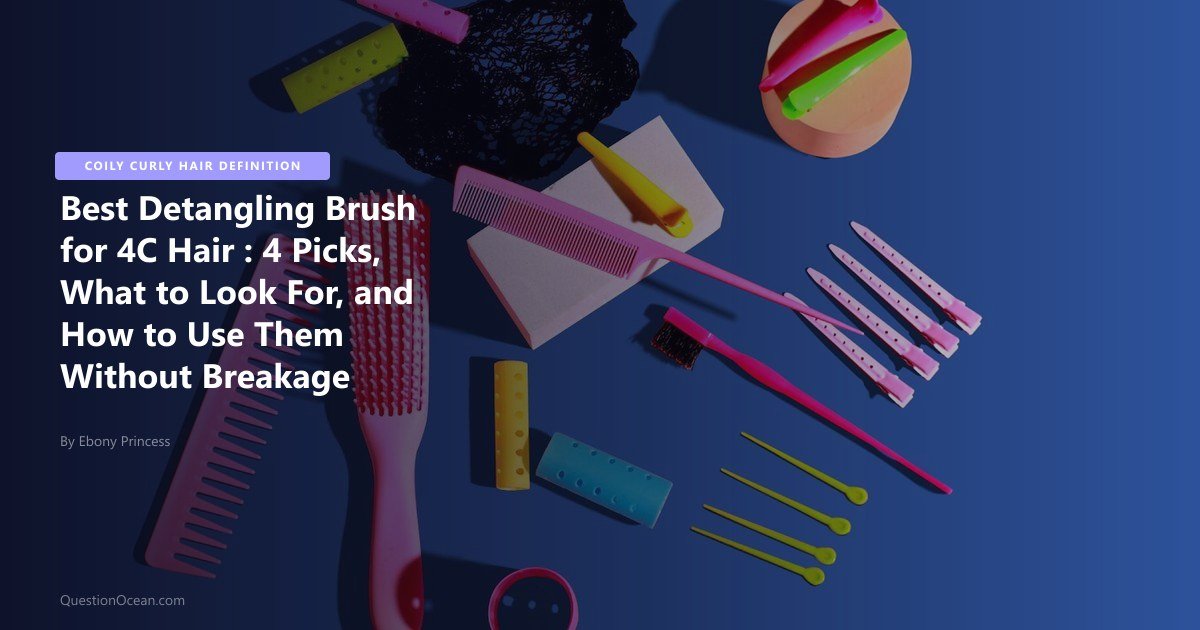
Quick answer: The best detangling brush for 4C hair has flexible bristles, wide spacing between bristles, and smooth tips that won’t snag on coils. The top pick for most people is the Felicia Leatherwood Detangler Brush ($18-22), designed specifically for textured hair with uniquely flexible, widely spaced rows. For budget buyers, the Wet Brush Pro Detangler ($8-12) works well as a second-pass brush after finger detangling. No brush should be used on dry 4C hair. Always detangle wet, conditioner-saturated hair.
What Makes a Detangling Brush Safe for 4C Hair
Last updated: June 23, 2026
Not all detangling brushes are created for tight coils. Most are designed for Type 1-2 hair and will rip through 4C, causing severe breakage. Here’s what to look for:
| Feature | Why It Matters for 4C |
|---|---|
| Flexible bristles | Rigid bristles catch on coils and snap strands. Flexible bristles bend around the coil instead of pulling through it. |
| Wide bristle spacing | 4C coils need room to pass between bristles without getting trapped. Closely spaced bristles act like a rake on tight coils. |
| Smooth, rounded tips | Sharp or flat-cut bristle tips snag on raised cuticle layers. Rounded tips glide over the cuticle. |
| No ball tips | Ball-tipped bristles (common on regular brushes) catch on single-strand knots and rip strands out. |
| Large surface area | A larger brush head covers more area per stroke, meaning fewer passes and less manipulation. |
The 4 Best Detangling Brushes for 4C Hair
1. Felicia Leatherwood Detangler Brush ($18-22)
Why it’s the top pick: This brush was designed by a celebrity stylist specifically for Type 4 textured hair. The bristles are arranged in flexible rows with wide gaps between them. The rows flex independently, which means each row adapts to the density and tightness of the section it’s passing through.
Best for: All-purpose 4C detangling, thick dense hair Bristle type: Flexible plastic, medium length Works on: Wet, conditioner-saturated hair
The main drawback is durability. The flexible bristle rows can break after heavy use, especially on very dense hair. Some people go through one every 6-12 months.
2. Wet Brush Pro Detangler ($8-12)
Why it works: The IntelliFlex bristles are extremely flexible, bending almost flat before snapping back. This flexibility means the bristles give way when they hit a tangle instead of forcing through it. Widely available at drugstores and online.
Best for: Second-pass detangling (after finger detangling removes major knots), thinner 4C Bristle type: Ultra-flexible IntelliFlex Works on: Wet hair with conditioner
Not as effective as the Felicia Leatherwood on very thick, dense 4C because the bristle spacing is tighter. Works best when the worst tangles have already been removed by fingers.
3. Denman D41 Large Paddle Brush ($12-16)
Why it works: The nylon-and-boar bristle combination provides enough grip to detangle while the large paddle shape covers a wide area. The widely spaced bristle rows work better on 4C than Denman’s smaller models (like the D3), which have bristles too close together for tight coils.
Best for: Smoothing and detangling, preparing hair for blow-drying or stretching Bristle type: Nylon + boar bristle mix Works on: Wet, conditioner-saturated hair
This brush is more aggressive than the Felicia Leatherwood or Wet Brush. Use it when you need both detangling and smoothing (like before a blow-dry) rather than for gentle weekly detangling.
4. Wide-Tooth Comb ($3-8)
Why it deserves a spot: Sometimes the best “brush” isn’t a brush at all. A wide-tooth comb with smooth, seamless teeth (no rough seams from the molding process) remains one of the safest detangling tools for 4C hair. The wide gaps between teeth let coils pass without snagging.
Best for: Gentle detangling, in-shower use with conditioner, budget option Tooth type: Smooth plastic, widely spaced Works on: Wet, conditioner-saturated hair
Look for combs with perfectly smooth teeth. Run your fingernail along the teeth; if you feel any ridges or rough spots from the manufacturing seam, those ridges will catch on hair. Sand them smooth or buy a seamless comb.
Brushes to AVOID on 4C Hair
| Brush Type | Why to Avoid |
|---|---|
| Boar bristle brush (fine) | Bristles are too close together and too stiff for 4C coils. Rips through tangles. |
| Denman D3 (7-row) | Bristle rows are too closely spaced for tight coils. Works great on Type 3, too aggressive on 4C. |
| Rat-tail comb (fine teeth) | Fine teeth catch on every coil. Only use the tail end for parting, never the teeth. |
| Teasing brush | Designed to create tangles (backcombing). The opposite of what 4C needs. |
| Any stiff-bristle brush | Rigid bristles can’t navigate tight coils without snapping strands. |
How to Detangle 4C Hair With a Brush (Step-by-Step)
Using even the best brush on 4C hair requires proper technique. The brush is the second step, not the first.
Step 1: Saturate with water. Hair must be wet. Not damp, not misted. Soaking wet.
Step 2: Apply conditioner or detangler generously. Cover each section with enough product that you can feel slip between your fingers when you run them through. Slip is what prevents breakage during brushing.
Step 3: Section the hair. Divide into 4-8 sections. Work one section at a time. Clip the rest out of the way.
Step 4: Finger detangle first. Use your fingers to gently pull apart the major tangles and knots. This removes the worst knots that would cause a brush to rip through the hair. Spend 2-3 minutes per section.
Step 5: Brush from ends to roots. Start the brush at the very tips of the section. Work up 1-2 inches at a time. Never start at the roots and pull down through the entire length. That’s how you break hair.
Step 6: Apply more conditioner as needed. If the section starts catching or feeling dry during brushing, add more conditioner and water before continuing.
Step 7: Twist or clip each detangled section. Prevent re-tangling by securing each section as you finish.
How Often to Brush 4C Hair
| Frequency | When It Makes Sense |
|---|---|
| Once per week (wash day only) | Best for most 4C hair. Minimizes manipulation. |
| Twice per week | For very tangle-prone 4C or very active lifestyles (daily sweating) |
| Daily | Not recommended. Daily brushing on 4C causes cumulative breakage. |
The less often you manipulate 4C hair, the more length you retain. Protective styles between wash days reduce the need for frequent detangling.
Frequently Asked Questions
Q: What is the best detangling brush for 4C hair? A: The Felicia Leatherwood Detangler Brush ($18-22) is the top pick for most 4C hair because of its uniquely flexible, widely spaced bristle rows designed for tight coils. For budget buyers, the Wet Brush Pro ($8-12) works well as a second-pass tool after finger detangling.
Q: Can I brush 4C hair dry? A: No. Brushing dry 4C hair causes extreme breakage because the coils catch and snap without the lubrication of water and conditioner. Always detangle wet, conditioner-saturated 4C hair.
Q: Should I use a brush or comb on 4C hair? A: Fingers first (always), then either a wide-tooth comb or a flexible detangling brush. Brushes cover more area per stroke, which can be faster. Combs are gentler because the wide gaps between teeth give coils more room. Many people use fingers, then comb, then brush in sequence.
Q: How do I detangle 4C hair without breakage? A: Saturate with water, apply generous conditioner, finger detangle first, then use a flexible brush or wide-tooth comb starting from the ends and working upward. Never start from the roots. Add more conditioner whenever the hair starts catching.
The right tool reduces detangling time and breakage, but technique matters more than the brush itself. Wet hair, plenty of conditioner, fingers first, and always ends-to-roots.
For detangling product recommendations, see our best detangler for matted hair guide.