
Over 1.5 billion plastic hair tool items enter US, UK, and Canadian landfills each year, and most sit there unchanged for the next 500 years. Sustainable hair care 2026 demands more than swapping one plastic brush for another with a green label. Genuine eco-friendly styling requires understanding material sourcing, end-of-life disposal, and the regulatory landscape that separates real sustainability from expensive marketing.
This guide delivers rigorous material analyses, certification breakdowns, and region-specific recycling logistics for every major zero-waste tool category on the market right now.
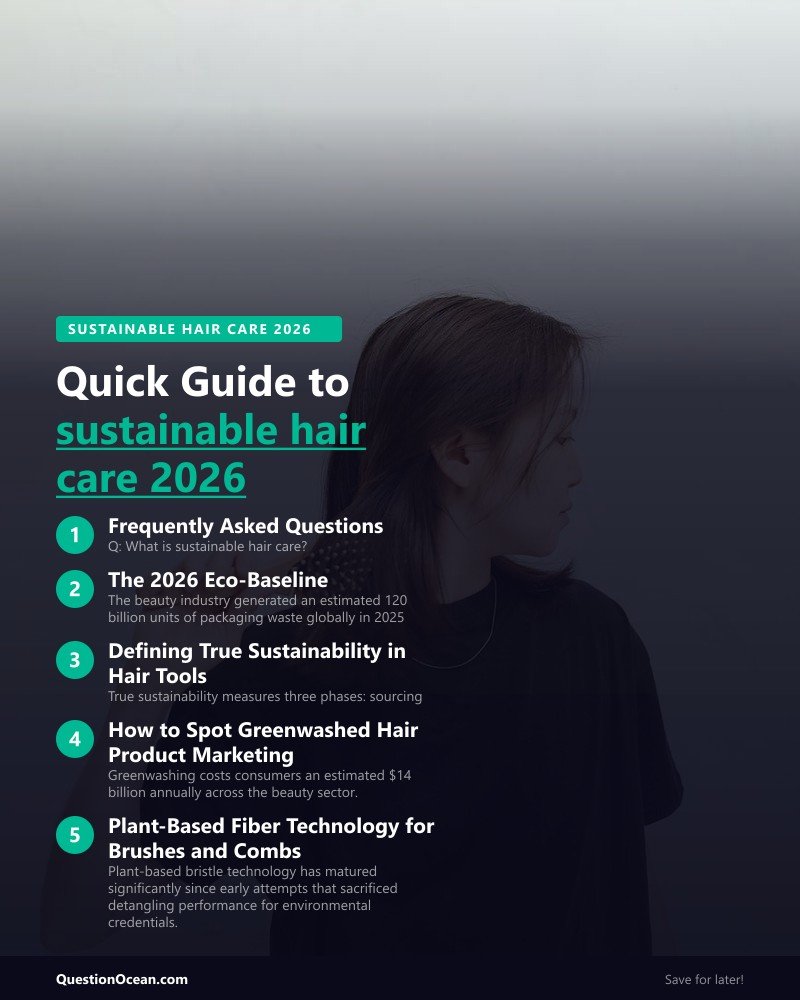
The 2026 Eco-Baseline: Where the Industry Actually Stands
The beauty industry generated an estimated 120 billion units of packaging waste globally in 2025, according to Euromonitor data. Hair care accounts for roughly 18% of that figure. In the US alone, shampoo and conditioner bottles represent the third-largest category of bathroom plastic waste after soap dispensers and toothpaste tubes.
The 2026 baseline is shifting because of three converging forces: tightened EU Extended Producer Responsibility regulations influencing UK imports, California’s SB 54 plastic reduction mandates, and Canada’s Single-Use Plastics Prohibition. These regulations now require brands selling in Western markets to demonstrate genuine end-of-life accountability for their packaging and products.
This means “eco-friendly” labels without third-party certification carry less weight than ever. The Federal Trade Commission’s updated Green Guides (revised 2024) now require specific, verifiable environmental claims, vague terms like “earth-friendly” or “natural” without supporting evidence violate US advertising standards.
Defining True Sustainability in Hair Tools
True sustainability measures three phases: sourcing, use, and disposal. A bamboo brush sourced from FSC-certified forests, manufactured with non-toxic adhesives, and compostable at end of life qualifies. A bamboo brush with synthetic bristles, petroleum-based lacquer, and a rubber cushion pad that requires landfill disposal does not: despite looking identical on a shelf.
The most reliable sustainability markers are third-party certifications: FSC (Forest Stewardship Council), USDA BioPreferred, B Corp, and Cradle to Cradle. Each certification audits a different aspect of the supply chain, and no single label covers everything.
For a detailed breakdown of FSC standards and how they apply specifically to bamboo brushes, see our guide to FSC-certified bamboo hair brushes.
- FSC Certification verifies that wood and bamboo are sourced from responsibly managed forests with replanting programs
- USDA BioPreferred confirms that a product contains a verified percentage of bio-based materials
- Cradle to Cradle evaluates material health, circularity, clean air quality during manufacturing, and water stewardship
- B Corp certifies the overall social and environmental performance of the parent company
How to Spot Greenwashed Hair Product Marketing
Greenwashing costs consumers an estimated $14 billion annually across the beauty sector. Hair care brands deploy several recurring tactics that sound compelling but mean nothing without verification.
The most common greenwashing tactic in hair tools is “biodegradable” labeling on products that only decompose under industrial composting conditions unavailable to 94% of US households. A hair tie labeled “biodegradable” that requires temperatures above 140°F (60°C) and sustained moisture for 12 weeks will sit in a home compost bin virtually unchanged.
Watch for these specific red flags:
- “Made with natural materials” without specifying what percentage is natural versus synthetic
- “Recyclable” on mixed-material products (wood handle + synthetic bristles) that recycling facilities cannot process together
- Earth-tone packaging and leaf imagery on products with zero third-party environmental certification
- “Plastic-free” claims on products that contain synthetic rubber, nylon, or petroleum-derived adhesives
Our guide to biodegradable hair ties tests real-world composting conditions against brand claims for the top eco-friendly hair tie options.
Plant-Based Fiber Technology for Brushes and Combs
Plant-based bristle technology has matured significantly since early attempts that sacrificed detangling performance for environmental credentials. The 2026 market offers three primary natural fiber categories, each with distinct functional properties.
Tampico Fiber (Agave Lechuguilla)
Tampico fiber, harvested from the agave plant native to northern Mexico, delivers the stiffest natural bristle available for hair brushes. Individual Tampico fibers measure 0.15-0.25mm in diameter with a tensile strength of approximately 350 MPa. Comparable to medium-grade nylon. This stiffness makes Tampico ideal for detangling thick, dense hair without synthetic materials.
The key advantage of Tampico is its natural static-reducing property. Unlike nylon bristles that generate triboelectric charge through friction, Tampico’s porous cellulose structure dissipates electrical charge during brushing. The result is noticeably less flyaway hair, particularly in dry winter climates across Canada and the northern US.
Sisal and Cactus Fibers
Sisal fibers (from Agave sisalana) offer a softer alternative to Tampico, measuring 0.10-0.15mm in diameter. These work well for fine-to-medium hair that cannot withstand Tampico’s rigidity. Cactus fiber brushes, sourced primarily from Nopal cactus pads, provide the gentlest natural option and are gaining popularity for scalp-sensitive users.
Boar Bristle Alternatives
For users seeking a vegan replacement for traditional boar bristle brushes, plant-based and recycled-nylon alternatives now closely replicate the sebum-distribution function of natural boar hair. Our guide to vegan boar bristle brush alternatives compares the top options side by side.
Bamboo Hair Brush. FSC-certified paddle brush with plant-based bristles
Tampico vs Nylon: Material Transparency and Performance
The Tampico-versus-nylon debate centers on three measurable factors: static generation, scalp feel, and environmental impact at disposal.
Nylon 6,6 bristles last approximately 3-5 years before losing structural integrity, but they persist in landfill for 30-40 years after disposal. Tampico fibers last 2-3 years with proper care and fully compost within 6-12 months in standard home composting conditions.
Performance-wise, nylon provides more consistent flexibility across humidity ranges. Tampico stiffens slightly in dry conditions (below 30% relative humidity) and softens in high humidity (above 70%). For users in stable indoor environments, this variation is negligible. For those styling outdoors or in poorly climate-controlled spaces, nylon maintains more predictable behavior.
The cost difference is narrowing. Quality Tampico brushes retail for $18-35 on Amazon US, compared to $12-28 for equivalent nylon-bristle options. UK pricing runs GBP 15-30 for Tampico versus GBP 10-24 for nylon. Canadian retailers stock both at $22-40 CAD versus $15-32 CAD.
To maintain the longevity of any natural-fiber brush, follow our guide on cleaning and maintaining wooden hair tools.
US, UK, and Canadian Packaging Regulations for Hair Products
Packaging regulations differ substantially across the three target markets, and these differences directly affect which products qualify as genuinely sustainable in each region.
In the US, California’s SB 54 (Plastic Pollution Prevention and Packaging Producer Responsibility Act) mandates that all single-use packaging be recyclable or compostable by 2032. This is driving reformulation across the hair care industry, as brands must redesign packaging to meet compliance timelines.
The UK’s Plastic Packaging Tax (effective April 2022, rates updated annually) charges GBP 217.85 per tonne on plastic packaging containing less than 30% recycled content. This tax has pushed UK-market hair care brands toward post-consumer recycled (PCR) plastic and alternative materials faster than their US counterparts.
Canada’s federal Single-Use Plastics Prohibition Regulations ban specific items but allow most hair care packaging. However, provincial programs like British Columbia’s Extended Producer Responsibility framework require brands to fund the collection and recycling of their packaging, creating financial incentive to reduce material weight and complexity.
For readers looking to dispose of old hot tools responsibly across all three markets, our guide covers recycling electronics-containing hair tools in the US, UK, and Canada.
Localized Recycling Logistics: What Actually Gets Recycled
The gap between “recyclable” labels and actual recycling rates reveals one of the biggest challenges in sustainable hair care 2026. Only 9% of plastic ever produced has been recycled globally, and hair care packaging faces particular difficulties because of mixed-material construction.
Pump dispensers on shampoo bottles are the single biggest recycling contaminant in bathroom waste. The metal spring, plastic housing, and rubber gasket create a multi-material unit that most Municipal Recycling Facilities (MRFs) cannot separate. Removing the pump and discarding it separately improves the recyclability of the bottle itself.
Regional recycling realities:
- US: Curbside recycling accepts HDPE (#2) and PET (#1) bottles in most municipalities, but caps, pumps, and tubes below 2 inches go to landfill
- UK: Kerbside collection varies by council; Terracycle hair care recycling programs operate through Boots and select retailers
- Canada: Blue box programs accept rigid plastics #1-7 in Ontario; western provinces have more limited acceptance
Switching to refillable hair care systems eliminates much of the packaging waste problem entirely. Aluminum bottles and glass containers cycle indefinitely when returned to participating retailers.
Zero-Waste Styling: Beyond the Brush
A truly zero-waste styling routine extends beyond brush selection into every product category. Solid shampoo bars eliminate plastic bottles entirely and last 60-80 washes per bar, equivalent to two standard 300ml bottles.
Reusable silk and satin accessories replace single-use elastic bands that snap and enter waste streams within weeks. A quality silk scrunchie or satin headband lasts 2-3 years with proper care.
Even aerosol hairsprays have zero-waste alternatives. Non-aerosol eco-friendly sprays use pump mechanisms with refillable glass bottles, delivering equivalent hold without propellant gases or single-use metal cans. Eco-friendly scalp tools also overlap with the scalp-first cosmetic styling approach, where silicone massagers and natural-bristle brushes serve double duty as both scalp care and styling instruments.
Zero-Waste Shampoo Bar. Sulfate-free solid shampoo
Building Your Sustainable Hair Care 2026 Toolkit
Start with the three items that create the most waste reduction per dollar spent:
- One FSC-certified bamboo brush with natural or recycled-nylon bristles (replaces 3-5 plastic brushes over its lifetime)
- Two solid shampoo bars: one clarifying, one moisturizing (eliminates 4-6 plastic bottles annually)
- Five reusable hair ties made from organic cotton or GOTS-certified silk (replaces 50-100 disposable elastics per year)
This starter kit costs $35-55 and prevents approximately 2.5 kg of plastic waste from entering landfill annually. Scale up by adding refillable conditioner systems, non-aerosol styling sprays, and compostable packaging options as each product in your current rotation runs out.
Reusable Hair Accessories Set: organic cotton scrunchies and silk ties
Frequently Asked Questions
Q: What is sustainable hair care? A: Sustainable hair care encompasses tools, products, and packaging designed to minimize environmental impact across their entire lifecycle: from raw material sourcing through manufacturing, use, and disposal. Genuine sustainability requires third-party certification (FSC, B Corp, Cradle to Cradle) rather than unverified marketing claims.
Q: Are eco-friendly hair brushes as effective as plastic ones? A: Modern plant-based bristle brushes made from Tampico, sisal, or recycled nylon now match plastic alternatives in detangling performance and durability. Tampico fiber delivers comparable tensile strength to medium-grade nylon while naturally reducing static, an area where it actually outperforms plastic brushes.
Q: How do I know if a product is greenwashed? A: Look for third-party certifications (FSC, USDA BioPreferred, Cradle to Cradle) rather than self-applied labels like “eco-friendly” or “natural.” Check whether “biodegradable” claims specify home composting or industrial composting conditions. Products using mixed materials (wood plus synthetic bristles) with “recyclable” labels are almost always misleading.
Q: What is the most impactful zero-waste swap for hair care? A: Switching from liquid shampoo in plastic bottles to solid shampoo bars creates the largest single waste reduction for most users, eliminating 4-6 plastic bottles per person annually. A single bar lasts 60-80 washes and ships without plastic packaging.
Q: Can I recycle old hair tools? A: Electronic hair tools (dryers, flat irons, curling wands) contain mixed materials and circuit boards that require e-waste recycling. Most US municipalities, UK councils, and Canadian provinces operate electronics drop-off points. Non-electronic tools like plastic brushes and combs are generally not accepted by curbside recycling programs.
Q: Are bamboo hair products actually better for the environment? A: Bamboo grows 30-50 times faster than hardwood trees and requires no pesticides or irrigation, making it one of the most sustainable raw materials available. However, the environmental benefit depends on responsible sourcing (look for FSC certification) and whether all components. Including bristles, cushion pads, and adhesives — are equally sustainable.
Sustainable hair care 2026 is no longer a niche preference. It is a measurable, regulation-driven shift reshaping how brushes, accessories, and products are manufactured and disposed of across the US, UK, and Canada. Start with certified tools, question every “eco-friendly” claim, and prioritize waste reduction at the product categories that generate the most landfill volume in your routine.