

The micro bob sits at or just above the jawline, making it roughly two inches shorter than a classic bob and the single most requested short cut in salons across North America and the UK heading into 2026. That minimal length difference changes everything: the way your jawline reads, how often you sit in the stylist’s chair, and which products earn permanent counter space. This guide breaks down whether the micro bob works for your face shape, hair density, and lifestyle before you commit.
If you are weighing this cut against other cropped styles, our pillar comparison of French bob vs Italian bob maps every short-bob silhouette side by side.
What Exactly Is a Micro Bob Haircut?
A micro bob is a blunt or slightly textured cut that terminates between the earlobe and the jawline, typically measuring 4 to 5.5 inches from crown to hem. Unlike a pixie, it retains a solid perimeter. Unlike a chin-length bob, it exposes the full jaw rather than skimming past it.
The term gained traction in late 2025 when editorial stylists began separating the cut from the broader “short bob” category. Key markers that define a true micro bob include:
- Length range: Bottom of the earlobe to the lower jaw hinge, never past the chin.
- Perimeter weight: A dense, blunt baseline or a softly beveled edge; no wispy graduation.
- Neckline reveal: The nape is either tapered clean or left as a short, natural line.
The result is a geometric frame that draws the eye straight to the jawline, making bone structure the focal point of the entire look.
Does a Micro Bob Suit a Round Face?
Yes, but the cut needs vertical engineering. A round face shape benefits from elongation, and the micro bob can deliver that when two details are correct.
First, ask your stylist for a centre part or a deep side part rather than a full fringe. A middle part creates two vertical columns of hair that lengthen the visual midline. Second, keep the perimeter slightly below the widest part of your jaw so the eye travels downward past the cheeks.
Avoid these common mistakes on a round face:
- Chin-level bluntness with zero texture: This adds horizontal width exactly where you do not want it.
- Heavy side-swept bangs: They widen the forehead-to-cheek ratio. Wispy, curtain-style tendrils work better.
- Volume at ear level: Blow-drying outward at the sides amplifies roundness. Direct volume at the crown instead.
For readers wondering, “How do we feel about a bob with a round face?” the answer is overwhelmingly positive when the geometry is right. The micro bob’s jawline exposure actually defines the lower third of a round face, adding angularity that longer cuts can hide.
Jawline Geometry: Matching the Micro Bob to Your Face Shape
Your jaw angle determines the ideal hem length down to the half-inch. Use the guide below to find your match.
Oval Face
- Ideal hem: Anywhere from mid-ear to jaw hinge. Oval faces have balanced proportions, so almost any micro bob length works.
- Best detail: A slight inward bevel at the ends to echo the natural curvature of the face.
Square Face
- Ideal hem: At the jaw hinge, softened with textured ends rather than a razor-sharp blunt line.
- Best detail: A soft side part to break the symmetry. Pair with our guide on asymmetrical bobs for bold, edgy looks for a dramatic option.
Heart Face
- Ideal hem: At or slightly below the jawline to add width at the narrow chin.
- Best detail: Subtle outward flicks at the ends using a mini flat iron to balance a wider forehead.
Oblong Face
- Ideal hem: Mid-ear to earlobe; avoid going all the way to the jaw as extra length elongates further.
- Best detail: Side-swept micro bangs or volume at the sides to create horizontal proportion.
Diamond Face
- Ideal hem: At the jaw hinge to fill the narrow chin area.
- Best detail: Soft texture at the perimeter to avoid emphasising angular cheekbones.
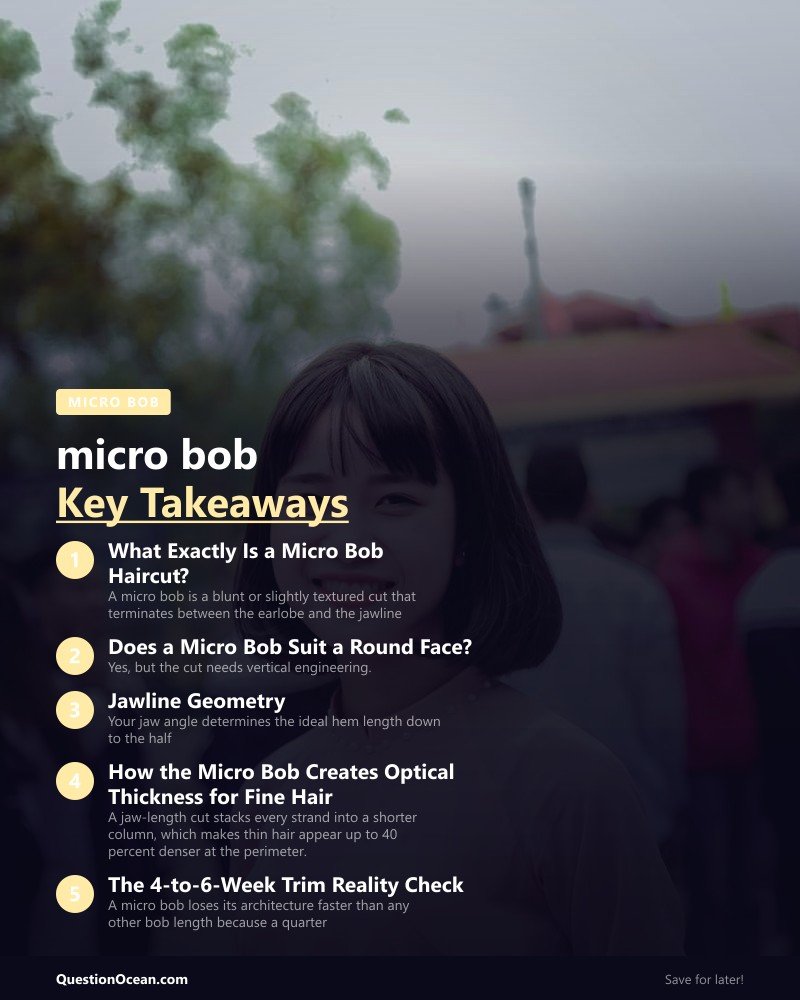
How the Micro Bob Creates Optical Thickness for Fine Hair
A jaw-length cut stacks every strand into a shorter column, which makes thin hair appear up to 40 percent denser at the perimeter. When hair hangs to the shoulders, gravity separates each strand and exposes the scalp line. The micro bob compresses that same strand count into half the vertical space.
To maximise the density illusion:
- Request a one-length base with invisible internal layers. Point-cutting the interior removes bulk without visibly thinning the outline.
- Apply a rice-sized amount of texturizing paste from mid-shaft to ends. This roughens the cuticle just enough to prevent strands from collapsing into each other. Texturizing paste for short bob
- Blow-dry with a boar bristle paddle brush, lifting at the root. Boar bristles grip fine hair without static. Boar bristle paddle brush
For a deeper look at volumising techniques, see our guide on styling a French bob for fine hair and the cross-cluster resource on strategic layering and face-framing for thin hair.
The 4-to-6-Week Trim Reality Check
A micro bob loses its architecture faster than any other bob length because a quarter-inch of growth represents a visible shape change at this scale. Here is what to expect in realistic terms.
- Weeks 1-2: The cut looks its sharpest. Perimeter lines are clean, the nape sits tight, and styling takes under five minutes.
- Weeks 3-4: Slight softening at the neckline. The overall shape still reads as intentional, but the geometric edge has relaxed.
- Weeks 5-6: The hem now grazes the chin on most people. The silhouette shifts from “micro bob” to “short bob.” Book your trim here or earlier.
Cost and Time Commitment
Budget for a trim every four to six weeks. In the US, a bob maintenance cut averages $45 to $75 at a mid-tier salon. In the UK, expect roughly the same in pounds at a high-street stylist. Factor this into your annual hair budget before committing; over twelve months, that is eight to twelve salon visits solely for shape upkeep.
If frequent trims are not realistic, consider transitioning from long hair to a bob at a slightly longer length that tolerates more grow-out.
Sleek vs. Tucked: Two Core Micro Bob Styling Methods
Every micro bob look falls into one of two camps: sleek-straight or tucked-under, and the technique difference is a single wrist rotation. Master both and you cover workdays and weekends with one cut.
Sleek-Straight Finish
- Apply a smoothing serum to damp hair.
- Blow-dry each section downward with a paddle brush, following the brush with the nozzle.
- Pass a mini flat iron (half-inch plates work best at this length) once from root to end. Mini flat iron 0.5 inch
- Finish with a light-hold hairspray to lock the glass effect.
Tucked-Under Finish
- Apply a volumising mousse at the roots.
- Blow-dry each section with a small round brush, rolling the ends inward as you reach the hem.
- Once dry, use the flat iron only if any sections flipped outward; curve gently inward at the last inch.
- Mist with flexible-hold spray to maintain movement.
The tucked version adds the illusion of a thicker perimeter because the curved ends layer over each other, while the sleek version highlights jaw definition.
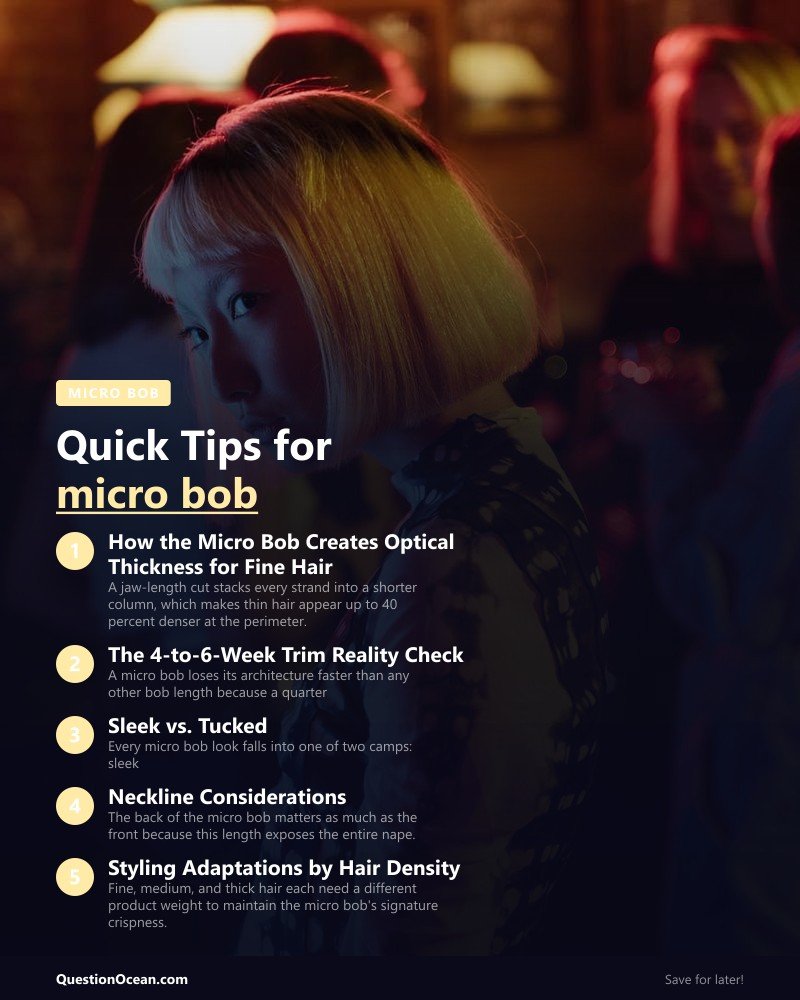
Neckline Considerations: Tapered, Grown-Out, or Undercut
The back of the micro bob matters as much as the front because this length exposes the entire nape. Discuss neckline finishing with your stylist before the first snip.
- Clean taper: Hair is gradually shortened at the nape with a clipper or razor. This keeps the back sharp for weeks and suits anyone who wears their hair tucked behind the ears.
- Natural neckline: The hair is cut to one length and the natural hairline is left as-is. This is lower-maintenance but can look uneven if your nape growth pattern is irregular.
- Undercut nape: A small section beneath the occipital bone is buzzed short. This reduces bulk for thick hair and adds an edge when the hair is tucked behind the ears.
For thick or coarse hair, the undercut nape is particularly effective because it prevents the back from “poofing” outward as it grows.
Styling Adaptations by Hair Density
Fine, medium, and thick hair each need a different product weight to maintain the micro bob’s signature crispness.
Fine Hair
- Goal: Maximise perceived fullness.
- Key product: Dry texture spray at the roots; avoid heavy waxes.
- Drying method: Rough-dry upside down for two minutes, then finish right-side up with a brush for control.
Medium Hair
- Goal: Maintain shape without stiffness.
- Key product: A lightweight cream styler from mid-shaft to ends.
- Drying method: Standard blow-dry with a paddle brush, low heat.
Thick or Coarse Hair
- Goal: Control volume and prevent triangle shape.
- Key product: Smoothing balm applied generously to damp hair; follow with argan oil on dry ends.
- Drying method: Section into four quadrants, dry each fully before releasing the next to prevent frizz expansion.
Frequently Asked Questions
How short is a micro bob compared to a regular bob?
A micro bob sits between the earlobe and the jawline, roughly two to three inches shorter than a classic chin-to-shoulder bob. The exact measurement varies by head size, but the defining feature is full jaw exposure.
Can I get a micro bob with curly hair?
Yes, but communicate with your stylist about shrinkage. Curly hair can spring up one to two inches when dry, so the wet cutting length must account for that. A DevaCut-trained stylist who cuts curls dry is ideal for precision at this length.
Will a micro bob make my neck look longer?
It can. Exposing the nape and jawline draws the eye vertically from chin to collarbone, which elongates the neck visually. If you prefer less neck exposure, a natural neckline finish with a slightly longer back is a good compromise.
How do I grow out a micro bob without an awkward stage?
Schedule trims that remove weight from the back and sides while allowing the front to lengthen. Adding face-framing layers during the grow-out phase keeps the cut looking intentional. Our guide on transitioning from long hair to a bob covers grow-out strategies in detail.
Is the micro bob high-maintenance?
It requires a trim every four to six weeks to maintain its shape, which is more frequent than longer styles. Daily styling time, however, is minimal at five to ten minutes because there is simply less hair to manage.
Does the micro bob work for professional settings?
Absolutely. The clean perimeter and structured silhouette read as polished in corporate, creative, and client-facing environments. A sleek-straight finish is the most universally professional version of the cut.
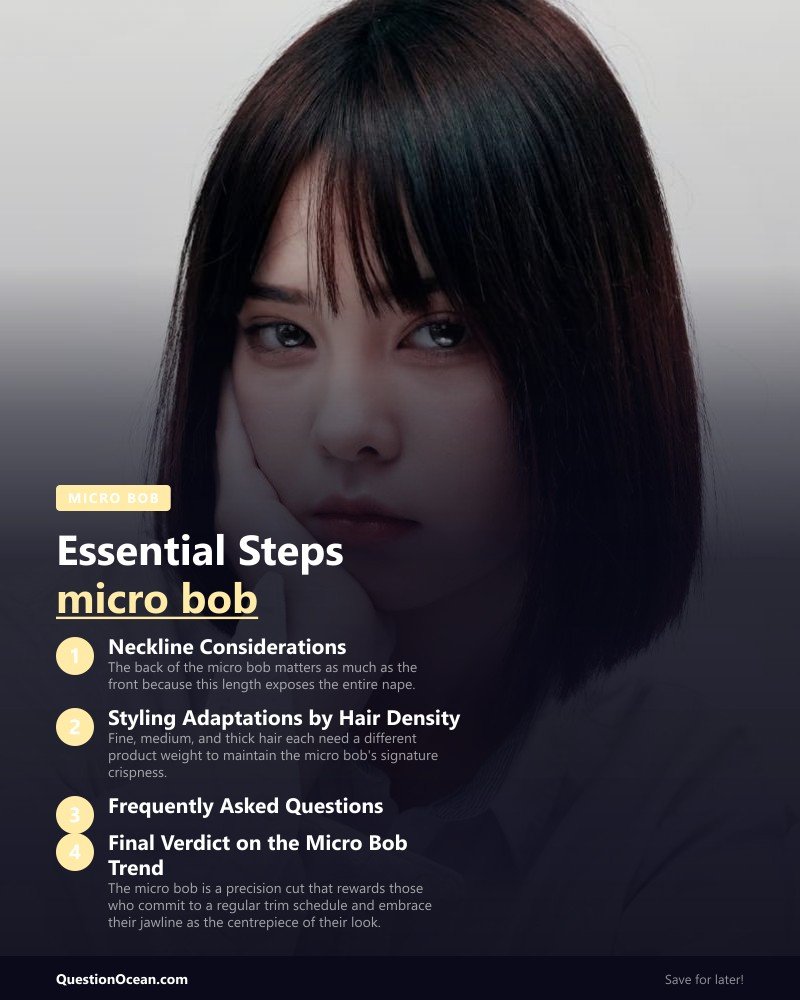
Final Verdict on the Micro Bob Trend
The micro bob is a precision cut that rewards those who commit to a regular trim schedule and embrace their jawline as the centrepiece of their look. It flatters every face shape when the hem length and perimeter texture are calibrated correctly. If you value low daily styling time and are comfortable with salon visits every four to six weeks, this is the short cut that delivers the most visual impact per inch of hair.