
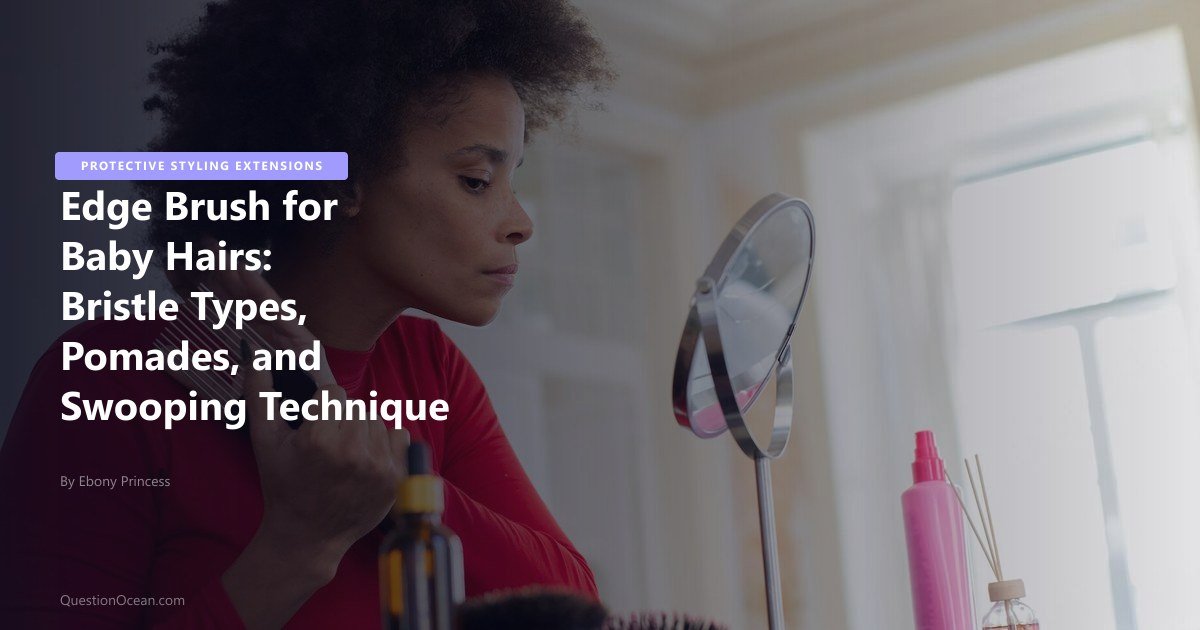
Baby hairs — the fine, short strands along the hairline, have become the defining detail of polished protective styling. The difference between edges that look sculpted and edges that look smeared comes down to three factors: bristle density of the edge brush, hold medium (wax pomade vs water-based gel), and the swooping pressure technique that lays hairs flat without creating tension damage. The right edge brush for baby hairs uses densely packed, ultra-fine bristles that grip individual hairs without pulling them from the follicle: creating a precision tool that sculpts without contributing to traction stress at the vulnerable hairline.
For the complete protective styling overview including edge preservation principles, see our pillar guide to protective hairstyles 2026.
Bristle Engineering: What Makes an Edge Brush Effective
Not all small brushes are edge brushes. The bristle type, density, and flexibility determine whether the brush sculpts precisely or simply pushes hair around.
Boar Bristle Edge Brushes
Best for: Fine to medium baby hairs that lay with minimal product.
Boar bristles are natural, flexible, and tapered, each bristle narrows to a fine point that grips individual strands. The natural keratin composition of boar bristles also carries a slight positive charge that helps smooth the negatively charged hair cuticle.
Limitation: Boar bristles don’t provide enough grip for thick, coarse baby hairs that resist laying flat.
Nylon Bristle Edge Brushes
Best for: Thick, coarse, or resistant baby hairs that need firm control.
Nylon bristles are stiffer and more uniform than boar bristles. The rigidity provides more laying power for baby hairs that spring back up immediately after being brushed down.
Limitation: The stiffness can scratch sensitive scalp skin along the hairline if pressed too hard.
Dual-Bristle Edge Brushes (Boar + Nylon Mix)
Best for: Most hair types. The 2026 standard.
Dual-bristle brushes combine the fine-grip precision of boar bristles with the laying power of nylon bristles. The mixed bristle bed provides both precision sculpting and hold force in a single tool.
Edge Brush Dual-Bristle for Baby Hairs
Spoolie-Tip Edge Brushes
A spoolie on the opposite end of the edge brush allows quick flyaway smoothing and brow grooming from the same tool. Useful for travel and quick touch-ups.
Wax Pomade vs Water-Based Edge Control
The hold medium matters as much as the brush. The two dominant categories, wax-based pomades and water-based gels. Create fundamentally different hold profiles.
Wax-Based Edge Pomades
Hold strength: Strong to extreme. Finish: Glossy, defined, wet-look. Duration: 8-14 hours in moderate humidity.
How they work: Beeswax, castor wax, or petroleum-based compounds coat the hair shaft with a water-resistant film that holds the baby hair in its sculpted position. The wax resists humidity penetration, maintaining the edge pattern even in high-humidity environments.
Drawback: Wax buildup. Daily wax application without thorough cleansing creates cumulative buildup along the hairline that can clog follicles and contribute to edge thinning over time. Requires clarifying shampoo at least weekly.
Water-Based Edge Gels
Hold strength: Light to strong (varies by formulation). Finish: Flexible, natural. Duration: 4-8 hours before requiring touch-up.
How they work: Water-based polymers (PVP, VP/VA copolymer) create a flexible film that holds the hair position without the heavy coating of wax. The water base washes out easily with regular shampoo.
Drawback: Flaking. Lower-quality water-based gels dry with visible white residue, particularly on dark hair. This flaking is the most common complaint about water-based edge controls.
The 2026 recommendation: Water-based edge controls for daily wear (less buildup, easier removal). Wax pomades reserved for events, photoshoots, or high-humidity days when maximum hold is essential.
For edge control products tested on 4C hair, see this resource on edge control for 4C hair.
The Swooping Technique: Sculpting Without Traction Damage
The swooping technique is the signature edge styling method, creating curved, wave-like patterns with baby hairs along the hairline. The motion must be gentle enough to avoid pulling the fine hairs from their shallow follicles.
Step-by-Step Swoop Protocol
- Apply edge control to the baby hairs. Use a pea-sized amount for the entire hairline, excess product creates buildup and flaking
- Load the edge brush by dipping the bristle tips into the product. Do not saturate the entire bristle bed
- Start at the temple on one side. Place the bristle tips flat against the baby hairs, pressing gently (not pulling)
- Sweep the brush in a single curved motion from the temple toward the forehead, creating the first swoop arc
- Lift the brush at the end of the arc. Do not drag it back. Each swoop should be one continuous forward motion
- Repeat for the opposite temple, mirroring the arc direction
- Set the swoop by pressing the back of the brush handle flat against the sculpted baby hairs for 3-5 seconds. This applies even pressure that locks the pattern without disturbing it
Critical Technique Details
Pressure matters: Use the weight of the brush only. No additional pressing force. The baby hairs along the hairline are connected to the shallowest follicles on the head. Excessive force, repeated daily, contributes to traction damage at the edges.
Direction matters: Always brush in the direction of natural hair growth. Forcing baby hairs against their growth direction creates persistent tension at the follicle base.
Frequency caution: Edge swooping more than once daily increases cumulative traction stress. Touch up with a clean brush and no additional product rather than reapplying from scratch.
Edge Brush Maintenance
A dirty edge brush redistributes old product, dead skin, and environmental debris onto your freshly styled edges. Creating a dull, built-up appearance.
Weekly cleaning protocol:
- Fill a small cup with warm water and a drop of dish soap
- Swirl the brush bristles in the soapy water for 30 seconds
- Rinse under running water until the water runs clear
- Lay flat on a clean towel to air dry (never stand bristle-side down in a cup: water pools at the bristle base and loosens the adhesive holding them in)
Replacement: Every 3-4 months for daily use. When bristles begin to splay, bend, or fall out, the brush loses its precision sculpting ability.
For overnight protection of styled edges, see our guide to silk bonnets for protecting braids.
Frequently Asked Questions
Q: What is the best edge brush for baby hairs? A: A dual-bristle brush (boar + nylon mix) provides both fine-grip precision and laying power for most hair types. For very fine baby hairs, a pure boar bristle brush offers gentler control. For thick, resistant baby hairs, a nylon-dominant brush provides stronger laying force.
Q: Is edge control bad for your hairline? A: Daily wax-based edge control without proper cleansing can cause buildup that contributes to edge thinning. Water-based gels are safer for daily use. The swooping technique itself is safe when performed with minimal pressure and in the direction of natural growth.
Q: How do you make edges last all day? A: Apply edge control to clean, dry baby hairs (not oily or product-laden hair). Use a wax-based pomade for 8-14 hour hold in humid conditions. Set the swoop by pressing the flat brush handle against the sculpted hairs for 3-5 seconds. Tie a silk scarf over the edges for 15 minutes after styling to lock the pattern.
Q: What edge control doesn’t flake? A: Water-based edge controls with PVP polymer base tend to flake less than those using older-generation holding agents. Look for “flake-free” on the label and test a small amount on the back of your hand: if it dries clear and flexible (not white and stiff), it’s unlikely to flake on hair.
Q: How often should you do your edges? A: Once daily maximum. Touch up mid-day with a clean brush and no additional product if needed. More frequent full applications increase cumulative tension on the hairline follicles and accelerate product buildup.
The right edge brush for baby hairs paired with the appropriate hold medium and swooping technique creates polished, sculpted edges that complete any protective style: without contributing to the traction damage that undermines the protective styling purpose. Precision without pressure is the goal.