
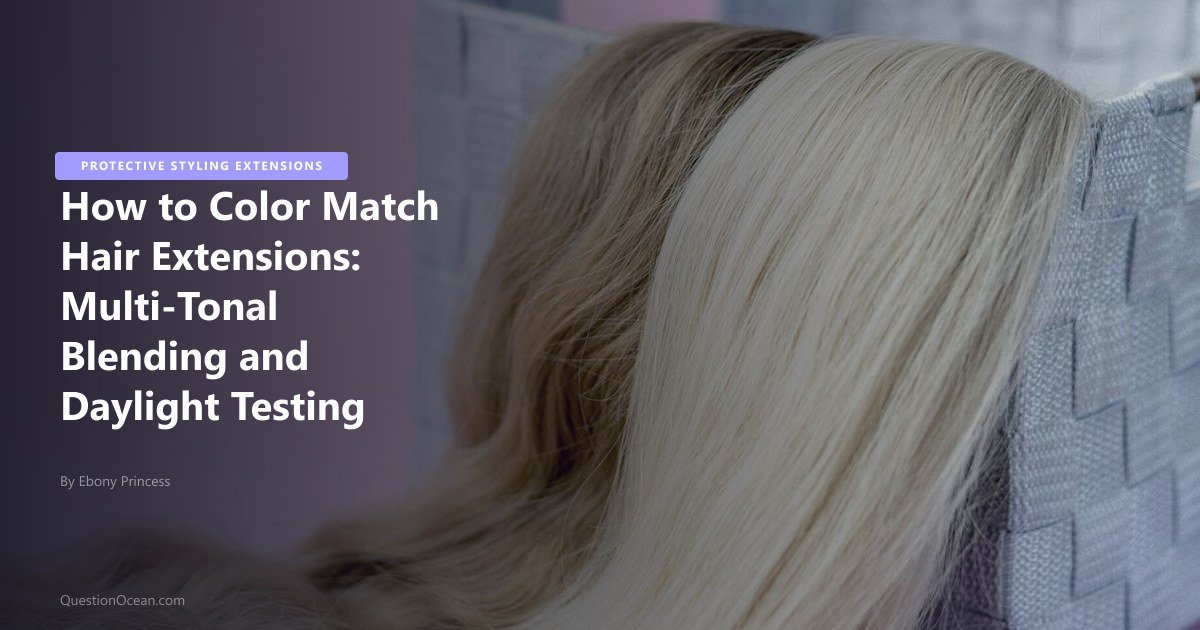
A perfectly installed extension that’s one shade off looks worse than a visibly installed extension in the exact right color. Color mismatch is the single most common reason people stop wearing extensions: the “wig energy” appearance almost always comes from a color problem rather than an installation problem. Learning how to color match hair extensions requires understanding that natural hair is never one color: it contains 3-5 visible tones from root to end, and a seamless match requires the extension to replicate this multi-tonal variation rather than matching a single swatch shade.
This guide covers the multi-tonal matching system, the natural daylight testing protocol that reveals mismatches invisible under indoor lighting, and the customization techniques for adjusting extension color after purchase.
For overall protective styling guidance including extension selection, see our pillar guide to protective hairstyles 2026.
Why Single-Shade Matching Fails
Extension companies sell hair in named shades: “Medium Brown,” “Dark Blonde,” “Auburn.” These single-shade designations suggest that matching your hair is a matter of selecting the right name from a dropdown menu.
The problem: your natural hair isn’t one shade. A typical brunette has:
- Roots: Darkest shade (Level 3-4 dark brown)
- Mid-shaft: Medium shade (Level 5-6 light brown)
- Ends: Lightest shade (Level 6-7 dark blonde from cumulative sun exposure)
- Face-framing sections: Often 0.5-1 levels lighter than the crown hair
- Underlayer: Often 0.5-1 levels darker than the surface hair
A “Medium Brown” extension matches the mid-shaft perfectly but looks too dark at the ends and too light at the roots. This creates a visible color discontinuity at the attachment point that no installation technique can disguise.
The Multi-Tonal Matching System
Professional extension colorists use a three-zone matching protocol that accounts for the root-to-end color variation:
Zone 1: Root Match
The 1-2 inches closest to the scalp where the extension attaches (tape bond, clip, or sew-in base). This zone must match the natural hair color at the attachment level, which is typically the mid-to-dark range of your natural color spectrum.
For tape-in extensions: The tape panel sits 0.5-1 inch from the root. Match the extension color at the attachment point to the natural hair color at that same distance from the scalp.
Zone 2: Mid-Shaft Blend
The 3-6 inch section where extension hair and natural hair are most visible together. This zone drives the overall color impression and should match the predominant visible tone of your natural mid-shaft hair.
This is the zone most people match when shopping for extensions by holding a swatch against their hair. It’s important, but it’s only one of three zones that need to match.
Zone 3: End Transition
The final 2-4 inches where extension hair hangs below the natural hair length. This zone has no natural hair reference next to it, so exact matching is less critical, but the undertone must be consistent.
If your natural ends are warm (golden, honey, copper): Extension ends should carry the same warmth. If your natural ends are cool (ashy, beige, neutral): Extension ends should be cool-toned as well.
Natural Daylight Testing: The Only Reliable Color Check
Indoor lighting, fluorescent, LED, warm incandescent. Distorts color perception dramatically. An extension that matches perfectly under bathroom lighting can reveal itself as 1-2 shades off in natural daylight.
The daylight testing protocol:
- Order 2-3 extension shade options in a sample ring or single-weft trial pack
- Clip or hold each sample against your natural hair at the mid-shaft zone
- Walk to a window with direct (not reflected) natural daylight
- Check the match from three angles: front, side, and above (how the person standing next to you sees it)
- Take a photo in daylight (phone cameras under natural light are more accurate than mirror assessment)
- Evaluate both the base color and the undertone — a correct base shade with the wrong undertone (warm vs cool) still mismatches visibly
When to test: Mid-morning or early afternoon daylight provides the most neutral color temperature. Avoid testing at sunset (golden-warm bias) or under overcast skies (blue-cool bias).
Extension Color Swatch Ring for Matching
Matching Extensions to Highlighted or Balayage Hair
Multi-dimensional color (highlights, balayage, ombre) makes extension matching exponentially harder because the natural hair contains intentional color variation that a single-shade extension can’t replicate.
Strategy 1: Mix Two Extension Shades
Purchase extensions in two shades, one matching the highlight color and one matching the base color, and alternate them during installation. During tape-in installation, place highlight-matched panels in the outer sections and base-matched panels in the under-sections.
Strategy 2: Rooted Extensions
Many extension brands now offer “rooted” options, wefts where the top 2-3 inches are darker than the remaining length. These replicate the natural dark-root-to-lighter-ends gradient that characterizes balayage and grown-out highlights.
Strategy 3: Custom Coloring After Purchase
Purchase extensions in a lighter shade (always go lighter. You can darken but can’t easily lighten), then have your colorist apply a custom toner, gloss, or demi-permanent color to match your specific multi-tonal pattern.
Important: Only human hair extensions can be custom-colored. Synthetic fibers reject standard hair dye entirely.
For blending techniques after achieving the right color match, see our tape-in extensions seamless blend guide.
Matching Root Smudge to Extensions
If your natural hair has a salon-applied root smudge (a graduated dark-to-light transition at the root zone), the extension must replicate this transition at its attachment point to avoid a visible color line.
Two approaches:
- Pre-colored rooted extensions that ship with a built-in root smudge. These are increasingly available from premium extension brands.
- Post-installation root smudge: Your stylist applies a demi-permanent color to the first 0.5-1 inch of the installed extension hair, matching the root smudge gradient of your natural hair. This is the most precise method.
See our detailed guide on root smudge techniques for extensions for the step-by-step application process.
Fixing a Bad Color Match After Purchase
If you’ve already purchased extensions and the color doesn’t match, several correction options exist before returning:
Extensions Too Dark
- Apply a color-depositing conditioner in a lighter shade (honey, golden) to the extension hair
- Use a clarifying shampoo wash to strip some pigment (this works on demi-permanent colored extensions)
- Have a colorist apply a high-lift toner to lighten the extensions 0.5-1 level
Extensions Too Light
- Apply a color-depositing conditioner in a darker shade (espresso, brunette) to the extension hair
- Use a demi-permanent gloss in the desired shade (lasts 6-8 weeks)
- This is the easier fix, darkening extensions is straightforward; lightening is risky
Wrong Undertone (Warm When You Need Cool, or Vice Versa)
- Too warm: Apply an ash or blue-violet toner to neutralize the warmth
- Too cool: Apply a warm gloss or golden color-depositing conditioner
Color Depositing Conditioner for Extension Adjustment
Extension Color Maintenance Over Time
Extension color fades differently than natural hair because the extension fiber doesn’t produce new pigment. Over time, washing, UV exposure, and heat styling progressively lighten the extension color while your natural hair maintains its shade: creating a growing mismatch.
Maintenance protocol:
- Use sulfate-free, color-safe shampoo exclusively
- Apply UV-protective spray before extended sun exposure
- Refresh extension color with a color-depositing conditioner every 3-4 weeks
- Minimize heat styling that accelerates color fade
For extension heat styling guidance, see our guide on heat styling synthetic vs human wigs. For the comparison of different extension systems, see tape-in vs clip-in extensions.
Frequently Asked Questions
Q: How do I match hair extension color to my hair? A: Use the three-zone matching system: match root zone (attachment point), mid-shaft (visible blend zone), and undertone (warm vs cool). Always test in natural daylight, indoor lighting distorts color accuracy by 1-2 visible levels.
Q: Should I match extensions to my roots or ends? A: Match to the mid-shaft primarily, with attention to the root zone at the attachment point. The mid-shaft is the most visible blend zone where natural hair and extension hair are seen together.
Q: Can I dye my hair extensions to match? A: Human hair extensions can be dyed, toned, or glossed. Synthetic extensions cannot accept standard hair dye. Always go lighter with your initial purchase, darkening is easy, lightening risks damage.
Q: What if my extensions are too warm or too cool? A: Apply an opposing toner or color-depositing conditioner. Too warm: use an ash or blue-violet toner. Too cool: use a warm or golden conditioner. These adjustments take 15-20 minutes and last 3-4 weeks per application.
Q: Do extension colors fade over time? A: Yes. UV exposure, heat styling, and washing all fade extension color progressively. Natural hair doesn’t have this issue because it produces pigment continuously. Refresh extension color with a color-depositing conditioner every 3-4 weeks to maintain the match.
Understanding how to color match hair extensions across multiple tonal zones. Root, mid-shaft, and ends: eliminates the single biggest barrier to natural-looking extensions. The multi-tonal system, daylight verification, and post-purchase correction techniques ensure that extension color enhances the installation rather than betraying it.