
Last updated: 2026-04
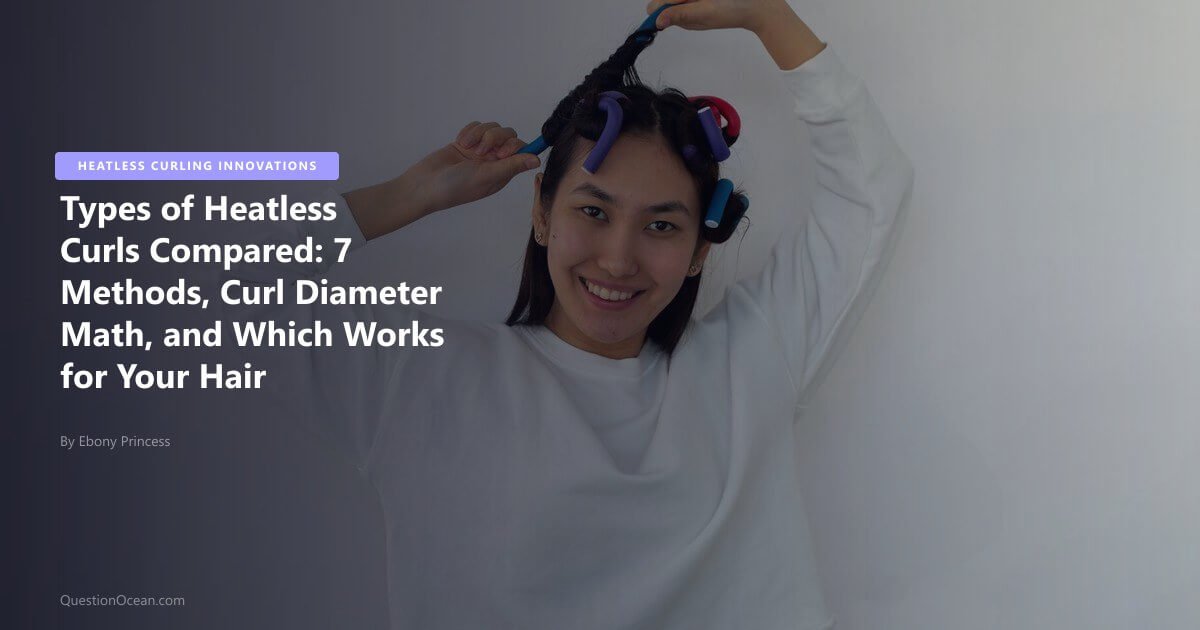
The seven main types of heatless curls each produce a different curl diameter, hold strength, and prep effort — and choosing the wrong method for your hair length, density, or sleep style is the single biggest reason heatless curls fail. A method that produces tight ringlets on shoulder-length fine hair will produce nothing on waist-length thick hair, and the sock bun that works perfectly for back sleepers tortures stomach sleepers all night. The types of heatless curls fall into two structural categories, wrap methods that twist hair around a tool and form-set methods that mold hair against a form, and the right choice for your hair depends on three measurable variables: curl diameter you want, hair density you have, and time you can commit before you need to release the set.
This guide compares all seven mainstream methods side-by-side with the data to choose intelligently rather than copy whichever TikTok went viral last week.
For the master decision tree on which method matches your hair type, see our pillar guide to heatless curls for every hair type.
The Curl Diameter Math
Every heatless curl method produces a curl whose diameter approximately equals the diameter of the tool the hair was wrapped around. This is the single most useful number when choosing a method.
| Tool Diameter | Curl Style Produced | Visual Result |
|---|---|---|
| 0.5-1 inch | Tight ringlet / spiral | Defined corkscrew curls |
| 1-1.5 inches | Medium curl | Bouncy, classic curl |
| 1.5-2 inches | Loose curl | Soft, romantic curl |
| 2-3 inches | Beachy wave | Loose S-wave |
| 3+ inches | Soft bend | Subtle directional movement |
Why this matters: A “sock bun” curl wrapped around a 4-inch sock-roll creates beachy waves. A “flexi rod” wrapped around a 0.75-inch rod creates ringlets. The same hair, different tool, different result. Pick your tool by the curl diameter you want.
Method 1: The Sock Method (Single-Strand Wrap)
A clean long sock is rolled into a flexible tube, hair is wrapped around it from ends to roots, and the sock is secured at the crown.
Curl diameter produced: ~1.5-2 inches (loose to medium curl) Setup time: 5 minutes Sleep comfort: High, sock is soft and compresses Best for: Medium-length hair, fine to medium density, side sleepers Worst for: Very long hair (sock can’t accommodate full length), very thick hair (won’t dry through)
The mechanic: Hair wraps the sock the way it would wrap a curling iron barrel: with smooth, continuous tension. Because the sock has give, the curl pattern stays soft rather than tight.
Method 2. The Sock Bun Method (Form-Set)
A sock is rolled into a doughnut shape, the hair is gathered into a high ponytail and threaded through the doughnut, then the ends are wrapped around the doughnut and pinned.
Curl diameter produced: ~3-4 inches (beachy waves) Setup time: 8 minutes Sleep comfort: Medium, bun sits on crown, can press into pillow Best for: Voluminous beachy waves, medium to thick hair, back sleepers Worst for: Stomach sleepers, very fine hair (the form bun is heavy relative to hair weight)
Pro tip: For tighter waves from a sock bun, divide the ponytail into 3-4 mini-buns instead of one large one. Smaller forms = tighter waves.
Method 3: The Robe Tie Method
A bathrobe belt or wide silk ribbon is placed across the head like a headband, hair is gathered into two sections, and each section is wrapped around its half of the robe tie from temple to ends.
Curl diameter produced: ~1.5 inches (medium, bouncy curl) Setup time: 10 minutes Sleep comfort: Medium, depends on tie thickness and head position Best for: Defined Hollywood-style curls, shoulder-length to mid-back hair Worst for: Hair shorter than shoulder length, stomach sleepers (tie ends can hang down)
The mechanic: The robe tie acts as a vertical guide. Hair wrapped around it from temple to ends takes a directional curl that falls toward the face, mimicking a salon blowout result.
For a head-to-head comparison of robe curls vs other tie methods, see our robecurls vs sleepy tie comparison.
Method 4: Flexi Rods
Flexible foam-and-rubber rods (typically 6-12 inches long with 0.5-1.5 inch diameter) are bent around hair sections from ends to roots and held in place by their own bend.
Curl diameter produced: ~0.5-1.5 inches (depends on rod size, tightest curls of any method) Setup time: 15-25 minutes (multiple rods required) Sleep comfort: Low. Rods are firm and pressure-point Best for: Tight, defined curls; thicker or coarser hair; people who can sleep with hair pinned up Worst for: Side or stomach sleepers, fine hair that breaks under tool weight
The mechanic: Unlike sock or ribbon methods that bend around a flexible form, flexi rods give the hair a fixed-shape mold to dry against. The fixed shape produces the most precisely defined curl pattern of any heatless method.
Heatless Curl Set Variety Pack
Method 5, Silk Ribbon Wrap
A 2-3 foot silk ribbon (or padded silk curling rod) is folded over the crown like a robe tie but is thinner and softer. Hair wraps around each side of the ribbon from temple to ends.
Curl diameter produced: ~1-1.5 inches (medium curl) Setup time: 8 minutes Sleep comfort: High: silk is the softest material option Best for: All hair types but especially fine and color-treated hair; humidity-sensitive curls Worst for: Very thick or very long hair (single ribbon can’t hold all the volume)
Why silk specifically: Silk fiber surface has a tighter weave than cotton, satin, or synthetic. The smoother surface lets hair slide rather than catch, which reduces friction-induced frizz that ruins curls overnight. Silk is the only material that consistently delivers frizz-free morning curls.
Method 6. Headband Curls (Greek Goddess Method)
A wide elastic headband is placed around the head sitting like a crown, then small sections of hair are wrapped over and under the headband from front to back, working all the way around the head.
Curl diameter produced: ~1.5-2 inches (loose romantic curls) Setup time: 12 minutes Sleep comfort: Medium, headband sits high enough to clear pillow Best for: Long hair (the headband has unlimited “circumference” for wrapping), all densities Worst for: Very short hair (sections too small to tuck under headband)
The mechanic: Each hair section bends around the headband twice, creating two hydrogen-bond reformation points per section. The result is a curl with built-in volume because the bend points sit close to the scalp.
Method 7: Pin Curls (The Original Heatless Method)
The oldest heatless technique. Sections of damp hair are wound around two fingers into flat coils, then secured against the scalp with bobby pins or duck-bill clips.
Curl diameter produced: ~0.75-1.25 inches (tight to medium curl) Setup time: 25-45 minutes (highest of any method) Sleep comfort: Medium-low (pin pressure points) Best for: Vintage Hollywood curls, hair down to chin length Worst for: Anyone with limited time, very long hair (each curl is tiny so you need 50+)
Why it persists: Pin curls produce the most uniformly defined curl pattern of any heatless method, with the longest hold (24-48 hours). Professional vintage stylists still use pin curls because the trade-off in setup time is justified by the precision of the result.
The Method Selection Matrix
Use this table to pick a method based on what matters most to you.
| Your Priority | Method to Choose |
|---|---|
| Fastest setup (5 min) | Sock method |
| Tightest curls | Flexi rods or pin curls |
| Loosest beachy waves | Sock bun (large) or headband |
| Best sleep comfort | Silk ribbon |
| Best for fine hair | Silk ribbon or sock |
| Best for thick coarse hair | Flexi rods or sock bun (multiple) |
| Best for very long hair | Headband or robe tie |
| Best frizz resistance | Silk ribbon |
| Longest hold (24+ hours) | Pin curls or flexi rods |
| Lowest cost | Sock method ($0 if you own socks) |
| Best for stomach sleepers | Silk ribbon (thinnest, softest) |
For the specific protocols when working with thick or coarse hair, see our heatless curls for thick coarse hair guide.
The Material Hierarchy (Why Silk Wins)
Across every method that uses fabric, the material determines the morning result more than the technique does.
| Material | Friction Level | Frizz Risk | Cost |
|---|---|---|---|
| Mulberry silk | Lowest | Very low | $$$ |
| Charmeuse satin | Low | Low | $$ |
| Cotton (T-shirt fabric) | Medium | Medium | $ |
| Polyester / synthetic | High | High | $ |
| Terry cloth (towel robe belt) | Highest | Very high | $ |
Practical translation: A silk ribbon at $25 produces consistently better results than a $5 cotton headband, every single time. The cost difference pays for itself in morning frizz time saved.
Common Method-Specific Mistakes
Sock method: Wrapping too tightly at the ends creates kinks. Wrap with even tension throughout.
Sock bun: Using a single large bun on thick hair leaves the inner sections damp by morning. Use 3-4 smaller buns.
Robe tie: Using a terry-cloth robe belt instead of a smooth one. Terry cloth’s looped fibers grab the hair and cause severe frizz.
Flexi rods: Removing the rods while hair is still slightly damp at the roots. Curls drop within hours if released early. Wait until 100% dry.
Silk ribbon: Wrapping the hair around the ribbon in twists (rotating as you wrap) instead of flat wraps. Twist-wrapping creates kinks.
Headband curls: Tucking sections too loosely. Each tuck must have enough tension to hold the curl shape, loose tucks unravel.
Pin curls: Using regular bobby pins instead of duck-bill clips on thick coils. Bobby pins can’t grip enough hair for thick sections, duck-bills hold properly.
Frequently Asked Questions
Q: What are the main types of heatless curls? A: The seven mainstream methods are: sock method (single-strand wrap), sock bun (form-set), robe tie wrap, flexi rods, silk ribbon wrap, headband curls (Greek goddess style), and pin curls. Each produces a different curl diameter (0.5 inch ringlets to 4 inch beachy waves) and has different sleep-comfort and setup-time profiles.
Q: Which type of heatless curl method lasts the longest? A: Pin curls and flexi rods produce the longest-lasting curls (24-48 hours) because they create the most precisely defined curl pattern with the smallest curl diameter. Loose methods like sock buns and large headband wraps drop faster because larger curls have less structural memory.
Q: What’s the difference between flexi rods and silk ribbons? A: Flexi rods produce tighter, more defined curls (0.5-1.5 inch diameter) but are uncomfortable to sleep in due to their firm structure. Silk ribbons produce softer 1-1.5 inch curls and are the most sleep-comfortable option but offer less curl precision than rods.
Q: Are sock curls or robe curls better? A: Sock curls are faster and more comfortable but produce looser, less defined curls. Robe curls take longer to set up but produce more glamorous, defined curls, at the cost of more friction-related frizz risk if the robe tie is rough fabric.
Q: Can I mix heatless curl methods on the same head of hair? A: Yes, and stylists often do this. A common combination: flexi rods at the crown for volume, silk ribbon wraps along the lengths for soft curls. This produces a multi-dimensional curl pattern that looks more natural than any single method.
Q: Which heatless curl type is best for beginners? A: The silk ribbon wrap. It’s forgiving (hard to mess up), comfortable to sleep in, works on most hair types, and produces consistent medium curls. Master this method before experimenting with flexi rods or pin curls.
Q: How many heatless curl tools do I need for full-head coverage? A: Sock method: 1-2 socks. Sock bun: 1-3 buns. Robe tie: 1 long tie. Flexi rods: 8-15 rods (depending on hair thickness). Silk ribbon: 1-2 ribbons. Headband: 1 headband. Pin curls: 30-50 bobby pins or duck-bill clips. Plan accordingly.
The seven types of heatless curls each occupy a specific niche in the curl-diameter / sleep-comfort / setup-time space. Match the method to your hair length, density, sleep position, and target curl diameter, and the heatless curls become a reliable styling routine instead of an unpredictable experiment. Once you’ve identified your two or three reliable methods, switching between them lets you achieve almost any curl style without ever picking up a heated tool.