
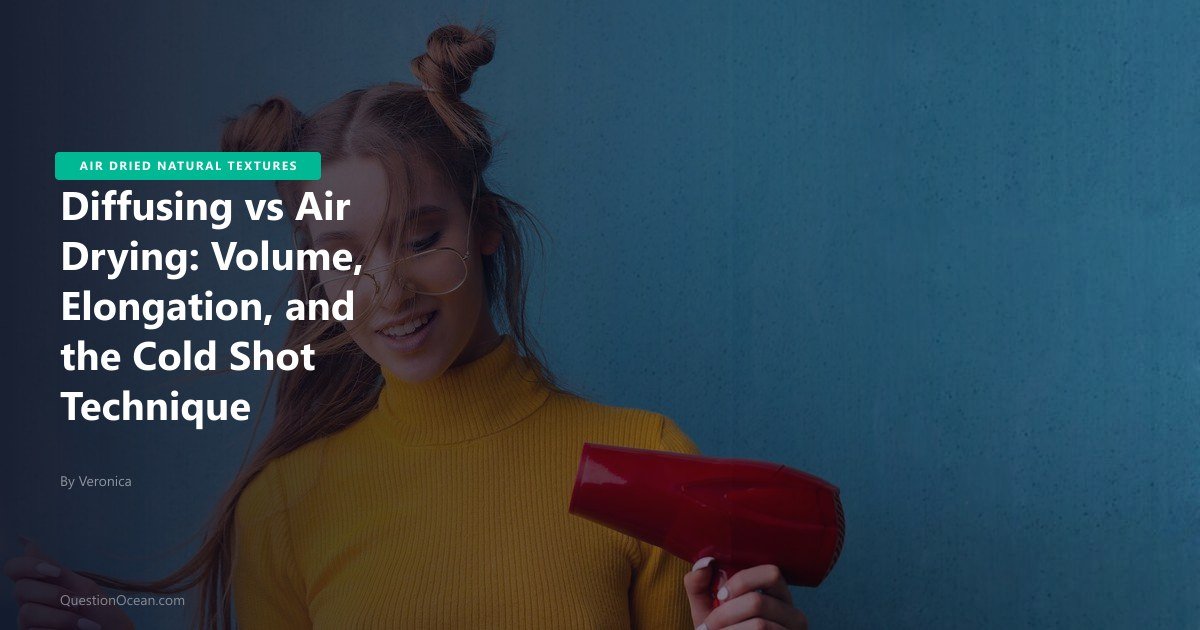
The “should I diffuse or air dry?” question is the most debated topic in wavy and curly hair communities — and the answer isn’t universal. Diffusing and air drying produce fundamentally different mechanical outcomes: diffusing creates shorter, tighter, more voluminous curls with faster setting; air drying produces longer, more elongated, looser waves with gentler cuticle care routine. The right choice depends on whether you prioritize volume (diffusing) or length retention and minimal manipulation (air drying).
This guide compares diffusing vs air drying on five measurable dimensions: curl definition, volume, frizz potential, heat exposure, and time, then provides the hybrid protocol that captures the advantages of both.
The Mechanical Difference: Why Diffusing Creates Volume
A standard hair dryer nozzle concentrates airflow into a narrow, high-speed stream that disrupts curl formation by blowing strands apart. A diffuser attachment disperses airflow across a wide surface area, reducing speed and turbulence while delivering heat evenly to a large section of hair simultaneously.
What the diffuser actually does mechanically:
- Lifts hair from the root. The prongs of the diffuser cup the hair upward against the scalp, holding the root zone in a lifted position while warm air sets the hydrogen bonds. This root lift is maintained after the bonds cool and harden.
- Accelerates drying from the inside out. Warm air flowing across multiple strands simultaneously dries the interior of each curl cluster, preventing the “dry exterior, damp interior” problem that causes curls to flatten 30-60 minutes after an otherwise complete air-dry session.
- Shortens curl pattern. Heat accelerates hydrogen bond setting. Bonds fix in whatever position the hair is holding at the moment they set. Since the diffuser cups hold curls in their compressed, scrunched position, the bonds lock into a tighter pattern than gravity-influenced air drying would produce.
What air drying does mechanically:
- Allows gravity to elongate the curl. Without the upward support of diffuser prongs, wet hair hangs under its own weight. Hydrogen bonds form slowly as water evaporates, setting in the gravity-elongated position. The result: longer, looser waves.
- Produces no heat exposure. Zero thermal stress on the cuticle. No risk of moisture evaporation beyond the natural drying rate.
- Requires no active styling time. Air drying is passive: apply products, plop for 15-20 minutes, then go about your morning while the hair dries over 45-120 minutes.
Diffusing vs Air Drying: Side-by-Side Comparison
| Factor | Diffusing | Air Drying |
|---|---|---|
| Curl definition | Higher (tighter, bouncier) | Moderate (looser, elongated) |
| Root volume | Significant lift | Minimal (gravity pulls flat) |
| Frizz potential | Higher (heat can ruffle cuticle) | Lower (no thermal disruption) |
| Drying time | 15-30 minutes | 45-120 minutes |
| Heat damage risk | Low-moderate (diffused heat is gentler than direct) | Zero |
| Best for Type | 2B-3C (curly/wavy benefits from curl compression) | 1C-2A (waves that drop if compressed too tightly) |
| Product longevity | 12-24 hours (heat sets bonds firmly) | 8-16 hours (gradual bond setting = gradual relaxation) |
The Hover Diffusion Technique: Maximum Volume, Minimum Damage
Standard diffusing involves pressing the diffuser bowl against the hair and holding it against sections for 20-30 seconds. This contact method produces excellent volume but concentrates heat at the contact point, raising surface temperature to 130-160°F, enough to cause mild cuticle stress with daily use.
Hover diffusing eliminates the contact heat issue by holding the diffuser 2-3 inches from the hair surface, close enough for effective drying, far enough to prevent heat concentration.
Hover Diffusing Protocol
- Apply all styling products to soaking wet hair (scrunching technique with gel or mousse)
- Set dryer to medium heat, low speed (high speed at any distance creates frizz-inducing turbulence)
- Flip hair upside down for maximum root lift
- Hold the diffuser 2-3 inches from the hair. Never pressing against the head
- Move the diffuser slowly around the head in a circular pattern, spending 15-20 seconds per area before moving on
- Continue hover diffusing for 10-15 minutes until hair is approximately 80% dry
- Switch to the cold shot button for the final 2-3 minutes, the cold air seals the cuticle and locks the curl pattern (see Cold Shot Technique below)
- Turn off the dryer and allow the remaining 15-20% moisture to air dry naturally (5-10 minutes)
Total time: 15-20 minutes. Significantly faster than 45-120 minute full air drying, with minimal heat exposure due to the 2-3 inch hover distance.
The Cold Shot Technique: Sealing the Cuticle
Every hair dryer has a cold shot button, and almost nobody uses it correctly for styling purposes.
The cold shot serves a specific scientific function: When warm air opens the cuticle slightly (allowing products to penetrate and bonds to reform), a final blast of cold air rapidly contracts the cuticle scales back into their smooth, flat position. This “seals” the cuticle, locking in moisture, increasing shine, and setting the curl shape in its final form.
How to Use the Cold Shot for Diffusing
- After hover diffusing to 80% dry on medium heat, switch to the cold shot
- Hold the diffuser at the same 2-3 inch hover distance
- Move slowly around the entire head for 2-3 minutes
- Focus on the crown and face-framing sections where shine is most visible
- When the hair feels cool to the touch (not warm), the cuticle has fully contracted
Without the cold shot: Curls continue to relax slightly after the dryer is turned off because the cuticle remains partially open, allowing moisture to escape and bonds to shift. With the cold shot, curls maintain their diffused shape for 2-4 additional hours.
Hair Dryer with Diffuser Attachment, ionic technology
The Hybrid Approach: 80% Diffuse + 20% Air Dry
For users who want the volume benefits of diffusing without the time commitment of full air drying, and without the complete heat exposure of full diffusing, the hybrid approach offers the optimal balance.
The 80/20 Hybrid Protocol
- After washing and product application, microfiber plop for 10-15 minutes to remove excess water
- Hover diffuse on medium heat for 8-12 minutes until hair is approximately 80% dry
- Apply the cold shot for 2 minutes to seal the cuticle
- Turn off the dryer and allow the remaining 20% moisture to air dry over 15-30 minutes
Total time: 25-30 minutes, faster than full air drying (45-120 min), lower heat exposure than full diffusing (15-30 min of continuous heat). The hybrid captures 80% of diffusing’s volume benefit with 50% less heat exposure.
Climate and Humidity Adjustments for Diffusing vs Air Drying
High Humidity (US Southeast, UK August)
Recommended: Full diffusing with cold shot finish. In humidity above 70%, air-dried hair continues to absorb ambient moisture after the drying window closes, causing waves to drop and frizz to expand. Full diffusing sets bonds with heat, then the cold shot seals the cuticle against humidity infiltration. Add a strong-hold anti-humectant gel (polyquaternium-11) before diffusing for maximum weather resistance.
Moderate Humidity (UK Year-Round, US Mid-Atlantic, Canadian Coastal)
Recommended: 80/20 hybrid. Moderate humidity (45-65%) is the ideal range for the hybrid approach: the air-dry portion doesn’t encounter enough ambient moisture to cause significant frizz, while the diffusing portion provides root volume and curl definition.
Low Humidity (Canadian Prairies, US Mountain West, UK Winter)
Recommended: Full air drying or minimal diffusing. Below 35% humidity, air drying is safe from frizz (dry air doesn’t contain enough moisture to disrupt the cuticle). Diffusing in very dry environments removes internal moisture too rapidly, creating static and brittleness. If diffusing, use the lowest heat setting and apply a sealing oil before drying.
Choosing the Right Diffuser Attachment
Not all diffuser attachments produce the same result. The diameter, prong length, and airflow distribution pattern affect volume, definition, and drying speed.
For root volume (fine/medium hair): Choose a smaller-diameter diffuser (3-4 inches) with long prongs (1.5-2 inches) that reach the root zone. The smaller cup concentrates airflow at the roots for maximum lift.
For curl definition (thick/curly hair): Choose a larger-diameter diffuser (5-6 inches) with shorter prongs (0.5-1 inch) that cradle curl clusters without breaking them apart. The wider cup accommodates more curl volume per section.
Universal attachment fit: Most diffusers are designed for specific dryer models. Universal diffusers use silicone gaskets that stretch to fit any nozzle, look for “universal fit” in the product description to avoid compatibility issues.
For specialized diffuser recommendations by hair type, see the best diffuser attachments for volume guide.
For the complete air-dry hair styling framework, see our pillar guide. For thick hair that needs specialized air-dry cream before either method, see our absorption-rate guide.
Frequently Asked Questions
Q: Is diffusing better than air drying? A: Neither is universally better. Diffusing vs air drying produces fundamentally different outcomes: diffusing creates tighter curls, more root volume, and faster drying at the cost of mild heat exposure. Air drying produces elongated waves, zero heat damage, and requires no active styling time but takes 45-120 minutes.
Q: Does diffusing damage hair? A: Hover diffusing at medium heat, held 2-3 inches from the hair, produces minimal cuticle stress. Significantly less than direct blow-drying. The cold shot finish seals the cuticle and prevents moisture loss. Daily contact diffusing (pressing the cup against the hair) at high heat produces moderate cumulative cuticle damage.
Q: How do I diffuse without frizz? A: Use medium heat and low speed (high speed creates turbulence). Hover 2-3 inches from the hair: never press. Apply a strong-hold gel or mousse before diffusing to coat the cuticle. Finish with 2-3 minutes on the cold shot to seal the cuticle flat.
Q: What is the cold shot button for on a hair dryer? A: The cold shot delivers room-temperature air that rapidly contracts the cuticle after warm-air styling. This “sets” the curl pattern, increases shine, and prevents post-dry frizz by sealing the cuticle against ambient humidity.
Q: Can I diffuse Type 1B-2A hair? A: Yes, use the hover technique on low heat for 8-10 minutes to set subtle waves and provide root lift. Fine, straight-to-wavy hair doesn’t need the full 20-minute diffusing session required for thick curly textures. The 80/20 hybrid approach works particularly well for this hair type range.
The diffusing vs air drying debate resolves when you understand what each method actually does: diffusing mechanically compresses and heat-sets curls for volume; air drying gravitationally elongates and ambient-sets curls for length. The 80/20 hybrid approach, hover diffusing to 80% dry, then air drying the remainder. Captures the volume of diffusing and the gentleness of air drying in a 25-minute total time that fits into any morning routine.