
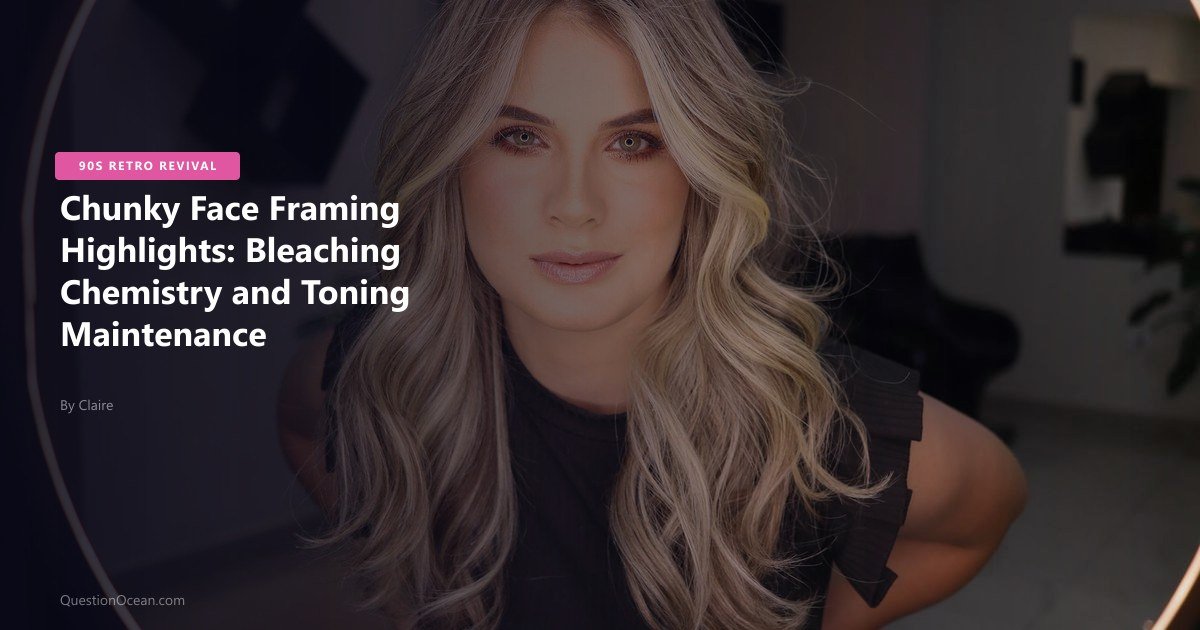
The subtle balayage of 2020-2023 has been systematically replaced by deliberate, thick, high-contrast chunky face framing highlights. The “money piece” trend that puts two wide bleached panels on either side of the face as the most visible element of any hairstyle. Chunky face framing highlights are the highest-maintenance color trend of 2026: the bleached panels require toning every 4-6 weeks, deep conditioning every 2 weeks, and weekly purple shampoo sessions to prevent the warm-base oxidation that turns platinum blonde into brassy orange.
This guide covers the bleaching chemistry that creates high-contrast front pieces, the root smudge technique that prevents harsh root grow-out lines, and the at-home toning maintenance that extends salon visits from monthly to every 6-8 weeks.
Why Chunky Face Framing Highlights Are Different from Balayage
Balayage uses a hand-painted, gradient application that blends light-to-dark seamlessly. The transition zone is wide and forgiving, root grow-out is invisible for 8-12 weeks because the color fades gradually into the natural base.
Chunky face framing highlights use foil-wrapped, full-saturation bleach applied to a clearly defined panel (typically 1-2 inches wide) starting at the hairline. There is no gradient, the bleached panel contrasts sharply against the natural base color. This creates the high-impact visual drama that drives the trend, but also means root grow-out is visible within 3-4 weeks as a dark line appears at the root.
The Width Decides the Impact
- 1-inch panels: Subtle money piece. Visible when hair is loose but blends when pulled back. Lower maintenance because less total bleached area.
- 1.5-inch panels: Standard 2026 chunky face framing highlights. Creates the definitive high-contrast framing visible in all hairstyles: down, up, partially clipped.
- 2-inch panels: Maximum impact. Dominates the visual field and creates a bold, editorial look. Highest maintenance because the wide panel shows root grow-out faster and requires more product for toning.
The Bleaching Chemistry Behind Chunky Highlights
Bleach (typically 20-30 volume developer plus lightening powder) works by oxidizing the melanin pigments inside the cortex of the hair shaft. This oxidation occurs in stages:
The Bleaching Level Progression
| Level | Color | Approximate Time | Status |
|---|---|---|---|
| 1-3 | Very dark brown to dark brown | 10-15 min | Early lifting |
| 4-5 | Medium brown to light brown | 15-20 min | Moderate lifting |
| 6-7 | Dark blonde to medium blonde (orange phase) | 20-30 min | Danger zone. Most at-home bleaching stops here |
| 8-9 | Light blonde to pale yellow | 30-40 min | Near completion |
| 10 | Lightest blonde / platinum | 40-50 min | Full lift (professional only) |
The orange phase (Levels 6-7) is the most critical. At-home bleaching kits typically don’t lift beyond this level, which is why DIY chunky highlights frequently turn brassy orange rather than clean blonde. Professional salons use higher-volume developers and bond-protection additives to push through the orange phase completely.
The professional advantage: A salon colorist monitors the lifting process in real-time, removing the foil when the hair reaches Level 9-10. At-home bleaching sets a timer and guesses. Frequently under-lifting (producing orange) or over-lifting (producing breakage).
For maintaining bleached front pieces alongside healthy ends, see our guide to affordable bond building treatments.
The Root Smudge: Preventing Harsh Root Grow-Out Lines
The root smudge technique. Applied by the salon colorist at the end of the highlighting session: deposits a semi-transparent wash of color at the root zone of the bleached panels. This creates a 0.5-1 inch gradient transition between the natural root and the bleached panel, eliminating the hard line of demarcation that makes root grow-out immediately visible.
Why it extends maintenance intervals: Without a root smudge, root grow-out is visible at 3-4 weeks. With a properly executed smudge, the gradient transition disguises new growth for 6-8 weeks, effectively halving the salon visit frequency.
What to ask your stylist: “Can you apply a root smudge at my natural base level to the face-framing panels?” The colorist will apply a demi-permanent color matching your root shade to the first 0.5-1 inch of the bleached section, blending it downward with a brush for a graduated transition.
At-Home Toning Maintenance for Chunky Face Framing Highlights
Between salon visits, the bleached panels gradually shift toward warm, brassy tones: this is a natural oxidation process, not product failure. The warm undertone (yellow-orange) is the natural remaining pigment from the bleaching process, and it becomes progressively visible as the cool-toned toner applied at the salon washes out.
Purple Shampoo Protocol
Purple shampoo deposits violet pigment onto the bleached hair, neutralizing the yellow-warm undertone and maintaining the cool blonde appearance.
Weekly regimen:
- Once per week, replace regular shampoo with purple shampoo for the face-framing panels only
- Apply purple shampoo to dry hair (for maximum pigment deposit) or damp hair (for lighter deposit)
- Leave on for 3-5 minutes (not longer — extended contact can produce an over-toned, ashy gray tint)
- Rinse thoroughly
- Follow with a hydrating conditioner, purple shampoo is drying
Product recommendations:
- Fanola No Yellow Shampoo ($16/350ml). The strongest pigment concentration in the market. Use 2-3 minute contact time; longer creates purple staining.
- Redken Color Extend Blondage ($23/300ml). Moderate pigment, gentler formula suitable for weekly use.
- Budget: Aussie Blonde Hydration Purple Shampoo ($6/300ml): lighter pigment that requires 5-minute contact time for visible toning.
Purple Shampoo for Chunky Highlights
Deep Conditioning Protocol
Bleached panels are structurally weaker than the surrounding natural-color hair. The oxidation process permanently removes protein from the cortex, creating porosity that requires regular moisture replenishment.
Bi-weekly deep conditioner:
- Every 2 weeks, apply a protein-enriched deep conditioner to the bleached front pieces only
- Focus on the mid-shaft and ends, these sections have undergone the most processing
- Leave on for 10-15 minutes under a shower cap (body heat accelerates absorption)
- Rinse with cool water to seal the cuticle
- Style as normal
Product recommendations:
- Olaplex No. 5 Conditioner ($28/250ml), bond-repairing conditioner that maintains structural integrity
- Budget: Pantene Miracle Rescue Intensive Mask ($5/150ml), protein-enriched mask that provides adequate hydration at the drugstore price point
Purple Shampoo Toning Schedule by Season
The frequency of purple shampoo use should shift with the seasons because UV exposure and environmental factors accelerate brassiness at different rates throughout the year.
Summer (weekly toning): UV radiation breaks down the violet pigment deposited by salon toner significantly faster than indoor lighting. Sun exposure also oxidizes the remaining warm pigments in bleached hair, pulling the color toward gold and orange more aggressively. Weekly purple shampoo sessions with 4-5 minute contact time compensate for this accelerated warm-tone emergence.
Winter (bi-weekly toning): Reduced UV exposure and lower humidity slow the oxidation process considerably. Bi-weekly purple shampoo application maintains cool tones without over-depositing violet pigment, which can push blonde panels toward an ashy, gray-purple cast that looks muddy under indoor lighting.
Spring and fall (every 10 days): Transitional seasons with moderate UV warrant a schedule between the summer and winter extremes. Monitor the bleached panels in natural daylight, when you see the first hint of warm gold at the ends, it is time for a purple shampoo session.
At-Home Root Smudge: DIY Caution
Semi-permanent root touch-up kits like Madison Reed Light Works ($26) can approximate a salon-applied smudge, but the margin for error is narrow. The product must be applied only to the first 0.5 inch of new growth at the root, blended downward with a clean brush, and removed within the timing window specified on the packaging.
The primary risk is staining the bleached panel. If the semi-permanent color overlaps onto the lightened hair below the root zone, it deposits visible pigment that cannot be washed out, only lifted with bleach. Practice on a single small section behind the ear before committing to both face-framing panels.
Styling Chunky Face Framing Highlights for Maximum Impact
The visual impact of chunky face framing highlights depends on their visibility. Which varies significantly based on hairstyle.
Maximum visibility (highlights as the focal point):
- Hair worn down with a center part, both panels frame the face symmetrically
- Half-up styles where the front panels fall freely while back hair is clipped up
- 90s supermodel blowout, the face-framing flip showcases the contrast between the bleached panel and natural color
Moderate visibility:
- Side part, one panel is fully visible, one is partially hidden
- Low ponytail. Panels fall forward at the temples
Low visibility (when you want to downplay):
- Pull all hair back into a high bun or French twist. The panels blend into the updo
For the broader retro color and styling context, see our pillar guide to 90s hair trends. For related blonde maintenance, see dark roots and sun-kissed balayage.
Frequently Asked Questions
Q: Are chunky face framing highlights in style in 2026? A: Yes. Thick face-framing highlights (the “money piece”) are the most requested salon color service across US, UK, and Canadian markets. The 2026 version uses 1.5-2 inch wide panels with high contrast against the natural base.
Q: How do I maintain chunky highlights at home? A: Weekly purple shampoo (3-5 minute contact time on the bleached panels), bi-weekly deep conditioning mask on the front pieces, and a root smudge applied at the salon to extend the time before root grow-out becomes visible from 3-4 weeks to 6-8 weeks.
Q: How much do chunky face framing highlights cost? A: US: $100-200 initial application, $80-150 for maintenance touch-ups every 6-8 weeks. UK: £80-150 initial, £60-120 maintenance. CA: $120-220 CAD initial, $90-170 CAD maintenance. The root smudge typically adds $20-30 to the service.
Q: Can I do chunky face framing highlights at home? A: Not recommended. The face-framing panels are the most visible section of hair, any uneven bleaching, under-lifting (brassy orange), or breakage is immediately obvious. The risk-to-reward ratio strongly favors professional application for this specific color service.
Q: Do chunky highlights damage hair? A: Bleaching permanently removes protein from the cortex, increasing porosity and fragility. The face-framing panels will always be structurally weaker than the surrounding natural hair. Regular protein conditioning, avoiding daily heat styling on the bleached sections, and using bond-protecting treatments minimize ongoing damage.
Chunky face framing highlights deliver the most dramatic color impact of any 2026 trend, but they demand the most rigorous maintenance routine. Purple shampoo weekly, deep conditioning bi-weekly, root smudge at every salon visit, and a realistic acceptance that 1.5-2 inch bleached panels adjacent to your natural base are a cosmetic commitment that requires ongoing investment in time and product.