
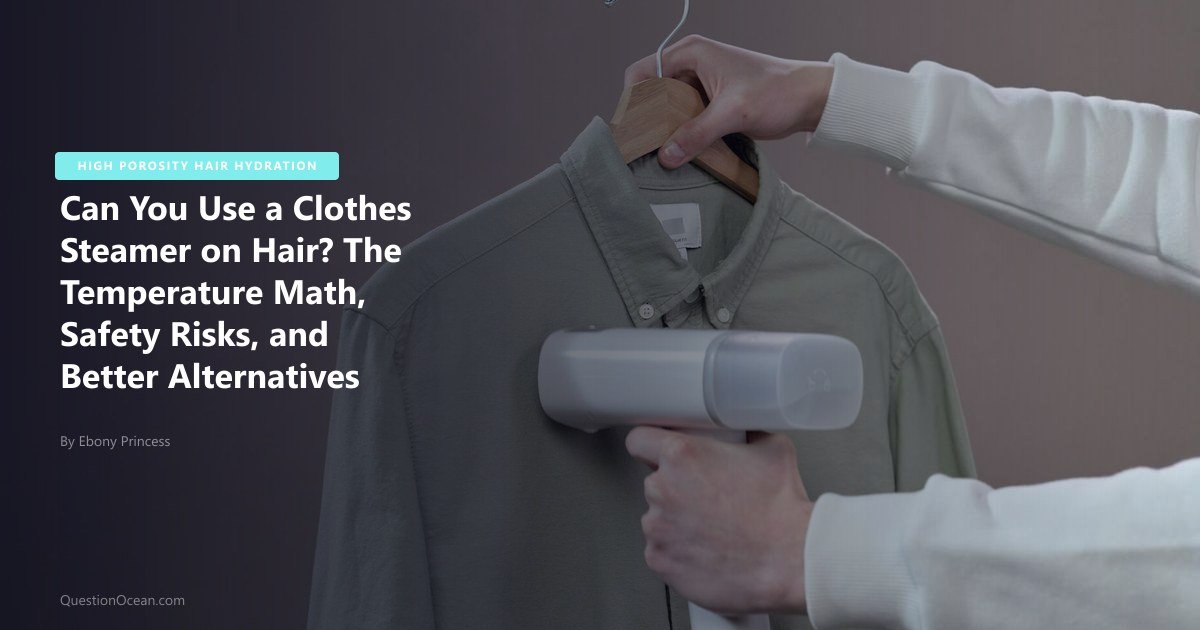
The viral hack of using a household garment steamer to deep condition hair is appealing because clothes steamers are cheap, easy to find, and produce visible steam, but the answer to whether it’s safe involves a temperature gap most tutorials never mention. Garment steamers operate at 212-300°F at the nozzle and discharge steam at 200-220°F, while purpose-built hair steamers regulate output to 110-140°F at the scalp distance. A clothes steamer can technically be used on hair for deep conditioning if held at a safe distance and angle, but it operates 60-100°F hotter than dedicated hair steamers, which means it carries genuine scalp-burn risk, can over-saturate the cortex causing hygral fatigue damage, and is prohibited entirely on color-treated or chemically processed hair where the temperature differential accelerates color fade and protein loss.
This guide covers the actual temperatures involved, the safer use protocols if you choose to proceed, and the dedicated alternatives that produce better results without the risk.
For the complete porosity and hydration framework, see our pillar guide to high porosity hair care.
The Temperature Math: Garment Steamer vs. Hair Steamer
Last updated: May 20, 2026
This is the data point most “DIY hair steamer” tutorials skip. The temperature differential is the entire reason this question matters.
| Tool | Steam Temp at Nozzle | Steam Temp at 6″ | Steam Temp at 12″ | Designed Use |
|---|---|---|---|---|
| Handheld garment steamer | 212-300°F | 180-220°F | 130-160°F | Wrinkle removal on fabric |
| Stand garment steamer | 220-300°F | 190-230°F | 140-170°F | Heavy-duty fabric |
| Hooded hair steamer | 110-140°F | 105-135°F | 100-130°F | Hair deep conditioning |
| Thermal heat cap (alternative) | 95-130°F | n/a (direct contact) | n/a | Hair deep conditioning |
| Bowl-of-hot-water DIY | 130-160°F | 110-140°F | 90-120°F | Improvised steaming |
The danger threshold: Human skin sustains first-degree burns at 118°F sustained contact and second-degree burns at 131°F. The scalp is more sensitive than other skin areas due to higher hair follicle density and thinner stratum corneum.
Practical translation: A garment steamer held closer than 12 inches from the scalp can cause burns within seconds. A hooded hair steamer produces continuous steam that the scalp tolerates indefinitely because it never crosses the burn threshold.
Why Clothes Steamers Are Marketed Differently
Garment steamers are explicitly designed to handle the temperatures needed to relax cellulose fibers in cotton, linen, and wool. Temperatures that are biologically incompatible with skin contact. The user manual of every major garment steamer includes warnings against directing steam at skin or hair. Manufacturers don’t include scalp-safety regulators because these devices were never intended for body contact.
Hair steamers are different in three engineered ways:
- Thermostat-regulated output. Held at 110-140°F regardless of element temperature
- Distributed steam distribution, released through perforated dome rather than concentrated nozzle
- Scalp-distance design, hood positioned 4-8 inches from the scalp with temperature falloff calibrated for that distance
A clothes steamer has none of these protections. It produces concentrated, high-temperature steam at a single point because that’s what fabric needs.
The Hygral Fatigue Risk
Beyond the burn risk, prolonged exposure to high-temperature steam can cause a less-discussed problem: hygral fatigue.
What it is: Hair shaft damage caused by repeated extreme swelling and contraction of the cortex. When water enters the hair shaft, the cortex swells; when water exits, it contracts. The hydrogen bonds in the cortex can only handle a limited number of swell-contract cycles before they weaken and the cuticle starts to lift permanently.
How clothes steamers contribute: The high-temperature steam (180-220°F at typical use distances) drives water into the cortex faster and more aggressively than the gentler steam of a hair steamer. A single 30-minute clothes-steamer session can cause more hygral fatigue than 3-4 hair-steamer sessions.
Visible signs: Hair that feels “mushy” or overly soft when wet, then becomes brittle and breakage-prone when dry. Color-treated hair that fades faster than expected. Coily or curly hair that loses its curl pattern definition.
The Color-Treated Hair Exception (Don’t Do It)
For color-treated, bleached, relaxed, or otherwise chemically processed hair, the answer is unambiguous: do not use a clothes steamer. The temperature differential causes:
- Accelerated color leaching. High-temperature water carries dye molecules out of the cortex faster than warm water does
- Protein cross-link damage: relaxed and bleached hair already has compromised disulfide bonds that further weaken under high heat
- Cuticle lifting — already-porous hair from chemical processing becomes more porous under steam temperature spikes
For chemically treated hair, only use dedicated hair steamers, thermal heat caps, or warm-water deep conditioning under a plastic cap. Never garment steamers.
The Safer Use Protocol (If You Insist)
If you’ve already decided to use a clothes steamer on healthy, virgin hair as a one-time experiment, follow this protocol to minimize risk.
Required Safety Setup
- Distance: Minimum 14 inches between the steamer nozzle and any part of the scalp at all times
- Movement: Keep the steamer in constant motion. Never let it dwell on one spot for more than 1-2 seconds
- Section work: Treat one small section at a time rather than attempting full-head exposure
- Time limit: Maximum 8-10 minutes total exposure
- Test patch: Run a 30-second test on a small section first; check for scalp redness or sensitivity
The 6-Step Procedure
Step 1. Apply deep conditioner liberally to clean, damp hair from mid-shaft to ends.
Step 2: Cover the head with a plastic cap. This is critical. The cap traps the warming effect without exposing the scalp directly to high-temperature steam.
Step 3: Hold the steamer at minimum 14 inches from the cap surface (not your scalp).
Step 4: Move the steamer continuously in slow circles around the cap exterior.
Step 5, Steam for 6-8 minutes maximum.
Step 6, Remove cap, rinse with cool water to seal the cuticle.
The plastic cap is the single most important safety element. Without it, you’re directing steam at exposed scalp. With it, the cap acts as a buffer that disperses the steam temperature before it reaches the skin.
Better Alternatives That Cost the Same or Less
The clothes-steamer hack only makes sense if you don’t know about the dedicated alternatives, all of which cost about the same as a garment steamer ($25-80) but produce better results.
Alternative 1, Thermal Heat Cap ($25-50)
A microwavable or electric cap that wraps around the head and provides controlled warmth (95-130°F) for 20-40 minutes. Used over a plastic cap and deep conditioner for the same penetration benefit as steaming, without any scalp exposure to direct steam. The most popular alternative.
Thermal Heat Cap Deep Conditioning
Alternative 2, Hooded Hair Steamer ($60-150)
Purpose-built dome that sits over the head and produces regulated 110-140°F steam for 20-30 minute treatments. Higher upfront cost but lasts years. The choice for serious deep conditioning routines.
Alternative 3. Bowl of Hot Water + Plastic Cap (Free)
Apply deep conditioner, cover with plastic cap, drape a hot towel over the cap. The warm towel creates the same conditioner-warming effect at body-safe temperatures. Refresh the towel every 5 minutes. Free DIY method that works.
Alternative 4, Body Heat + Plastic Cap (Free)
Apply deep conditioner, cover with plastic cap, then with a beanie or knit hat. Body heat (98°F) gradually warms the conditioner without any external heat source. Slowest method but completely safe and free.
For details on which deep conditioner formulas work best with each warming method, see our deep conditioners for porous hair guide.
The Steam Frequency Question
Even with a proper hair steamer, frequency matters for protecting hair structure.
| Hair Type | Recommended Steaming Frequency |
|---|---|
| Low porosity, healthy | Once every 2-3 weeks |
| Medium porosity | Every 2 weeks |
| High porosity | Every 2-4 weeks |
| Color-treated | Every 3-4 weeks (gentle steam only) |
| Bleached / over-processed | Monthly or less |
| Coily Type 4 (regardless of porosity) | Every 1-2 weeks |
Why over-steaming damages: Repeated cuticle opening eventually prevents the cuticle from closing properly. Hair that’s been over-steamed becomes permanently more porous, more frizz-prone, and harder to detangle. The “more is better” instinct is wrong here.
For the protein-moisture balance principles that pair with steam treatments, see our protein vs moisture balance guide.
Frequently Asked Questions
Q: Can I use a clothes steamer on my hair? A: Technically yes, but it’s not recommended. Garment steamers operate 60-100°F hotter than dedicated hair steamers and can cause first-degree scalp burns at 118°F sustained contact. If you must, hold the steamer at least 14 inches away, keep it in constant motion, always cover your head with a plastic cap first, and limit exposure to 6-8 minutes maximum. For chemically treated, color-treated, or bleached hair, do not use a clothes steamer at all: the temperature differential accelerates damage.
Q: What’s the difference between a hair steamer and a clothes steamer? A: Hair steamers are thermostat-regulated to maintain 110-140°F at the scalp, distribute steam through a perforated dome rather than a concentrated nozzle, and are positioned 4-8 inches from the scalp. Clothes steamers produce concentrated 200-220°F steam through a single nozzle, are designed for fabric, and have no temperature safety regulators for skin contact.
Q: Can hair steam burn your scalp? A: Yes, at temperatures above 118°F sustained contact. Dedicated hair steamers operate below this threshold. Clothes steamers exceed it within 12 inches of the nozzle. Even with proper hair steamers, prolonged sessions (over 30 minutes) can cause scalp irritation and dryness from excess heat exposure.
Q: Does steaming hair really help deep conditioning? A: Yes, when done correctly. Moist heat opens the cuticle layer and allows conditioner ingredients to penetrate the cortex more deeply than room-temperature application. The benefit is most significant for low-porosity hair (which resists product penetration) and high-porosity hair (which needs intensive moisture replacement). Medium-porosity hair sees moderate benefit.
Q: How long should I steam my hair for deep conditioning? A: With a dedicated hair steamer: 20-30 minutes. With a thermal heat cap: 30-40 minutes. With a hot towel/plastic cap method: 30-45 minutes (refresh towel as needed). With a clothes steamer (not recommended): maximum 6-8 minutes total. Longer sessions don’t increase benefit and can cause hygral fatigue.
Q: What’s the cheapest way to steam hair at home without a clothes steamer? A: The bowl-of-hot-water method or body-heat method. Apply deep conditioner, cover with a plastic cap, then either drape a hot towel over the cap (refresh every 5 minutes) or wear a beanie for body-heat warming. Both methods cost nothing and produce 70-80% of the benefit of a dedicated steamer with zero burn risk.
Q: Can I use a face steamer for hair instead? A: Face steamers operate at lower temperatures than clothes steamers (typically 100-130°F) and are skin-safe. They can be used on hair for short-duration treatments, though they release a smaller volume of steam than dedicated hair steamers and would require longer sessions. Face steamers are a safer DIY hack than clothes steamers if you already own one.
Q: Will steaming hair every week damage it? A: Possibly, depending on hair type. Coily Type 4 hair tolerates weekly steaming. Most other hair types do better with bi-weekly or every-3-week steaming. Color-treated and chemically processed hair should not be steamed more than monthly. Watch for “mushy when wet, brittle when dry” symptoms, these signal hygral fatigue from over-steaming.
The clothes-steamer-on-hair hack works in theory but carries risks that dedicated alternatives eliminate for the same or lower cost. A $25 thermal heat cap delivers most of the deep-conditioning benefit of professional steaming with zero burn risk and no concerns about temperature regulation. For the small minority of cases where you genuinely have nothing else available, the plastic-cap-and-distance protocol above can make a clothes steamer marginally safer, but it never becomes the right tool for the job.