
The 2026 “Wellbeing Era” in haircare has produced the most significant shift in Western styling habits in a decade: active rejection of the polished, heat-dependent blowout in favor of natural, air-dried texture that looks intentional rather than neglected. Air dry hair styling in 2026 isn’t about skipping the styling step. It’s about replacing thermal manipulation with friction-reduction techniques, porosity-matched creams, and mechanical curl enhancement methods that produce deliberate, repeatable texture without hot tools.
Google Trends data shows “air dry hair styling” searches have increased 340% since 2023 across the US, UK, and Canada. TikTok posts tagged #airdry have accumulated 4.2 billion views. The demand is clear. The gap in search results is equally clear: most content offers generic advice (“scrunch and go”) without the specific product chemistry, humidity management, and mechanical technique detail that produces professional-looking heatless results.
This pillar guide covers every element of air dry hair styling in 2026, from understanding your hair’s porosity and selecting the right cream weight, to advanced plopping techniques and climate-specific frizz management across US, UK, and Canadian environments.
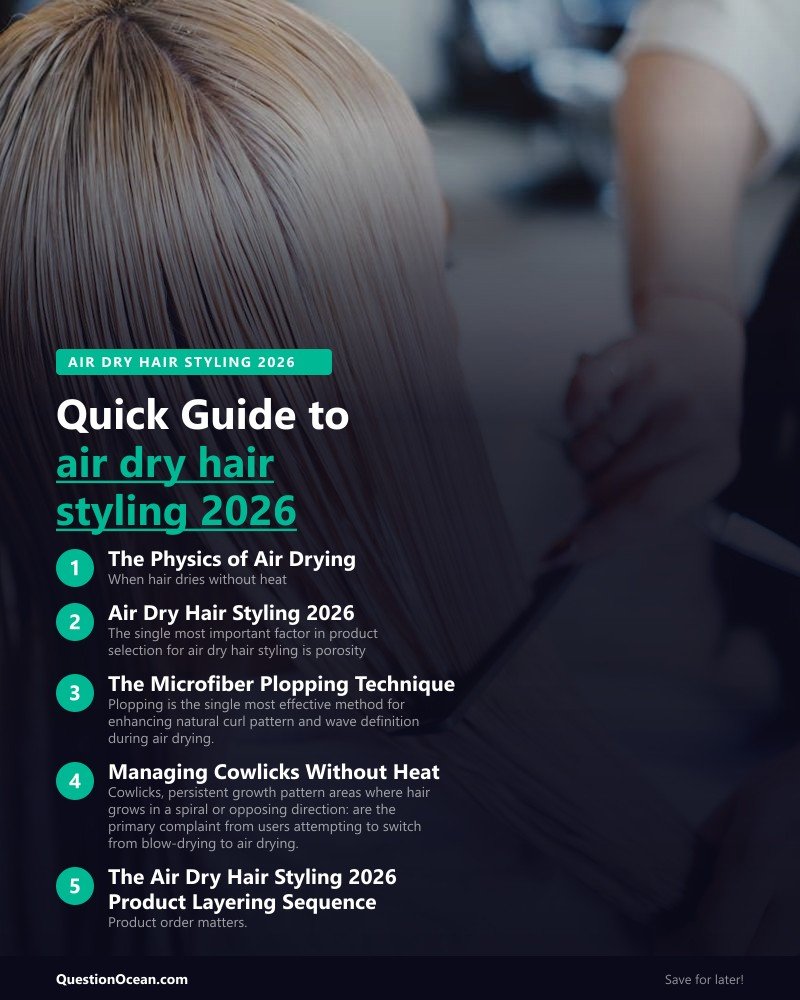
The Physics of Air Drying: Why Technique Matters More Than Product
When hair dries without heat, the hydrogen bonds within each strand reform slowly as water evaporates at ambient temperature. The shape these bonds adopt — straight, wavy, or curly. Depends on three factors: the hair’s natural curl pattern, the product applied before drying, and the physical position of each strand during the drying window.
Blow-drying forces a specific shape by fixing bonds quickly at high temperature. Air drying allows bonds to set gradually over 45-120 minutes, which means any product applied, any friction encountered, and any physical movement during this window directly affects the final result.
This is why identical products produce wildly different results on different people. The product isn’t the primary variable: the drying environment, strand position, and friction reduction during the setting window are.
The Three-Variable Framework for Air Dry Hair Styling
Variable 1: Moisture Control How much moisture is in the strand when the setting period begins determines the final texture. Too wet = prolonged dampness, limp waves, potential hygral fatigue. Too dry = inadequate bond mobility, frizz, static.
Variable 2: Friction Reduction Every surface the wet hair touches during drying disrupts the forming bonds. Cotton pillowcases, regular towels, and constant touching create frizz by roughing up the cuticle during the vulnerable drying window.
Variable 3: Product Weight The right product weight holds forming waves in position. Too heavy = limp, greasy texture that collapses. Too light = insufficient hold, texture that dissipates within 2 hours.
Air Dry Hair Styling 2026: Porosity-Matched Product Selection
The single most important factor in product selection for air dry hair styling is porosity, how readily your hair absorbs and retains moisture. Porosity determines the weight, consistency, and active ingredients your hair needs.
Low Porosity (Cuticle Lies Flat, Resists Absorption)
Low-porosity hair dries slowly because water sits on the surface rather than absorbing. Products applied to low-porosity hair tend to coat the strand without penetrating, creating a visible product layer that looks greasy rather than textured.
Best product types: Lightweight sprays, water-based leave-ins, and liquid-consistency creams. Avoid heavy butters and thick oils that sit on the surface. Apply to thoroughly soaked hair (not towel-dried), the excess water carries the product beneath the cuticle.
Recommended active ingredients: Glycerin (in moderate humidity), aloe vera, hydrolyzed rice protein
Medium Porosity (Standard Absorption)
Medium-porosity hair is the most versatile for air dry styling. It absorbs product at a predictable rate and holds texture consistently.
Best product types: Medium-weight creams, curl-defining jellies, and hybrid cream-gel formulas. The 2026 market has produced excellent “cream-gel” hybrids specifically designed for air dry hair styling: they provide cream-level moisture with gel-level hold.
Recommended active ingredients: Shea butter (light concentration), flaxseed extract, panthenol
High Porosity (Cuticle Is Raised, Absorbs Rapidly)
High-porosity hair absorbs product quickly but also loses moisture quickly. Products need to both deposit moisture and seal the cuticle to prevent evaporation during the drying window.
Best product types: Rich creams, sealing oils layered over leave-in conditioners, and the LOC/LCO method (Liquid, Oil, Cream layering). Apply products to damp-but-not-dripping hair.
Recommended active ingredients: Castor oil, coconut oil, shea butter (higher concentration), hydrolyzed wheat protein
For a dedicated deep-dive into cream selection for dense hair, see our air-dry creams for thick, wavy hair guide.
The Microfiber Plopping Technique: Step by Step
Plopping is the single most effective method for enhancing natural curl pattern and wave definition during air drying. It positions the hair on top of the head, compressing each curl into a controlled shape while the hair dries in a low-friction microfiber environment.
How to Plop with a Microfiber Towel
- After washing, apply your air-dry product to soaking wet hair (do not towel-dry first)
- Lay a microfiber towel flat on a surface or hold it behind your head
- Flip your head forward so all hair hangs toward the floor
- Lower your head onto the center of the towel
- Wrap the sides of the towel up and over the hair, tucking the edges at the nape or securing with a scrunchie
- Leave the plop in place for 15-30 minutes (not longer, extended plopping can create flat spots at the crown)
- Unwrap gently, flip hair back, and use your fingertips to position curls without disturbing the forming wave pattern
- Allow remaining drying time to occur naturally without touching
Why microfiber and not cotton: Microfiber fibers are 1/100th the diameter of cotton fibers, creating a surface with dramatically lower friction. Cotton’s larger, looped fibers catch on the wet cuticle and physically ruffle it. The mechanical cause of post-towel frizz. Microfiber glides over the cuticle without disruption.
For the full microfiber science and product recommendations, see our frizz-free air drying with microfiber guide.
Managing Cowlicks Without Heat
Cowlicks, persistent growth pattern areas where hair grows in a spiral or opposing direction: are the primary complaint from users attempting to switch from blow-drying to air drying. Without the forced redirection of a round brush and dryer heat, cowlicks spring back to their natural growth direction.
Heat-free cowlick correction methods:
- Pin clips during drying: Place metal duckbill clips across the cowlick area, pressing the hair flat in the desired direction. Leave clips in for the first 30 minutes of drying, then remove. The hydrogen bonds set in the clipped position.
- Directional plopping: When setting up the plop, manually position the cowlick area against the microfiber towel in the correction direction before wrapping.
- Strategic product weight: Apply a slightly heavier cream or gel directly at the cowlick area. The additional weight helps the hair lie in the desired direction as it dries.
- Pre-part technique: Immediately after washing, part the hair in the opposite direction of the cowlick’s natural tendency for 10 minutes, then switch to the correct part. This “resets” the growth direction at the root during the initial bond-forming window.
The Air Dry Hair Styling 2026 Product Layering Sequence
Product order matters. Applying in the wrong sequence traps lighter products beneath heavier ones, preventing absorption and creating a layered coating.
Correct layering for air dry hair styling:
- Leave-in conditioner (applied to soaking wet hair for maximum absorption)
- Curl-defining cream or air-dry cream (applied to scrunched, upside-down hair for pattern enhancement)
- Gel or mousse (applied sparingly over the cream for hold. See lightweight mousses for soft hold)
- Anti-frizz serum (applied by pressing a micro-amount between palms, then gliding over the surface of formed curls, never raking through)
The critical rule: Each product must be applied to progressively drier hair. Leave-in goes on dripping-wet. Cream goes on scrunched-damp. Gel goes on barely-damp. Serum goes on 80% dry.
Climate-Specific Air Drying Challenges
US Southeast (Atlanta, Houston, Miami): High Humidity Year-Round
Humidity above 70% RH rehydrates the hydrogen bonds in drying hair, causing waves to drop, frizz to expand, and hold to collapse. Use gel-based hold products with strong anti-humectant properties (polyquaternium-11, VP/VA copolymer). Avoid glycerin-heavy products in this climate: glycerin attracts ambient moisture and amplifies frizz.
UK (Year-Round Moderate Humidity, August Peaks)
UK humidity typically sits between 50-75% RH, which is the ideal range for air dry styling. Cream-gel hybrids work well year-round except during August heat waves, when switching to a gel-first approach prevents humidity-related drop. See our sea salt sprays without crunch guide for UK-specific texturizing.
Canadian Prairies and Northeast US, Extreme Dry Winters
Below 30% RH, drying hair loses moisture too rapidly, creating static, flyaways, and brittle texture. Add a sealing oil as the final product layer to slow evaporation during the drying window. Run a bedroom humidifier during overnight air drying to maintain ambient moisture.
The Scrunch-and-Clip Method for Maximum Wave Definition
For users whose natural pattern falls between straight and wavy (Type 1C to 2B), the scrunch-and-clip method provides the mechanical encouragement needed to form visible waves during air drying.
- Apply scrunching technique with product-coated hands to soaking wet hair
- Scrunch each section upward toward the scalp 10 times per section
- While the hair is still in the scrunched position, clip each section at the root using a duckbill clip or root-lifting clip
- Allow 30-45 minutes of drying time with clips in place
- Remove clips gently and scrunch out any crunch (SOTC technique)
- Finish with 1-2 drops of anti-frizz serum pressed over the surface
This method adds 10-15 minutes to your routine but produces dramatically more defined waves than passive air drying alone.
When Air Drying Isn’t Enough: The Hybrid Approach
Some hair textures, particularly very fine, low-density Type 1A-1B. Don’t produce visible texture through air drying alone because the natural curl pattern is too straight to respond to mechanical enhancement.
For these textures, a hybrid approach combines air drying for 80% of the drying time with a brief 3-5 minute diffusing session for root lift and texture setting. See our diffusing vs. air drying comparison for the exact hybrid protocol.
For completely heatless texture on straight hair, our heatless texture hacks guide covers overnight setting techniques that create mechanical waves without any thermal exposure.
For second-day and third-day maintenance of air-dried styles, the intentionally imperfect bedhead look guide covers product refresh techniques.
For overnight drying protocols that prevent breakage and hygral fatigue, see our sleeping with wet hair safely guide.
Frequently Asked Questions
Q: How do you style hair to air dry nicely in 2026? A: Air dry hair styling in 2026 uses porosity-matched creams applied to soaking wet hair, microfiber plopping for 15-30 minutes to enhance natural curl pattern, and anti-humidity hold products to lock the texture. The three-variable framework. Moisture control, friction reduction, product weight. Determines the final result more than any single product.
Q: What products should I use for air drying? A: Start with a leave-in conditioner on soaking wet hair, add a curl-defining or air-dry cream on scrunched-damp hair, apply a lightweight gel or mousse for hold, and finish with an anti-frizz serum on 80% dry hair. Select product weight based on your hair porosity. Lighter for low porosity, heavier for high porosity.
Q: How do I air dry without frizz? A: Replace cotton towels with microfiber, avoid touching hair during the drying window, apply anti-humectant hold products (gel containing polyquaternium-11 or VP/VA copolymer), and reduce friction from pillowcases by using silk or satin during any overnight drying.
Q: Can straight hair be air dried with texture? A: Yes. Use the scrunch-and-clip method to mechanically encourage wave formation. For Type 1A-1B hair, overnight braid or twist setting creates texture without heat. Very straight hair benefits from a hybrid approach: 80% air dry time followed by 3-5 minutes of diffusing for shape setting.
Q: How long does air drying take? A: Depending on density and thickness, full air drying takes 45-120 minutes. Microfiber plopping for the first 15-30 minutes reduces total time by accelerating initial moisture removal. Fine hair dries in 30-45 minutes; thick, dense hair requires 90-120 minutes.
Q: Is air drying better for your hair than blow drying? A: Air drying eliminates thermal exposure, which prevents heat-related cuticle damage and protein denaturation. However, prolonged wetness (beyond 2 hours) can cause hygral fatigue, swelling and contracting of the cortex. The 80% dry rule (never sleep with hair wetter than 80% dry) prevents this risk while maintaining all heatless benefits.
Air dry hair styling in 2026 represents the convergence of Wellbeing Era aesthetics, advanced product chemistry, and friction-reduction science. The “just don’t blow dry” approach produces inconsistent results. The methodical approach. Matching product weight to porosity, controlling friction through microfiber plopping, and managing climate-specific humidity, produces intentional, repeatable, professional-looking air dry hair styling without touching a hot tool.