
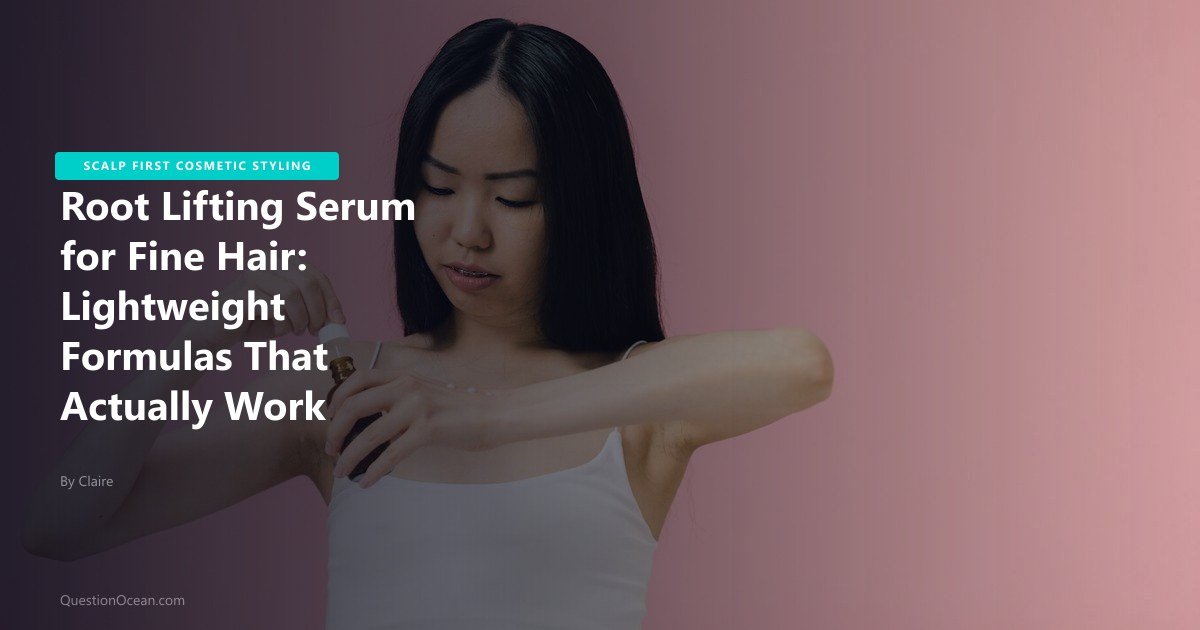
Traditional volumizing mousses add roughly 0.3 grams of product weight per application. A negligible amount on thick hair, but enough to collapse lift on fine, low-density textures within 4-6 hours. A root lifting serum engineered for 2026 operates on an entirely different mechanical principle: it deposits polymer scaffolding exclusively at the first two inches of the hair shaft, providing structural lift that activates with blow-dryer heat and lasts through second-day styling without crunch or residue.
This guide breaks down the polymer science, nozzle application method, and exact product categories that produce genuine root volume on fine hair. Every root lifting serum recommendation is evaluated on weight, hold flexibility, and ease of washout.
How a Root Lifting Serum Differs from Volumizing Mousse
The critical distinction between a root lifting serum and a volumizing mousse is delivery precision and product weight per application.
Mousses distribute foam uniformly from root to tip. Even when applied primarily at the roots, the foam migrates down the strand during blow-drying, depositing polymers along the entire length. On fine hair, this creates a coated, subtly stiff texture across the mid-shaft that undermines the goal of natural-looking volume.
Root lifting serums use liquid or lightweight gel formulations applied directly to the scalp through nozzle applicators. The lower viscosity (typically 10-25 cP compared to mousse at 100-200 cP) prevents the product from migrating down the strand during heat activation. The polymer matrix stays concentrated at the root, precisely where lift needs to occur.
Our scalp-first styling guide positions the root lifting serum as Step 5 in the product layering sequence, applied after cleansing, exfoliating, and targeted scalp cosmetic routines.
The Polymer Science Behind Root Lifting Serum Performance
Root lifting serums achieve their lift through one of two polymer mechanisms: heat-activated scaffolding or humidity-responsive expansion. Understanding these mechanisms helps you choose a formula that performs in your specific climate.
Heat-Activated Polymers (PVP and VP/VA Copolymers)
PVP (polyvinylpyrrolidone) and VP/VA copolymers are the most common root-lifting ingredients in professional-grade serums. In their liquid state, these polymers have zero holding power. They feel like water on the hair. When exposed to blow-dryer heat above 200°F (93°C), the water content evaporates and the polymer chains contract into a rigid-yet-flexible scaffold around the base of each strand.
This scaffolding physically props the hair shaft at a wider angle from the scalp, approximately 15-25 degrees wider than unsupported hair: which is the structural mechanic responsible for visible root lift. The lift persists until the polymer is disrupted by water (washing or heavy humidity above 80%), which rehydrates the polymer chains and relaxes their contracted structure.
Kevin Murphy Anti.Gravity Oil Free Volumizer ($32/150ml, US/UK/CA) uses VP/VA copolymers as its primary lift mechanism. Living Proof Full Root Lifting Spray ($29/163ml) combines PVP with the brand’s proprietary OFPMA polymer for additional humidity resistance.
Humidity-Responsive Polymers
Newer 2026 formulations incorporate polymers that swell slightly in response to ambient humidity, pushing the hair shaft upward rather than collapsing under moisture weight. These work particularly well in the humid summers of the US Southeast (Atlanta, Houston, Miami), UK July-August, and Toronto July when heat-activated polymers alone can lose 30-50% of their hold as airborne moisture rehydrates their structure.
The most effective root lifting serum formulations combine both polymer types, heat-activated PVP/VP-VA for initial lift on wash day, and humidity-responsive polymers for environmental resilience through day two and three.
Decoding Root Lifting Serum Labels for Fine Hair
The ingredient list on a root lifting serum determines whether it adds volume or silently weighs your hair down within hours. Fine-haired users need to screen for three ingredient categories before purchasing.
Ingredients to Seek
- PVP or VP/VA copolymer, flexible-hold scaffolding polymers that provide 24-72 hour lift without crunch
- Panthenol (Pro-Vitamin B5), attracts moisture to the strand’s surface, adding the cosmetic appearance of thickness at approximately 0.5-2% concentration
- Hydrolyzed wheat or rice protein: deposits a lightweight structural layer (molecular weight under 1,000 daltons) on fine strands
- Rice starch, absorbs root-level oil without visible white residue
Ingredients to Avoid
- Dimethicone and heavy silicones (amodimethicone, cyclomethicone above 2%), these smoothing agents coat the root zone, reintroducing the weight you spent your clarifying shampoo removing
- Castor oil or coconut oil, too heavy for root application on fine hair at any concentration; use these only on mid-shaft and ends
- Alcohol denat. (SD alcohol, drying alcohol), strips moisture from the root, creating brittle, static-prone hair that looks thinner and flatter rather than fuller
Ingredients That Require Climate-Based Balancing
- Glycerin, beneficial at 2-5% in moderate climates (Pacific Northwest, Northern UK) but attracts excess humidity in the US South and UK summers above 70% RH, causing activated polymer roots to soften and go limp
- Cetearyl alcohol (fatty alcohol), adds slip and moisture; beneficial at low concentrations (under 1%) but adds weight at higher concentrations that negates serum lift
Root Lifting Serum, PVP/VP-VA polymer formula for fine hair
Targeted Nozzle Application: The Root Lifting Serum Technique
How you apply a root lifting serum matters as much as which serum you choose. The nozzle applicator. A narrow, pointed tip that parts the hair and delivers product directly to the scalp, ensures the serum reaches the root zone without coating visible portions of the strand that would add weight.
Step-by-Step Application
- Towel-blot freshly washed hair with a microfiber towel until it’s approximately 80% dry, not soaking, not fully damp
- Part the hair into four sections using duckbill or butterfly clips (center part, two side sections, back section)
- Insert the nozzle tip at the root of the first section, dispensing 2-3 drops directly onto the scalp along the part line
- Use fingertips to spread the serum along the first inch of each strand in that section, press and pat, don’t rub
- Repeat across all four sections, applying 2-3 drops per section
- Clip the roots upward using metal root-lifting clips if air-drying; if blow-drying, proceed immediately with a round brush
- Direct the dryer’s heat at the roots for 5-7 seconds per section at medium heat (300-350°F) to activate the polymer scaffold
The total product used should be 6-10 drops across the entire head for fine hair (12-15 drops for medium to thick). Exceeding this amount does not produce more volume — it produces weight. The polymer scaffold operates on a microscopic level; additional product fills the gaps between scaffolding structures and creates a heavier coating that pulls the root down rather than propping it up.
Blow-Drying to Activate the Root Lifting Serum
Root lifting serums require heat activation to function: this is non-negotiable. Air-drying after serum application produces 70-80% less lift because the polymer chains cannot contract without thermal energy above 200°F.
The optimal blow-drying technique for root lifting serum activation:
- Set the dryer to medium heat (300-350°F nozzle temperature), not maximum, which can stiffen the polymer beyond its flexible range, creating a rigid, crunchy texture
- Use a ceramic round brush (1.5-inch barrel for fine hair) to lift each root section perpendicular to the scalp
- Direct airflow at the root for 5-7 seconds per section, following the brush as it rolls upward
- Immediately follow with a 3-second blast of cold air (cool shot button) to lock the polymer in its contracted state
- Release the section from the brush and move to the next area
The hot-then-cold sequence is critical. Hot air activates and contracts the polymer; cold air “freezes” the structure in position. Skipping the cold shot allows the polymer to gradually relax as it cools to room temperature, diminishing the lift by 30-50% within the first hour.
If you’re clarifying properly before applying the serum, the clarifying shampoo step removes old product residue that would otherwise create a barrier between the fresh serum and the hair shaft surface.
Avoiding Crunch and Sticky Residue
The number-one complaint with root-lifting products is the crunchy, stiff texture they create at the root zone. A problem that occurs when too much product is applied or when the polymer formulation uses rigid-hold rather than flexible-hold chemistry.
To eliminate crunch entirely:
- Use no more than 6-10 drops of serum for fine hair (12-15 drops for medium to thick hair)
- Choose flexible-hold polymers (PVP or VP/VA copolymer) rather than rigid-hold polymers (polyquaternium-11 or VP/dimethylaminoethylmethacrylate copolymer)
- Ensure the hair is 80% dry before application. Applying to soaking wet hair dilutes the polymer concentration by 40-60% and creates an uneven cast when dried
- Complete the full hot-then-cold blow-dry activation; partially dried polymer creates a tacky, gummy texture rather than a clean hold
If residue occurs despite correct application technique, the serum formula likely contains heavy waxes or dimethicone that aren’t appropriate for fine-hair root use. Switch to a water-based, silicone-free root lifting serum. Living Proof Full and Verb Volume Spray ($18/236ml) are both silicone-free options available across US, UK, and CA.
Root Lifting Serums vs. Root Powders: When to Use Each
Root powders (also called volumizing powders or texturizing dusts) offer an alternative lift mechanism that works on dry, styled hair. These micro-fine powders. Typically based on silica, rice starch, or kaolin clay: absorb sebum at the root and create temporary grippy texture through friction.
Root lifting serums work best on wash day, providing structural polymer lift that lasts 24-72 hours through heat activation. Root powders work best on second and third-day hair, refreshing the roots between washes when the serum’s polymer hold begins to relax and sebum accumulation adds weight.
Combining serums on wash day with powders on maintenance days creates a five-to-seven-day volume cycle: serum on day one (full volume), powder touch-up on day three (refreshed volume), and a complete wash-and-reset on day five or six.
For managing the transition between fresh roots and oily second-day roots, see our guide on balancing oily roots and dry ends. For cosmetic surface shine enhancement using natural pre-wash oils, rosemary oil’s cosmetic benefits complement root lifting serums when applied on alternating days, oil for shine on day two, serum for structure on wash day.
Root Volumizing Powder, silica or rice starch formula
Frequently Asked Questions
Q: What is the best root lifting serum for fine hair? A: The best root lifting serum options for fine hair contain PVP or VP/VA copolymers, deliver product through a nozzle applicator for precision, and are silicone-free. Living Proof Full Root Lifting Spray ($29/163ml) and Kevin Murphy Anti.Gravity ($32/150ml) are leading performers across US, UK, and CA markets.
Q: Do root lifting serums work on fine hair? A: Root lifting serums are significantly more effective than mousses for fine hair because they concentrate lightweight polymers (weighing less than 0.1 grams per application) at the root without adding weight to the lengths. Use 6-10 drops maximum and activate with targeted blow-drying.
Q: How do I apply root lifting serum without making hair greasy? A: Apply only to 80% dry hair, use a nozzle applicator for precision placement at the root, and limit product to 6-10 drops total across four sections. Avoid serums containing heavy silicones (dimethicone at high concentration) or oils (castor, coconut) in the first five ingredients.
Q: Can I use a root lifting serum and mousse together? A: Layering both products typically adds too much weight for fine hair, collapsing the volume within 2-3 hours. A root lifting serum alone provides sufficient lift when combined with proper tension blow-drying technique. If layering is necessary, apply the serum at the roots only and a minimal amount of mousse at the mid-shaft.
Q: How long does root lifting serum hold last? A: Heat-activated root lifting serums maintain their polymer scaffold for 24-72 hours depending on humidity, hair texture, and sleep friction. Using a silk or satin pillowcase extends hold by reducing overnight mechanical disruption at the roots.
The root lifting serum represents the most significant product evolution for fine-haired users in the volume category. Every root lifting serum applies the same core principle: delivering structural polymer support exclusively where volume originates, at the first two inches of the hair shaft, without distributing weight along the lengths that pulls your blowout flat by midday.